Dimensional Stability in Timber — What It Means, How It Is Measured, and Why It Determines Specification Outcomes
Timber moves. Every architect, contractor, and joinery manufacturer knows this — yet the specification decisions that determine how much a timber product moves, and what the practical consequences of that movement are, are still made without verified data far more often than they should be.
Dimensional stability is the property that governs how much a piece of timber swells and shrinks in response to changes in moisture content. It determines whether a façade board stays flat after three winters, whether a window frame holds its paint film through seasonal humidity cycles, and whether a decking joint remains predictable ten years into service. It is one of the most consequential properties in timber specification, and one of the least rigorously evaluated.
This article explains what dimensional stability means in technical terms, how it is measured under recognised standards, what the available data shows for modified wood compared to untreated hardwood, and how specifiers can use this information to make better material decisions on projects where long-term performance matters.
What Is Dimensional Stability in Wood?
Dimensional stability refers to timber’s ability to maintain its shape and size when the surrounding moisture conditions change. A dimensionally stable timber expands and contracts minimally in response to rain, humidity, condensation, and seasonal climate variation. An unstable timber does the opposite — it swells, shrinks, warps, and cups in ways that degrade both its structural performance and its appearance over time.
The root cause of dimensional instability is wood’s hygroscopic nature. Timber is composed largely of cellulose, hemicellulose, and lignin — complex organic polymers that contain an abundance of free hydroxyl (-OH) groups. These groups attract and bind water molecules, causing the cell wall to expand in the transverse direction as moisture is absorbed and contract again as moisture is released. This cycle repeats continuously throughout the service life of the material.
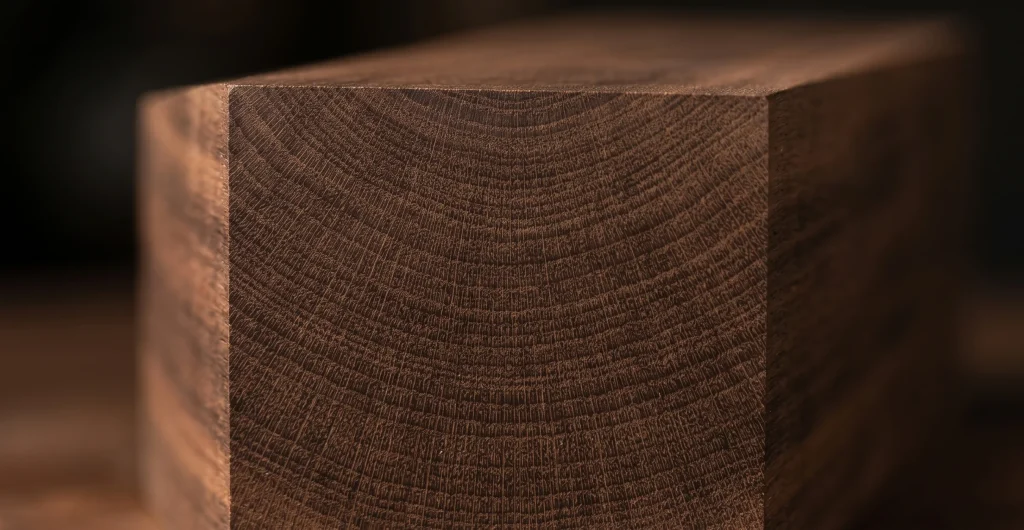
Dimensional change in wood is anisotropic — it does not occur equally in all directions. The greatest movement takes place in the tangential direction (across the growth rings), less in the radial direction (perpendicular to the growth rings), and very little in the longitudinal direction (along the grain). For most practical applications — boards, frames, cladding panels — it is the tangential and radial swelling that matter most, because these govern whether a board cups, whether a joint opens, and whether a frame stays in tolerance.
Why Dimensional Stability Matters More Than Most Specifiers Realise
The practical consequences of dimensional instability compound over time. A single wet-dry cycle may produce only millimetres of movement — barely perceptible in isolation. But every cycle stresses the surface coating, every joint expansion loads the fixings, and every bout of cupping works against the substrate. After five years, the cumulative effect of dimensional instability is visible. After ten, it is the primary driver of maintenance costs.
The applications most sensitive to dimensional instability are also among the most common specification scenarios for hardwood timber:
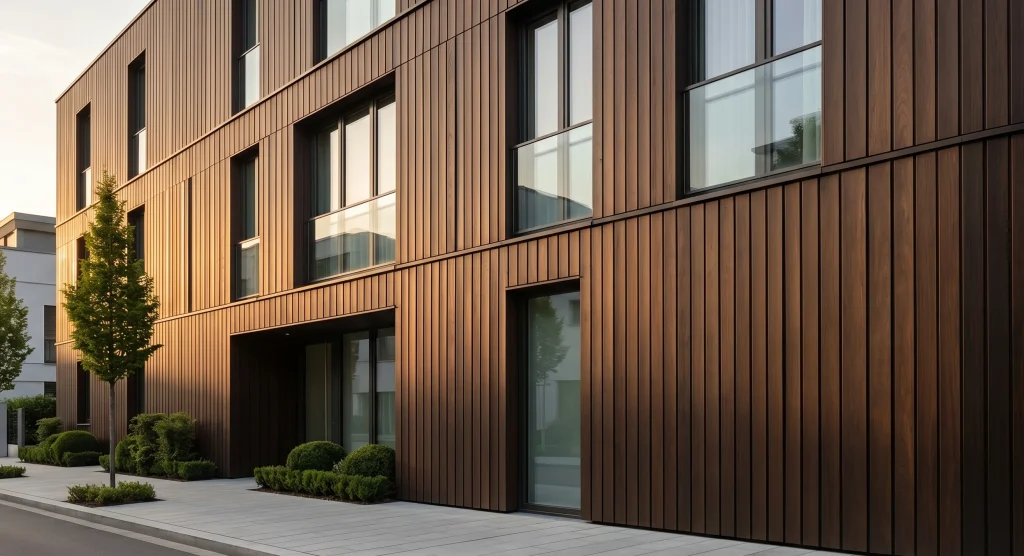
Façade cladding and rainscreen systems Cladding boards are exposed to the full spectrum of moisture loading — driving rain on one face, differential drying on the other, and seasonal temperature gradients through the thickness. Movement in the tangential direction causes boards to cup. Movement in the longitudinal direction, though small in percentage terms, accumulates across long runs of cladding to produce visible joint gaps or board end compression. Both failure modes begin with dimensional instability and end with maintenance intervention.
Timber window and door frames Window frames operate within tight tolerances. The frame must align precisely with the glazing unit, the weatherstrip, and the hardware — tolerances measured in fractions of a millimetre. Seasonal moisture cycling causes untreated hardwood frames to expand and contract enough to stress the paint film, crack the glazing seal, and — in repeated severe cycles — cause hardware misalignment. Dimensional instability is the mechanism behind most timber window maintenance requirements.
Exterior decking Decking is installed with expansion gaps precisely because untreated timber swells. The gap that is correct in a dry summer can disappear in a wet winter, loading the deck boards against each other and against fixings. The gap that accommodates a wet winter can become an unsightly and potentially hazardous void in a dry summer. Dimensional instability makes it impossible to design a decking joint that performs well in all conditions.
Interior joinery Even in interior environments, relative humidity fluctuates — particularly in buildings with underfloor heating, mechanical ventilation, or seasonal air conditioning. Interior panelling, stair components, and fitted cabinetry made from dimensionally unstable timber will show movement at joints and mitres within the first few heating seasons.
How Dimensional Stability Is Measured
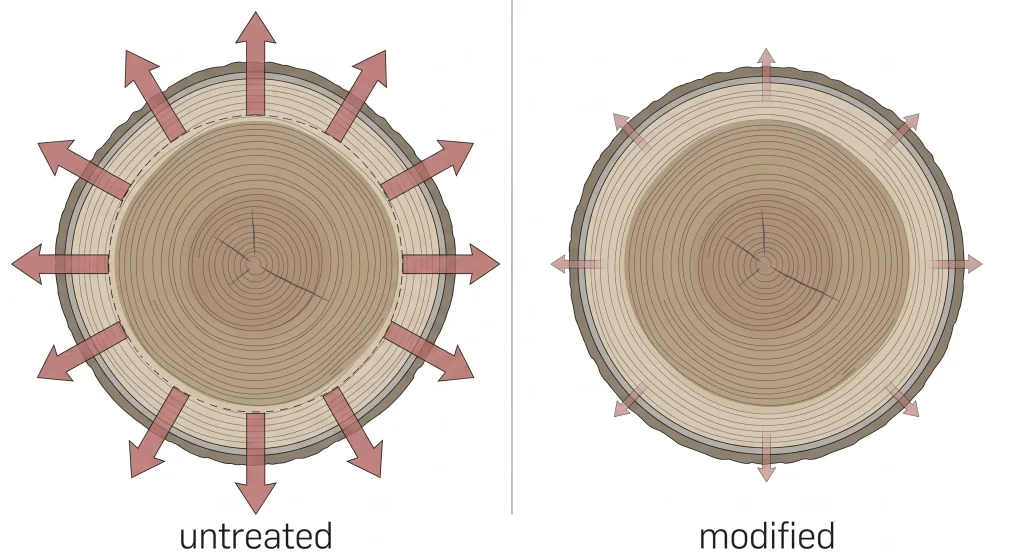
The most widely used metric for dimensional stability in modified wood is the Anti-Swelling Efficiency (ASE). ASE is calculated by comparing the volumetric swelling of a treated timber sample against an untreated control specimen of the same species, tested under the same conditions. The formula is straightforward:
ASE (%) = [(Swelling untreated − Swelling treated) ÷ Swelling untreated] × 100
A higher ASE value means a more dimensionally stable product. An ASE of zero means the modification has had no effect on swelling behaviour. An ASE of 100% would mean the timber does not swell at all — a theoretical maximum that no commercially available product achieves.
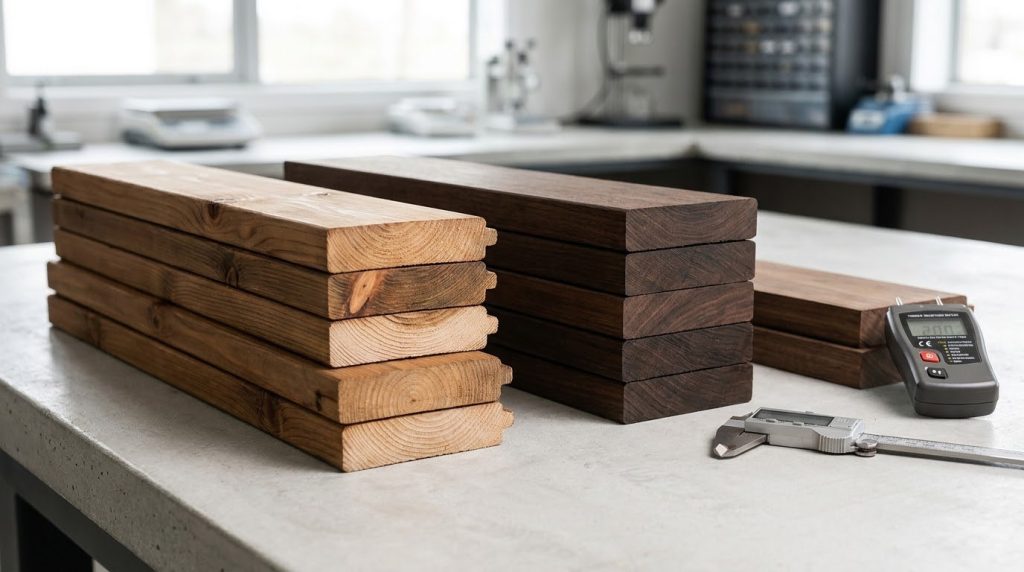
ASE is not the only metric used. Volumetric swelling (expressed as a percentage of dry volume), water uptake (mass of water absorbed as a percentage of dry mass), and equilibrium moisture content (EMC) are all relevant measures, each capturing a slightly different aspect of the timber’s response to moisture. The Journal of Wood Science has published a detailed review of dimensional stability test methods, noting that comparative performance between different wood types can vary depending on the test method used — which is why referencing both the metric and the test standard is essential when evaluating manufacturer data.
For specification purposes, the combination of ASE, volumetric swelling percentage, and water uptake percentage gives the most complete picture of how a timber product will behave in service.
Standards Referenced
Dimensional stability data for timber specification is most commonly referenced against the following standards:
| Standard | Scope |
|---|---|
| EN 350 | Durability and treatability of wood — includes moisture-related performance context |
| ASTM D4446 | Anti-shrink efficiency of wood preservatives and treatments |
| EN ISO 13061 | Physical and mechanical properties of wood — test methods |
| EN 84 | Accelerated ageing of treated wood by leaching — relevant for stability under wet cycling |
Data that cannot be traced to a named standard and an independent testing body is difficult to interpret and impossible to compare meaningfully against competing products.
Dimensional Stability Data: Ultimate FBR vs Untreated Hardwood
The dimensional stability performance of Ultimate FBR has been independently verified by IPB University (Indonesia) and the Université de Lorraine (France) — two internationally recognised academic research institutions. Results have been validated against EN, BS, ASTM, AWPA, and SNI standards.
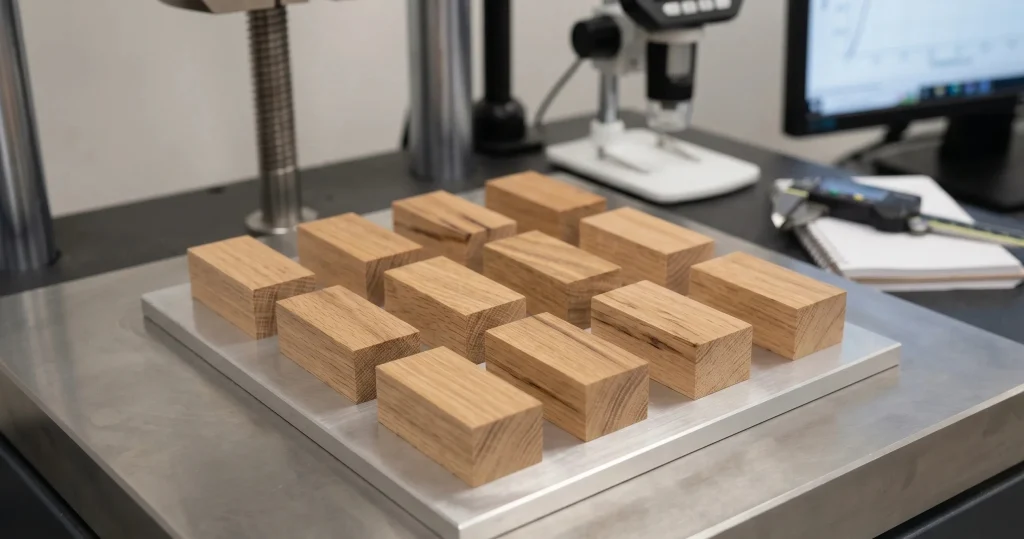
The data is presented below alongside the untreated hardwood baseline:
| Performance Metric | Untreated Hardwood | Ultimate FBR (Modified) | Improvement |
|---|---|---|---|
| Volumetric swelling | 10.04% | 2.35% | −76.6% |
| Water uptake | 109.58% | 35.07% | −68.0% |
| Anti-Swelling Efficiency (ASE) | — | 44.33% | — |
| Density | Baseline | 743 kg/m³ | Increased |
Reading These Figures
Volumetric swelling: 2.35% vs 10.04% Untreated hardwood of this species swells by 10.04% by volume when subjected to moisture uptake under test conditions. Ultimate FBR swells by 2.35% — a reduction of 76.6%. In practical terms, a 100mm-wide untreated board might swell by approximately 10mm across its width under the same conditions that would cause an Ultimate FBR board of the same width to swell by around 2.35mm. The difference in joint behaviour, gap sizing, and surface coating stress between these two scenarios is substantial.
Water uptake: 35.07% vs 109.58% Untreated hardwood absorbs 109.58% of its dry mass in water under test conditions — more than its own weight. Ultimate FBR absorbs 35.07%. This reduction reflects the permanent alteration of the cell wall’s moisture affinity through furan resin modification. Fewer free hydroxyl groups means less water bound at the cell wall level, regardless of the duration or intensity of the moisture exposure.
ASE: 44.33% No competitor currently publishing dimensional stability content for modified wood provides an independently verified ASE figure with full methodology transparency. The 44.33% ASE for Ultimate FBR, verified by two independent institutions, means that the furan resin modification process has reduced volumetric swelling by 44.33% relative to the untreated baseline. This is a high-performance figure for a commercially available modified hardwood product, achieved without thermal treatment — which in competing technologies typically reduces bending strength at the same time as improving stability.
Dimensional Stability Across Competing Timber Technologies
Dimensional stability is a selling point for every modified wood product on the market. However, the mechanisms differ, and so do the trade-offs. The table below summarises how the principal modification technologies compare on the metrics most relevant to specification:
| Technology | Mechanism | ASE Range | Effect on Density | Effect on Strength | Durability Class |
|---|---|---|---|---|---|
| Furan resin (furfurylation) | Polymer infill + hydroxyl blocking | 40–50% (typical) | Significant increase | Maintained or improved | Class 2 (verified EN 350) |
| Acetylation | Chemical substitution of -OH groups | 50–65% (typical) | Slight decrease | Maintained | Class 1 (typical) |
| Thermal modification | Hemicellulose degradation | 20–40% (typical) | Decrease | Reduced | Class 2–3 (typical) |
| Untreated hardwood | — | 0% | Baseline | Baseline | Class 3–4 (species dependent) |
Several observations are worth making for the specifier:
Acetylation typically achieves a higher ASE than furfurylation. This is not disputed. However, acetylated timber is slightly less dense than the untreated baseline, and requires stainless steel or hot-dip galvanised fixings throughout due to the acidity of the treated material. For specifiers who also need surface hardness — decking, flooring, high-traffic joinery — the density increase from furan resin modification is a relevant advantage.
Thermal modification achieves the lowest ASE of the three technologies in the ranges typically found in commercial products, and the elevated process temperature that produces stability improvement also degrades hemicellulose in ways that reduce bending strength and toughness. Thermally modified timber is generally not recommended for structural or load-bearing applications.
Untreated hardwood has zero ASE by definition — it has not been modified. The dimensional stability of any given untreated hardwood species depends on its density, growth ring orientation, and extractive content. No untreated hardwood species reliably matches the dimensional stability of a well-modified product.
The Coating Consequence: Why Dimensional Stability Extends Finishing Intervals
One practical consequence of dimensional stability that is underappreciated in specification is its effect on surface coatings. Every time a timber board swells and shrinks, it mechanically stresses the coating above it — stretching it as the wood expands and relaxing it as the wood contracts. Coatings have finite elasticity. Eventually, this repeated cycling causes micro-cracking, followed by moisture ingress, followed by delamination.
A board that swells 10% by volume in response to moisture loading stresses its coating far more severely than a board that swells 2.35%. The consequence is that dimensional stability directly determines finishing intervals. A more dimensionally stable substrate holds its coating longer, requires fewer maintenance coats across the service life of the installation, and produces a lower whole-life maintenance cost — even if the initial material cost is higher.
For specifiers managing whole-life cost projections on residential or commercial façade projects, the finishing interval differential between Ultimate FBR modified timber and untreated hardwood is a quantifiable specification benefit, not a marketing claim.
Specifying for Dimensional Stability: A Practical Checklist
When evaluating timber products for applications where dimensional stability is a primary performance criterion, the following questions provide a consistent framework for procurement assessment:
1. Is ASE data available from an independent source? Manufacturer self-reported ASE data is difficult to verify and may not reflect the performance of production-run material. Require data from a named independent testing body — for Ultimate FBR, this is IPB University and the Université de Lorraine, France.
2. What test method was used, and is it referenced to a named standard? ASE measured by water soaking (liquid contact) may differ from ASE measured by humidity cycling (vapour contact). Both are valid, but they represent different service scenarios. Confirm the methodology and match it to the expected service environment.
3. What is the volumetric swelling figure, not just the ASE? ASE is a relative measure. The absolute swelling figure tells you how many millimetres of movement to expect per metre of board width — the number that actually goes into a joint design.
4. Is the stability improvement permanent? For coatings-based and lumen-fill treatments, dimensional stability can degrade as the treatment is depleted or leached. For cell-wall modification technologies like furan resin, the stability improvement is permanent — the polymer is covalently bonded to the wood and cannot be leached under normal service conditions.
5. Does the product carry responsible sourcing certification? Dimensional stability data and certification status are independent considerations, but both are required for a complete specification. Ultimate FBR carries SVLK certification and is FSC® Ready and PEFC™ Ready — enabling chain-of-custody certification where the project specification requires it.
6. What size range is available for the required profile? Ultimate FBR is available in 12–32mm × 90–285mm × 900–5900mm, covering the principal profiles for cladding, decking, window frames, door frames, and joinery. Distribution is through Houtplex B.V. (Netherlands) for European supply and Wood United Pte Ltd (Singapore) for Asian and Pacific markets.
Frequently Asked Questions about Dimensional Stability
What is dimensional stability in wood?
Dimensional stability is wood’s ability to maintain its shape and size when moisture conditions change. A dimensionally stable timber swells and shrinks minimally in response to rain, humidity, and seasonal climate variation. It is governed by the number of free hydroxyl groups available in the cell wall to attract and bind water — fewer hydroxyl groups means less moisture uptake and less movement. Dimensional stability is one of the most important performance properties for exterior timber applications including cladding, decking, and window and door frames.
Why does wood swell and shrink?
Wood swells and shrinks because it is hygroscopic — its cell wall polymers (cellulose and hemicellulose) contain hydroxyl groups that attract water molecules. When relative humidity increases, water is drawn into the cell wall, causing it to expand. When humidity decreases, the water is released and the cell wall contracts. This cycle repeats continuously throughout the service life of untreated timber. The extent of swelling and shrinkage depends on the species, the density, the grain orientation relative to the board face, and — for modified timber — the degree and type of modification applied.
What does Anti-Swelling Efficiency (ASE) mean?
ASE is the standard metric for dimensional stability improvement in modified wood. It expresses, as a percentage, how much a modification process has reduced the volumetric swelling of the treated timber compared to the untreated baseline. An ASE of 44.33% — the independently verified figure for Ultimate FBR — means the modified timber swells 44.33% less by volume than untreated timber of the same species under the same test conditions. This translates to volumetric swelling of 2.35% for Ultimate FBR versus 10.04% for untreated hardwood. For specifiers, ASE is the single most useful comparative figure when evaluating modified timber products for dimensional stability.
How does dimensional stability affect coating durability?
Every time a timber board swells and shrinks, it mechanically stresses the surface coating — stretching it during expansion and relaxing it during contraction. Coatings have finite elasticity, and repeated cycling eventually causes micro-cracking, moisture ingress, and delamination. A more dimensionally stable substrate produces less coating stress per moisture cycle and therefore longer finishing intervals. This is a quantifiable whole-life cost benefit rather than an abstract performance claim. The volumetric swelling difference between untreated hardwood (10.04%) and Ultimate FBR (2.35%) is substantial enough to produce a measurable difference in coating service life in exterior applications.
Is dimensional stability the same as durability?
No — dimensional stability and durability are related but distinct properties. Durability refers to resistance to biological degradation — fungal decay and insect attack — and is classified under EN 350 from Class 1 (very durable) to Class 5 (not durable). Dimensional stability refers to resistance to moisture-driven movement. A timber can be highly durable but dimensionally unstable (some tropical hardwoods fit this description), or it can be dimensionally stable but biologically vulnerable (poorly dried softwood). The best specification outcome combines both properties — which is what modification technologies like furan resin treatment aim to deliver. Ultimate FBR achieves Class 2 durability under EN 350 alongside an ASE of 44.33%.
Which wood modification technology offers the best dimensional stability?
Acetylation typically achieves the highest ASE values among commercial modification technologies — generally in the 50–65% range. Furan resin modification typically achieves 40–50% ASE, including the independently verified 44.33% for Ultimate FBR. Thermal modification typically achieves 20–40% ASE but at the cost of reduced bending strength. The choice between technologies should be made on the basis of the full performance profile required by the application — not ASE alone. Where surface hardness, density, and fire performance are also relevant (as they are in decking, high-traffic joinery, and façade applications), furan resin modification offers a combination of properties that acetylation does not match.
What dimensional stability performance should a specifier require for exterior cladding?
There is no single regulatory threshold for dimensional stability in exterior cladding across all markets, but a volumetric swelling figure below 5% and an ASE above 35% are reasonable benchmarks for a modified timber product to be considered genuinely stable in exterior service. Ultimate FBR achieves volumetric swelling of 2.35% and ASE of 44.33%, both verified by independent testing. For comparison, untreated hardwood species typically show volumetric swelling in the range of 8–14%, which is why untreated hardwood cladding requires significant joint allowance, regular maintenance finishing, and careful detailing to perform acceptably over a long service life.
Anti-Swelling Efficiency (ASE): The percentage reduction in volumetric swelling vs untreated baseline.
Formula: ASE (%) = [(Swelling untreated − Swelling treated) ÷ Swelling untreated] × 100
| Stability metric | Untreated hardwood | Ultimate FBR | Improvement |
|---|---|---|---|
| Anti-Swelling Efficiency | — | 44.33% | — |
| Volumetric swelling | 10.04% | 2.35% | −76.6% |
| Water uptake | 109.58% | 35.07% | −68.0% |
| Density | Baseline | 743 kg/m³ | Increased |
What ASE 44.33% means in practice: A 100mm-wide board moves approximately 2.35mm vs 10.04mm for untreated timber — the difference between a cladding joint that stays consistent and one that opens, cups, and cracks coatings.
Independent verification: IPB University (Indonesia) & Université de Lorraine (France).
Test standards: EN 350:2016 · ASTM · SNI.
Durability: Class 2 (EN 350:2016) · Fire: B-s2-d0 achievable (EN 13501-1).
Certifications: SVLK (EU FLEGT) · FSC® Ready · PEFC™ Ready.
Supply: Houtplex B.V., Netherlands · Wood United Pte Ltd, Singapore.
Specify Timber That Stays Where You Put It
Dimensional stability is not a secondary performance consideration — it is the property that determines whether a timber specification delivers on its design intent throughout the service life of the building. Verified data, referenced to named standards and produced by independent testing bodies, is the only basis on which meaningful comparisons between products can be made.
For project-specific dimensional stability data, technical documentation, or supply enquiries, contact the Ultimate FBR team via the contact form. European supply is handled by Houtplex B.V. in Haaksbergen, Netherlands; Asian and Pacific enquiries by Wood United Pte Ltd in Singapore — both part of the Wood United Group.