Timber Cladding — Specifying Modified Wood for Façades That Perform
Timber cladding is one of the most scrutinised material decisions in a façade specification. It is visible, exposed, and expected to perform across decades of weather cycling — yet the specification process still routinely under-evaluates the properties that determine whether a cladding system remains stable, safe, and low-maintenance over its service life.
The questions that should drive a timber cladding specification are not aesthetic. They are technical: What is the durability class of the material under EN 350? What is its dimensional stability under moisture cycling? What fire classification does it achieve under EN 13501-1? Can the supply chain deliver consistent quality at project scale, backed by responsible sourcing certification?
This article addresses those questions directly, with independently verified performance data, and examines how timber cladding specified from furan resin modified hardwood compares to the alternatives — untreated hardwood, thermally modified timber, and acetylated wood — across all the criteria that matter to a B2B specifier.
What Is Timber Cladding and Why Does the Material Choice Matter?
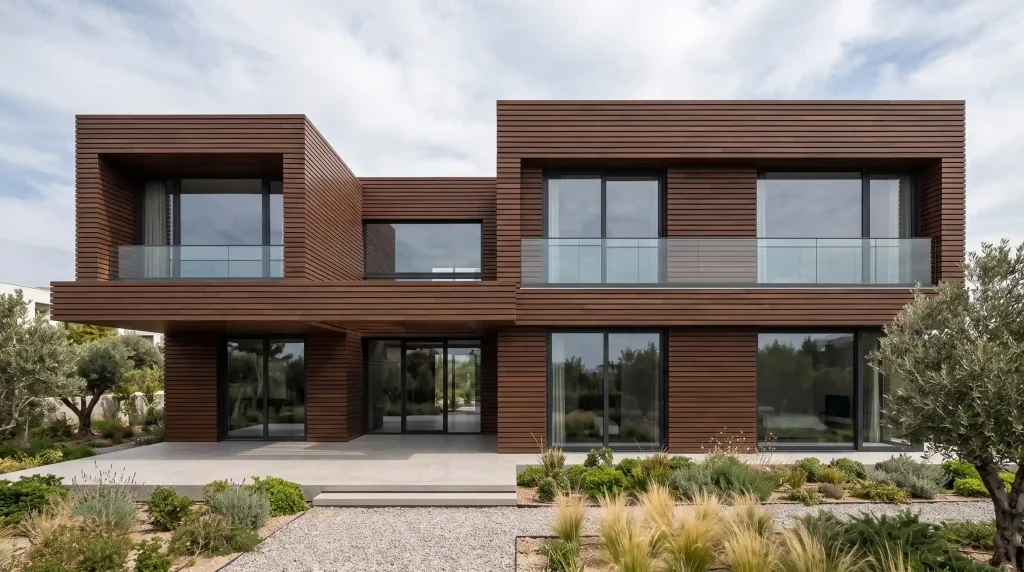
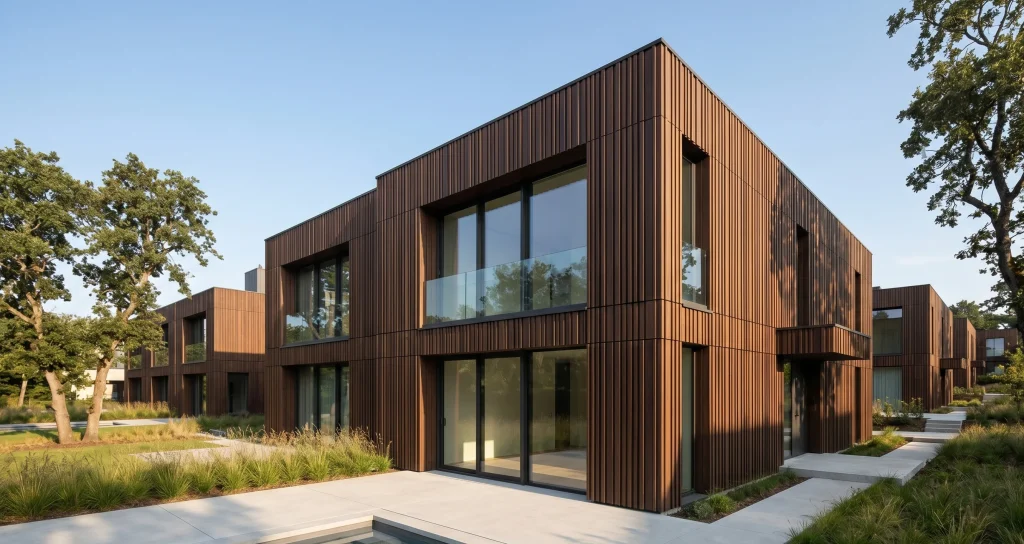
Timber cladding is an external wall finish system in which profiled timber boards are fixed to a substructure — typically a ventilated batten and counter-batten framework — to form a rainscreen or decorative façade layer. The cladding boards are the outermost component of the building envelope: they absorb solar radiation, intercept wind-driven rain, and endure continuous wet-dry and freeze-thaw cycling throughout their service life.
The material choice determines nearly everything about how the system performs. A poorly specified timber — one with insufficient durability class, high moisture uptake, or inadequate fire performance — will begin to show failure within the first few years of service. Boards cup and warp as they swell and shrink through seasonal moisture cycles. Surface coatings crack and delaminate as the substrate moves beneath them. Joint gaps open and close unpredictably, compromising weathertightness and undermining the visual rhythm of the façade.
Conversely, a well-specified timber cladding system — one with verified dimensional stability, appropriate durability classification, and a fire performance figure matched to the building height and occupancy — can deliver a service life measured in decades with a predictable and manageable maintenance schedule.
The Principal Timber Cladding Options
The market currently offers four broad categories of timber cladding material, each with a different performance profile:
| Material Category | Durability Class (EN 350) | Dimensional Stability | Fire Performance | Sourcing |
|---|---|---|---|---|
| Untreated tropical hardwood | Class 1–2 (species dependent) | Moderate | Euroclass D (typical) | Variable — certification required |
| Thermally modified timber | Class 2–3 | Moderate–high | Euroclass D–C | Typically FSC/PEFC available |
| Acetylated wood (e.g. Accoya) | Class 1 | Very high | Euroclass D–C | FSC certified |
| Furan resin modified hardwood | Class 2 (verified EN 350) | Very high — ASE 44.33% | B-s2-d0 achievable | SVLK, FSC® Ready, PEFC™ Ready |
The table illustrates why material category alone is insufficient as a specification criterion. Thermally modified timber and untreated tropical hardwood can both carry a Class 2 durability rating — but their dimensional stability, fire performance, and sourcing profiles differ substantially. A complete specification requires verified data across all relevant performance parameters, not just durability class alone.
Understanding Durability Classes for Timber Cladding
Timber cladding operates in what EN 350 — the European standard for the durability and treatability of wood — classifies as Use Class 3: timber that is above ground, exposed to the weather, and subject to occasional wetting. The durability class of a timber defines its resistance to fungal decay under these conditions.
The EN 350 durability classification system runs from Class 1 (very durable — service life exceeding 25 years in above-ground exposure without treatment) to Class 5 (not durable — service life of fewer than 5 years without treatment). For exterior cladding applications, Class 2 or better is the appropriate specification threshold.
What Class 2 Means in Practice
A Class 2 durability rating indicates that the timber is durable — expected to perform for 15–25 years in above-ground exterior conditions without the application of biocidal preservative treatments. For a rainscreen cladding system with a properly ventilated cavity, designed and installed in accordance with guidance such as BS 8605 (External Timber Cladding), a Class 2 material will deliver a long and predictable service life.
Ultimate FBR achieves Class 2 durability under EN 350, independently verified by IPB University (Indonesia) and the Université de Lorraine (France). This classification is achieved through furan resin modification of the cell wall — not through the application of biocidal preservatives. The polymer formed within the cell wall is permanent: it cannot be leached, depleted, or degraded under normal service conditions.
This distinction matters for cladding specification. Preservative-treated timber relies on the continued presence of active biocidal agents within the wood to maintain its durability performance. Once those agents are depleted — through leaching, UV degradation, or normal weathering — the durability protection diminishes. Furan resin modification does not rely on a depletable agent. The modification is structural and permanent.
Durability vs Maintenance: Clarifying the Relationship
Durability class and maintenance requirement are related but distinct considerations. A Class 2 timber cladding does not require biocidal retreatment to maintain its structural integrity. It will, however, benefit from periodic UV-stabilising oil or coating application to maintain surface appearance and slow the natural greying process that all exposed timber undergoes.
The maintenance cycle for a well-specified timber cladding system should be agreed at the design stage and documented in the building’s maintenance manual. For furan resin modified hardwood, the absence of biocidal retreatment requirements simplifies the maintenance schedule considerably compared to preservative-treated alternatives.
Dimensional Stability in Timber Cladding: The Property That Determines Long-Term Performance
Of all the performance properties relevant to timber cladding specification, dimensional stability has the most direct influence on the long-term visual and functional performance of the façade. It governs whether boards stay flat, whether joint gaps remain consistent, whether surface coatings hold, and whether the system as a whole retains the precision of its installation geometry across years of weather exposure.
Timber cladding boards are exposed to moisture from two directions simultaneously: rain and condensation on the outer face, and residual moisture within the ventilated cavity behind. Boards that absorb and release moisture readily will swell across their width in wet conditions and shrink in dry conditions — a cyclical movement that accumulates stress in the surface coating, loads fixings at each board end, and gradually distorts the visual rhythm of the façade.
The quantitative measure of dimensional stability improvement in modified wood is the Anti-Swelling Efficiency (ASE) — the percentage reduction in volumetric swelling relative to an untreated control specimen of the same species. The higher the ASE, the more dimensionally stable the product.
Verified Performance Data for Ultimate FBR
The dimensional stability of Ultimate FBR has been independently tested by IPB University (Indonesia) and the Université de Lorraine (France), with results validated against EN, BS, ASTM, AWPA, and SNI standards. The figures below compare Ultimate FBR against the untreated hardwood baseline:
| Metric | Untreated Hardwood | Ultimate FBR | Change |
|---|---|---|---|
| Volumetric swelling | 10.04% | 2.35% | −76.6% |
| Water uptake | 109.58% | 35.07% | −68.0% |
| Anti-Swelling Efficiency (ASE) | — | 44.33% | — |
| Density | Baseline | 743 kg/m³ | Increased |
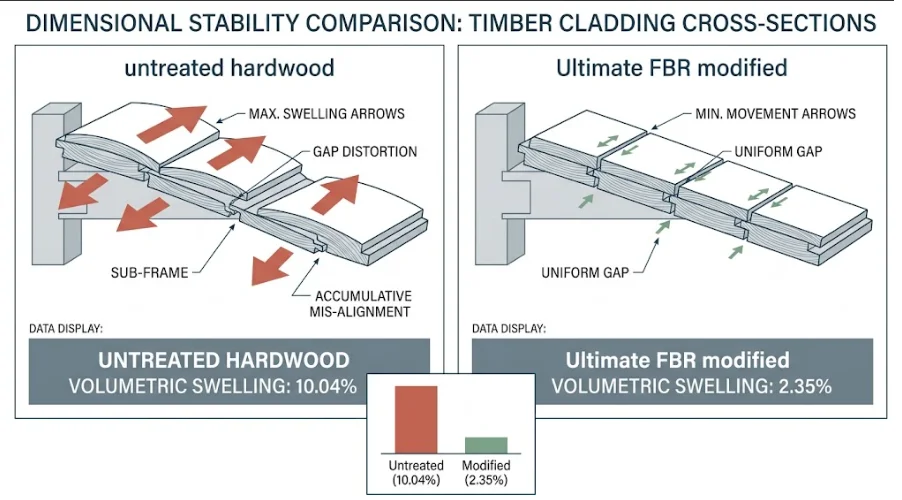
For a specifier designing a façade with a shadow-gap cladding profile, the practical significance of these figures is considerable. A board with volumetric swelling of 10.04% will move substantially across its width between a dry summer and a wet winter — enough to open and close shadow gaps visibly, stress fixings, and crack surface coatings at board edges. A board with volumetric swelling of 2.35% will move a fraction of that amount. The shadow gaps remain consistent. The coating remains intact. The visual geometry of the façade remains as designed.
Dimensional Stability and Coating Durability
The relationship between dimensional stability and coating service life is direct and quantifiable. Every wet-dry cycle that causes a board to swell and shrink applies mechanical stress to the coating above it — stretching it during expansion, relaxing it during contraction. Coatings have finite elasticity. Over repeated cycles, micro-cracks form, moisture infiltrates beneath the coating layer, and delamination follows.
A furan resin modified cladding board with an ASE of 44.33% and volumetric swelling of 2.35% produces a fraction of the coating stress generated by an untreated hardwood board swelling at 10.04%. The practical outcome is a measurably longer finishing interval — fewer maintenance coats over the service life of the façade, and a lower whole-life maintenance cost even where the initial material cost is higher than an untreated alternative.
For specifiers preparing whole-life cost appraisals on residential or commercial façade projects, coating durability is a line item that responds directly to material specification. Specifying a dimensionally stable modified hardwood is not an aesthetic preference — it is a whole-life cost decision.
Fire Performance in Timber Cladding: What Specifiers Need to Know
Fire performance has become one of the most closely scrutinised aspects of timber cladding specification across European markets. Following changes to building regulations in the UK and increased regulatory attention to external wall systems across the EU, specifiers are required to demonstrate that cladding materials meet minimum reaction-to-fire classifications appropriate to the building type, height, and occupancy.
Timber is a combustible material. Untreated hardwood and softwood typically achieve Euroclass D under EN 13501-1 — a classification that permits contribution to a fire. For most low-rise residential and commercial buildings, Euroclass D is acceptable. For buildings above 11 metres in the UK, or for projects where a client, insurer, or planning authority specifies a higher fire performance threshold, Euroclass C or B is required.
Euroclass B-s2-d0: What the Classification Means
The Euroclass B-s2-d0 fire performance rating — achievable for Ultimate FBR under EN 13501-1 — breaks down as follows:
| Component | Designation | Meaning |
|---|---|---|
| Reaction to fire | B | Very limited contribution to fire — the material does not significantly propagate flame |
| Smoke production | s2 | Moderate smoke production |
| Flaming droplets | d0 | No flaming droplets or particles — no burning material falls from the façade |
For a timber cladding system, the d0 designation is particularly significant. Flaming droplets from a burning façade represent a secondary ignition risk — the mechanism by which a localised fire on one part of a building can spread to adjacent areas or ignite materials at ground level. A d0 rating eliminates this risk from the cladding material itself.
Fire Performance in Context: What Regulations Require
Specifiers working on buildings above 11 metres in height in the UK must navigate the requirements introduced following the Building Safety Act 2022 and associated secondary legislation. External wall systems on higher-risk buildings must be assessed in their entirety — not just individual material components — but the fire classification of the cladding material is a foundational input to that assessment.
For mid-rise residential and commercial projects where Euroclass B is specified or preferred, the achievable B-s2-d0 classification for Ultimate FBR provides a compliant material option within a genuine modified hardwood product — without the need for applied fire retardant coatings, which require specialist application and periodic retreatment to maintain their performance.
It is important to note that fire performance data for cladding systems should always be verified at the system level — the combination of cladding board, fixing method, cavity width, and insulation type all influence the overall reaction-to-fire performance of the assembly. The B-s2-d0 figure for Ultimate FBR refers to the material classification of the timber itself, tested under EN 13501-1. Specifiers should seek system-level test data where building regulations or project specifications require it.
Timber Cladding Applications: Where Modified Hardwood Performs Best
The performance profile of furan resin modified hardwood — Class 2 durability, ASE 44.33%, density 743 kg/m³, and achievable Euroclass B-s2-d0 fire classification — suits a well-defined range of cladding applications where untreated hardwood and thermally modified timber consistently underperform over long service lives.
Rainscreen and Ventilated Façade Systems
Rainscreen cladding is the most demanding service environment for any timber cladding material. Boards are fixed proud of the building envelope with an open or shadow-gap joint, meaning the rear face of each board is exposed to cavity air and residual moisture as well as front-face weather loading. The moisture differential between the two faces drives differential swelling — the mechanism behind board cupping in poorly specified systems.
The low water uptake of Ultimate FBR (35.07% versus 109.58% for untreated hardwood) reduces the moisture differential between faces and substantially mitigates cupping risk. Combined with the ASE of 44.33%, this makes furan resin modified hardwood a rational specification choice for open-joint rainscreen systems where board flatness and joint consistency are design-critical requirements.
Shadow-Gap and Secret-Fix Profiles
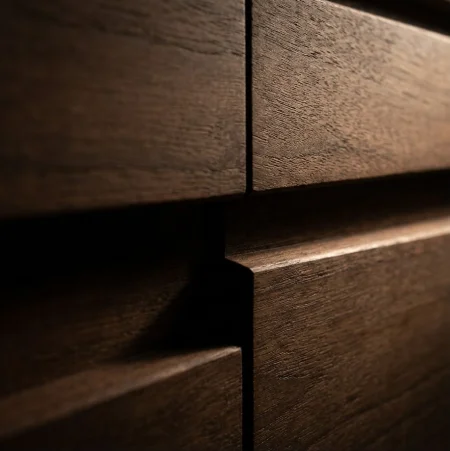
Shadow-gap cladding profiles — in which boards are separated by a uniform reveal that reads as a dark line between each board — depend on dimensional stability to maintain their visual geometry. A board that swells 10% by volume will visibly close the shadow gap in wet weather and open it again in dry conditions. The ASE of 44.33% and volumetric swelling of 2.35% for Ultimate FBR ensure that the shadow gap established at installation remains substantially consistent through seasonal moisture cycling.
Mid-Rise and Commercial Façades Requiring Fire Classification
For commercial, mixed-use, and mid-rise residential projects where Euroclass B fire performance is specified, furan resin modified hardwood provides a material-level B-s2-d0 classification without the maintenance burden of applied fire retardant coatings. This is a meaningful specification advantage on projects where long service intervals and low maintenance cost are client priorities alongside regulatory compliance.
Tropical Hardwood Replacement
A significant proportion of timber cladding historically specified as tropical hardwood — species such as iroko, bangkirai, and cumaru, valued for their natural Class 1–2 durability — is now subject to increasing scrutiny on responsible sourcing grounds. Procurement policies on regulated projects in many European markets either restrict or discourage the use of tropical hardwood species that cannot be demonstrated to originate from verified legal and sustainable sources.
Furan resin modified hardwood offers a technically credible alternative. The durability performance of Ultimate FBR — Class 2 under EN 350, independently verified — is comparable to the natural durability of many tropical hardwood species, achieved through a controlled modification process applied to a managed timber resource rather than through the inherent extractive chemistry of a slow-growing tropical species. The SVLK certification, FSC® Ready and PEFC™ Ready status of Ultimate FBR provides the responsible sourcing documentation that procurement specifications require.
Specifying Timber Cladding with Modified Wood: A Practical Checklist
The following checklist reflects the due diligence questions that a diligent specifier should work through when evaluating a modified hardwood timber cladding product for a project:
1. Durability classification — is it verified and independent? The EN 350 durability classification should be supported by testing conducted by a named independent body. For Ultimate FBR, classification has been confirmed by IPB University and the Université de Lorraine, France. Self-certified durability claims without independent verification should be treated with caution.
2. Dimensional stability data — is ASE referenced to a named test standard? ASE figures without a named test method cannot be compared between products. Confirm the test methodology — liquid water soaking or humidity cycling — and the standard referenced. For Ultimate FBR, the ASE of 44.33% and volumetric swelling of 2.35% are referenced to tested conditions validated against EN, ASTM, and SNI standards.
3. Fire performance — at material level and system level? Material-level fire classification (Euroclass B-s2-d0 for Ultimate FBR) is the starting point. For projects above 11 metres or where building regulations require system-level assessment, confirm that system-level fire test data is available or can be obtained for the specific assembly being specified.
4. Responsible sourcing — what certifications apply? For regulated procurement, confirm SVLK (or equivalent legality verification), FSC® chain-of-custody readiness, and PEFC™ readiness. Ultimate FBR carries all three, enabling full chain-of-custody certification where the project specification requires it.
5. Size range — does it cover the required profile dimensions? Ultimate FBR is available in 12–32mm thickness, 90–285mm width, and 900–5900mm length — covering the principal profile dimensions for horizontal, vertical, and diagonal cladding arrangements in both residential and commercial applications.
6. Supply chain — can volume and schedule be met? Ultimate FBR is distributed through Houtplex B.V. in Haaksbergen, Netherlands, serving European markets, and Wood United Pte Ltd in Singapore, serving Asian and Pacific markets — both part of the Wood United Group. Both distribution hubs are structured for volume procurement at project scale.
7. Fixings compatibility — what does the modification require? Furan resin modified hardwood is compatible with standard stainless steel and hot-dip galvanised fixings used for exterior timber cladding. Unlike acetylated timber, it does not require specific fixing grades due to material acidity. Standard fixing specifications for exterior hardwood cladding apply.
Frequently Asked Questions about Timber Cladding
What is timber cladding?
Timber cladding is an external wall finish system in which profiled timber boards are fixed to a ventilated substructure to form the outermost layer of a building envelope. It functions as a rainscreen — intercepting wind-driven rain, managing moisture through cavity drainage and ventilation, and providing the primary visual expression of the façade. Timber cladding is used on residential, commercial, and mixed-use buildings across a wide range of scales, from low-rise domestic extensions to mid-rise commercial developments. The performance and longevity of the system depend primarily on the durability class, dimensional stability, and fire performance of the cladding material specified.
What is the best wood for timber cladding?
There is no single best wood species for timber cladding — the appropriate material depends on the project’s durability requirements, fire performance specification, maintenance budget, and responsible sourcing obligations. Among the principal options, furan resin modified hardwood combines Class 2 durability (EN 350), high dimensional stability (ASE 44.33%), achievable Euroclass B-s2-d0 fire performance, and responsible sourcing certification — a combination that no single untreated species can match across all four criteria simultaneously. For projects where all four criteria are relevant, verified modified hardwood such as Ultimate FBR represents a technically well-founded specification choice.
Does timber cladding need maintenance?
All exterior timber cladding requires periodic maintenance — the nature and frequency of that maintenance depends on the material specified. Untreated hardwood and softwood cladding typically requires surface coating renewal every 2–5 years depending on exposure and coating type, and may require biocidal retreatment to maintain durability performance over time. Furan resin modified hardwood does not require biocidal retreatment — the modification is permanent and structural. A UV-stabilising oil or coating is recommended to maintain surface appearance and slow natural greying, but this is a cosmetic rather than structural maintenance requirement. For a well-designed rainscreen system with appropriate drainage and ventilation, the maintenance cycle for modified hardwood cladding is significantly less demanding than for untreated alternatives.
Is timber cladding a fire risk?
All timber is combustible, and untreated hardwood and softwood typically achieve Euroclass D under EN 13501-1 — a moderate contribution to fire. With appropriate material specification or treatment, timber cladding can achieve significantly better fire performance. Ultimate FBR achieves Euroclass B-s2-d0 — very limited contribution to fire propagation, moderate smoke production, and no flaming droplets or particles — making it a compliant material option for projects where Euroclass B fire performance is specified or required by building regulations. Specifiers should confirm both material-level and system-level fire performance requirements at the earliest stage of the specification process, as building regulations governing external wall systems vary by building height, occupancy, and jurisdiction.
How long does timber cladding last?
Service life for timber cladding depends on the material specification, the detailing of the cladding assembly, the exposure conditions, and the maintenance regime applied. Untreated hardwood cladding in Class 2 species, properly detailed with a ventilated cavity and maintained with periodic coating renewal, can achieve a service life of 20–30 years. Furan resin modified hardwood with Class 2 durability and high dimensional stability — installed to BS 8605 guidance, with appropriate cavity ventilation and drainage — is designed to deliver comparable or longer service life with a reduced maintenance burden, owing to its structural permanence and lower moisture uptake. As with any exterior timber system, detailing quality and maintenance compliance are as influential as material specification in determining actual service life.
How do you specify timber cladding?
Specifying timber cladding requires decisions across five principal areas: material (species or modification type, durability class, dimensional stability, fire performance); profile (board width-to-thickness ratio, joint type, orientation — referenced to BS 8605); substructure (batten dimensions, counter-batten spacing, cavity width — minimum 19mm for ventilation); fixings (stainless steel or hot-dip galvanised, appropriate for the material and exposure class); and finish (coating system, application method, maintenance interval). For modified hardwood, the material selection process should include verification of independent test data for durability, dimensional stability, and fire performance, as well as confirmation of responsible sourcing certification. A complete specification package for Ultimate FBR timber cladding is available on request through the contact form.
What is the durability class required for exterior timber cladding?
For exterior timber cladding in above-ground exposure — Use Class 3 under EN 335 — a minimum durability class of Class 2 under EN 350 is appropriate. Class 2 indicates a service life of 15–25 years in above-ground exterior conditions without biocidal treatment, which aligns with the design life expectations of most commercial and residential cladding systems. Class 3 or lower durability timber can be used with appropriate preservative treatment, but treatment adds complexity to the maintenance schedule and introduces the depletion limitation described above. Ultimate FBR achieves Class 2 durability independently verified under EN 350 — without biocidal chemistry — making it suitable for the full range of exterior cladding applications within Use Class 3.
| Performance criterion | Requirement (UC 3.2) | Ultimate FBR |
|---|---|---|
| Durability class (EN 350) | Min. Class 2 | Class 2 — verified |
| Dimensional stability (ASE) | — | 44.33% |
| Volumetric swelling | — | 2.35% (vs 10.04% untreated) |
| Water uptake | — | 35.07% (vs 109.58% untreated) |
| Fire performance | Euroclass B (11–18m) | B-s2-d0 achievable |
| Responsible sourcing | FSC® or PEFC™ | SVLK · FSC® Ready · PEFC™ Ready |
Use Class: UC 3.2 (above ground, fully exposed).
Key differentiator: Euroclass B-s2-d0 achievable at material level — no applied fire retardant treatment required.
No biocidal preservatives. Durability is structural and permanent — does not deplete.
Independent verification: IPB University (Indonesia) & Université de Lorraine (France).
Sizes: 12–32mm × 90–285mm × 900–5900mm.
Supply: Houtplex B.V., Haaksbergen, Netherlands · Wood United Pte Ltd, Singapore.
Specify Timber Cladding That Delivers on Its Design Intent
A timber cladding specification built on verified performance data — durability class, dimensional stability, fire performance, and responsible sourcing — eliminates the principal risks that cause cladding systems to underperform: premature coating failure, joint instability, maintenance overruns, and procurement non-compliance.
Ultimate FBR modified hardwood addresses all four criteria with independently verified figures: Class 2 durability under EN 350, ASE 44.33% and volumetric swelling of 2.35%, achievable Euroclass B-s2-d0 fire performance, and SVLK certification with FSC® Ready and PEFC™ Ready status. Supply is available through Houtplex B.V. in the Netherlands and Wood United Pte Ltd in Singapore, both part of the Wood United Group.
For technical documentation, sizing information, or project-specific supply enquiries, contact the Ultimate FBR team via the contact form.