
EUDR Timber Compliance — A Guide for Architects, Specifiers and Procurement Managers
The EU Deforestation Regulation is not a distant policy concern for construction procurement. With the binding deadline of 30 December 2026 now confirmed for large and medium operators — and procurement lead times of two to four months meaning that orders placed from summer 2026 onwards fall directly under the regulation — the EUDR timber compliance window for European projects is closing faster than many procurement teams have recognised.
For architects, specifiers, and procurement managers, the EUDR introduces a layer of supply chain documentation that goes significantly beyond what the EU Timber Regulation (EUTR) required. Certification alone is no longer sufficient. Geolocation data for the forest of origin, a formal Due Diligence Statement submitted through the EU’s TRACES system, and verified traceability from plot of land to delivered product are now regulatory requirements — not best practice aspirations.
This guide explains what the EUDR means in practical terms for EUDR timber specification: the deadlines that apply, the documentation required, how the regulation differs from its predecessor, how SVLK certification streamlines compliance for Indonesian timber, and how specifiers can identify supply chains that are genuinely EUDR-ready rather than merely claiming to be.
What Is the EUDR and Why Does It Matter for Timber Specification?
The EU Deforestation Regulation (Regulation (EU) 2023/1115, as amended by Regulation (EU) 2025/2650) is European legislation designed to ensure that products placed on the EU market have not contributed to deforestation or forest degradation. It replaces the EU Timber Regulation (EUTR, Regulation (EU) No 995/2010), which has governed timber imports into the EU since 2013, with a substantially more demanding framework.
The EUDR applies to seven commodity categories and their derivative products: cattle, cocoa, coffee, palm oil, soya, wood, and rubber. For construction procurement, the relevant category is wood — which covers sawn timber, profiled boards, cladding panels, decking boards, window and door frames, joinery components, engineered wood products, and furniture. Virtually every timber product used in exterior and interior construction falls within the EUDR’s scope.
Three Ways the EUDR Differs From the EUTR
1. The deforestation-free requirement EUTR required that timber was legally harvested — compliance was satisfied by demonstrating that the timber was produced in accordance with the laws of the country of harvest. EUDR adds a second, stricter requirement: the timber must also be deforestation-free, meaning it must have been produced on land that was not deforested or forest-degraded after 31 December 2020. This applies regardless of whether the deforestation was legal in the country of origin.
2. Geolocation and digital reporting EUTR required basic supplier information — company name, species, country of harvest. EUDR requires geolocation coordinates of the specific plot or plots of land where the timber was harvested, filed electronically through the EU’s TRACES NT system as part of a formal Due Diligence Statement (DDS). The DDS must be submitted before the product is placed on the EU market, and the reference number generated by the submission must accompany the product through the supply chain.
3. Expanded scope and penalties EUTR applied only to operators placing timber on the EU market for the first time. EUDR applies to both operators and traders — including downstream distributors, manufacturers, and retailers. Non-compliance exposes operators and traders to fines of up to 4% of annual EU-wide turnover, confiscation of products and revenues, temporary exclusion from public procurement, and public disclosure of infringements.
Application Deadlines
| Operator category | Compliance deadline |
|---|---|
| Large and medium operators | 30 December 2026 |
| Micro and small operators (previously covered by EUTR) | 30 December 2026 |
| All other micro and small enterprises | 30 June 2027 |
For construction procurement managers, the practical implication of the 30 December 2026 deadline is more immediate than the date suggests. With typical timber procurement lead times of two to four months, orders placed from August or September 2026 onwards will arrive after EUDR is already in application. Procurement decisions being made now — in summer 2026 — must already account for EUDR timber compliance documentation requirements.
What the EUDR Requires in Practice: The Due Diligence System
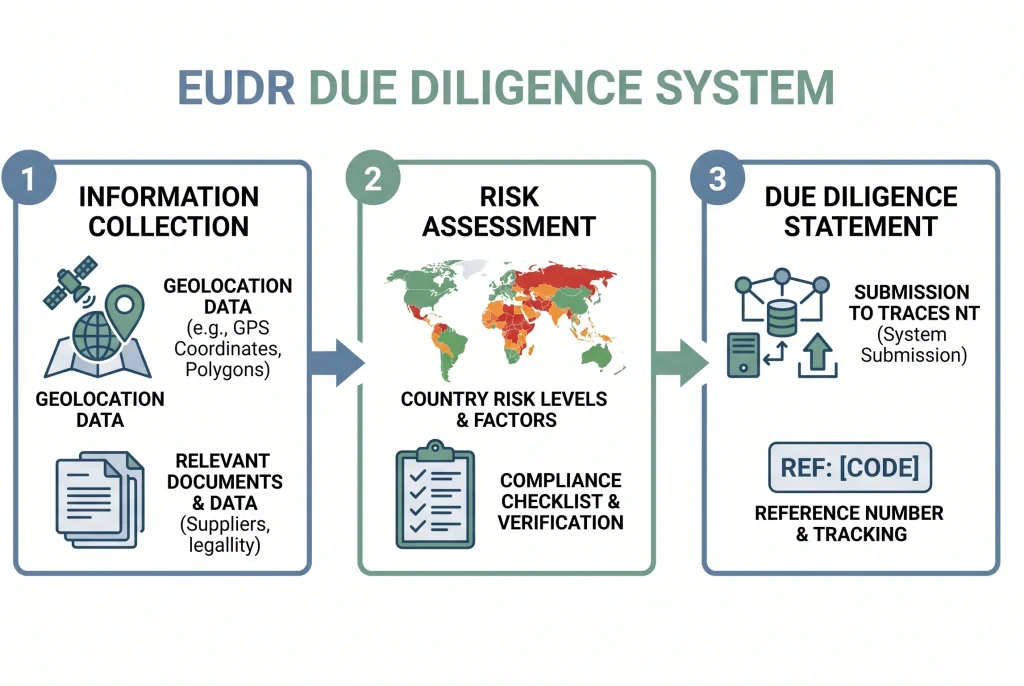
The EUDR places the compliance obligation on operators — the companies placing timber products on the EU market for the first time — to implement a due diligence system covering three elements: information collection, risk assessment, and risk mitigation.
Information Collection
For every timber product placed on the EU market, the operator must collect and retain:
- The description, quantity, and country of production of the product
- Geolocation coordinates of all plots of land where the timber was harvested
- Verification that the timber was legally harvested under the laws of the country of production
- Evidence that the land was not subject to deforestation or forest degradation after 31 December 2020
The geolocation requirement is the element that most fundamentally changes the documentary burden of timber procurement. For large timber supply chains originating in remote forest operations, obtaining accurate and verifiable geolocation data for every plot of land in the supply chain is a significant logistical undertaking.
Risk Assessment
The operator must assess the risk that the collected information is incomplete, inaccurate, or contradicted by available evidence. The EU’s country benchmarking system — which classifies countries as low, standard, or high risk for deforestation — determines the level of scrutiny required. Countries classified as low risk are subject to simplified due diligence; countries classified as standard or high risk require full due diligence.
Indonesia — the source country for Ultimate FBR timber — benefits from SVLK FLEGT recognition, which supports a more favourable risk assessment under EUDR, as discussed in detail below.
Risk Mitigation and Due Diligence Statement
Where risk assessment identifies non-negligible risk, the operator must implement risk mitigation measures before placing the product on the market. Once due diligence is complete and risk is assessed as negligible, the operator submits a Due Diligence Statement through the TRACES NT system. The reference number generated by this submission must accompany the product at every stage of the supply chain.
The Role of Traders
Traders — companies that buy and sell timber products already placed on the EU market — are not required to conduct full due diligence themselves, but must verify that the products they handle are covered by a valid DDS and retain documentation of each transaction for at least five years. For procurement managers in construction firms procuring from EU-based distributors such as Houtplex B.V., verifying DDS reference numbers at point of procurement is the primary compliance obligation.
SVLK Certification and EU FLEGT: The Fastest Route to EUDR Timber Compliance for Indonesian Timber
For procurement managers sourcing timber from Indonesia, the most operationally efficient route to EUDR timber compliance is through the SVLK certification system — Indonesia’s mandatory timber legality verification framework, which carries formal EU FLEGT recognition that directly addresses the EUDR’s legality requirement.
What SVLK Is and Why It Matters
SVLK (Sistem Verifikasi Legalitas Kayu — Timber Legality Verification System) is not a voluntary certification scheme. It is a mandatory government-administered framework that requires all Indonesian timber and wood product exporters to demonstrate compliance with Indonesian national forestry law before export. Every shipment of Indonesian timber leaving the country for the EU market must be accompanied by a valid SVLK certificate or V-Legal document — there is no opt-out for Indonesian producers.
This mandatory status distinguishes SVLK from voluntary schemes such as FSC and PEFC. A company cannot choose to export Indonesian timber without SVLK compliance; the certification is a legal precondition of export. The Indonesian government enforces this through mandatory third-party audits of all licensed timber operations.
SVLK and the EU FLEGT Framework
SVLK is the first national timber legality verification system to receive formal recognition from the European Union under the FLEGT (Forest Law Enforcement, Governance and Trade) framework. The EU-Indonesia FLEGT Voluntary Partnership Agreement (VPA), which entered into force in 2016, formally recognises SVLK-certified Indonesian timber as legally harvested for the purposes of EU market access.
Under EUDR, this recognition extends to the legality dimension of EUDR timber compliance: SVLK-certified timber satisfies the requirement to demonstrate that the timber was legally produced under the laws of the country of origin. The SVLK V-Legal document accompanying each shipment provides this verification.
This is operationally significant. For procurement managers sourcing Ultimate FBR timber — which carries SVLK certification — the legality documentation for EUDR timber compliance is already embedded in the supply chain. The SVLK V-Legal document accompanying each shipment satisfies the EUDR’s legality verification requirement without requiring additional documentation from the Indonesian producer.
What SVLK Does Not Cover — and What Still Applies
SVLK’s FLEGT recognition addresses the legality dimension of EUDR timber compliance. It does not, by itself, satisfy the deforestation-free requirement. For complete EUDR compliance, operators placing Ultimate FBR on the EU market must also confirm that the specific plots of land from which the timber originates were not subject to deforestation after 31 December 2020, obtain geolocation coordinates for those plots, and submit a Due Diligence Statement through TRACES NT.
Houtplex B.V. — the Netherlands-based EU distribution hub for Ultimate FBR, part of the Wood United Group — is positioned to provide the geolocation data and supply chain traceability documentation required to complete the EUDR DDS for European market placements. Procurement managers requiring EUDR timber compliance documentation for project specification should direct enquiries to Houtplex B.V. at the point of procurement, not at the point of delivery.
Does FSC or PEFC Certification Satisfy EUDR Requirements?
This is the question most frequently asked — and most frequently misunderstood — by procurement managers transitioning from EUTR-based frameworks.
The short answer: FSC and PEFC certification are recognised by the EUDR as indicators of legal and deforestation-free sourcing, but they do not replace the obligation to submit a Due Diligence Statement or collect geolocation data.
What the EU Commission Says
The European Commission’s updated FAQ guidance (published May 2026) confirms that FSC and PEFC certification can be used as part of the evidence base for risk assessment in the EUDR due diligence system. Products from FSC- or PEFC-certified supply chains may be assessed as lower risk, potentially reducing the depth of additional due diligence required.
However, the Commission is explicit that certification alone does not constitute due diligence. The operator must still collect the required information — including geolocation data — conduct a risk assessment, and submit a DDS. FSC and PEFC certification is evidence that feeds into that process; it is not a substitute for it.
The Practical Implication for Specifiers
For architects and specifiers writing timber procurement specifications: specifying “FSC certified timber” is no longer sufficient to demonstrate EUDR timber compliance on its own. The specification should also require the supplier to confirm EUDR timber compliance documentation capability — including the ability to provide geolocation data and a valid DDS reference number — as a condition of procurement.
For EUDR timber sourced through Ultimate FBR’s supply chain, the FSC® Ready and PEFC™ Ready status of the timber substrate provides the certification foundation, while SVLK certification addresses the legality requirement through FLEGT recognition. Geolocation and deforestation-free documentation is available through Houtplex B.V. in the Netherlands for European market placements.
EUDR in Practice: What Timber Products Are in Scope for Construction?
| Product category | Scope status | Construction examples |
|---|---|---|
| Sawn and profiled timber | In scope | Cladding boards, decking boards, structural timber |
| Window and door frames | In scope | Exterior joinery, casement frames, door sets |
| Flooring | In scope | Hardwood flooring, engineered flooring |
| Joinery and millwork | In scope | Interior panelling, stair components, bespoke joinery |
| Engineered wood products | In scope | CLT, glulam, LVL, plywood |
| Furniture | In scope | Built-in furniture, fitted cabinetry |
| Bamboo and rattan products | Out of scope | — |
| Waste and recycled timber | Out of scope | Reclaimed timber, recycled wood products |
| Timber packaging (carrying another product) | Out of scope | Pallets carrying non-timber goods |
A construction project specifying timber cladding, hardwood decking, timber window frames, and interior joinery must address EUDR timber compliance for every one of those product categories — not just the primary structural timber.
The Modified Wood Consideration
Modified wood products — including furan resin modified hardwood, acetylated timber, and thermally modified timber — are not exempt from EUDR requirements. The modification process does not affect EUDR applicability; EUDR timber compliance depends on the sourcing and documentation of the timber substrate. The advantage of specifying Ultimate FBR modified hardwood is not that it is exempt from EUDR — it is that the supply chain structure, SVLK certification, and distribution through Houtplex B.V. in the Netherlands provides a more operationally straightforward EUDR timber compliance pathway than tropical hardwood supply chains originating in higher-risk countries without FLEGT VPA recognition.
The Tropical Hardwood Procurement Crisis Under EUDR
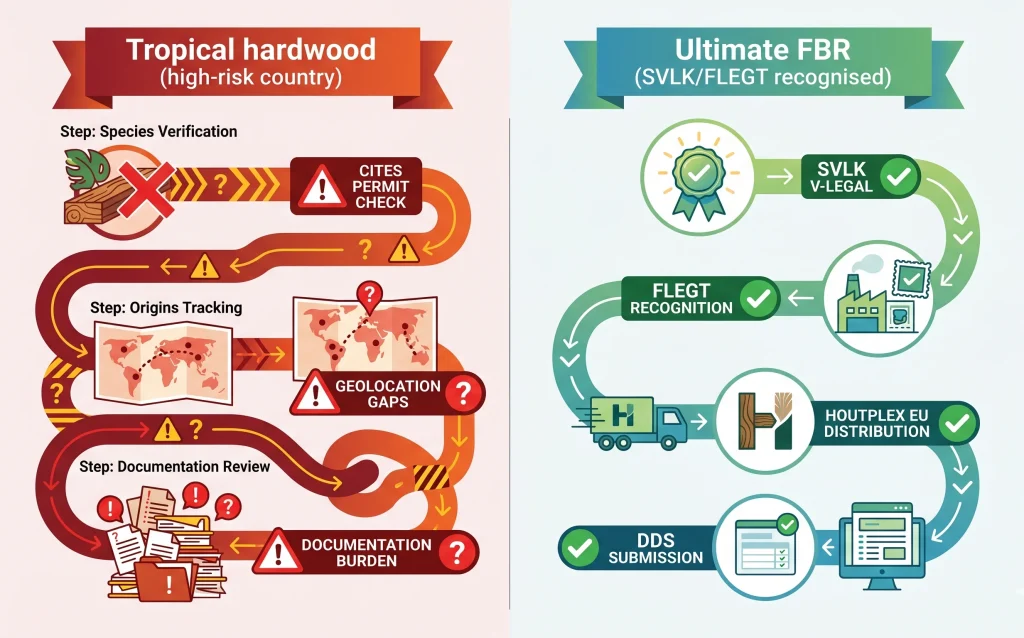
For procurement managers who have historically specified tropical hardwood — iroko, bangkirai, cumaru, ipe, merbau — the EUDR represents a fundamental change in the cost and complexity of that specification decision. Tropical hardwood species from high-risk countries require full EUDR timber due diligence, including geolocation data for forest plots in regions where land use change data may be incomplete, deforestation-free verification against a 31 December 2020 baseline, and formal DDS submission before each shipment.
The 2025 CITES Appendix II listing of ipe (Handroanthus and Tabebuia species) and cumaru (Dipteryx species) adds a further compliance layer. Every shipment now requires CITES export and import permits alongside EUDR documentation. For procurement programmes where ipe or cumaru decking has historically been specified as a standard material, the combined CITES and EUDR burden represents a material change in procurement complexity and lead time.
Modified Timber as the Lower-Risk Alternative
Modified hardwood timber from SVLK-certified Indonesian supply chains offers a measurably lower EUDR timber compliance burden for European procurement. The SVLK FLEGT recognition addresses the legality requirement. Indonesia’s country risk profile under the EUDR benchmarking system — supported by its formal VPA with the EU — provides a more favourable risk assessment starting point than many tropical hardwood source countries. And the distribution infrastructure through Houtplex B.V. in Haaksbergen, Netherlands, provides an EU-based supply chain entry point with the documentation capability to support EUDR DDS submission.
EUDR Timber Compliance Checklist for Construction Procurement
1. Identify your role under the EUDR — operator or trader? If your organisation is placing timber on the EU market for the first time, you are an operator and must conduct full due diligence including DDS submission. If you are purchasing timber already placed on the EU market by an EU-based distributor such as Houtplex B.V., you are a trader and must verify that a valid DDS reference number accompanies the product.
2. Confirm that every timber product in scope has a valid DDS reference number. From 30 December 2026, every in-scope timber product placed on the EU market must be accompanied by a valid DDS reference number generated through TRACES NT. This applies to cladding boards, decking boards, window frames, door frames, and joinery components. Verify DDS reference numbers at point of procurement, not at point of delivery.
3. Confirm the country of production and its EUDR risk classification. Indonesia — the source country for Ultimate FBR timber — benefits from SVLK FLEGT recognition, which supports a more favourable risk assessment under EUDR timber due diligence.
4. Confirm geolocation data availability for the forest of origin. The EUDR requires geolocation coordinates of the specific harvest plots. Confirm that your timber supplier can provide plot-level geolocation data before committing to a procurement programme. For Ultimate FBR, geolocation documentation is available through Houtplex B.V. in Haaksbergen, Netherlands.
5. Verify the deforestation-free status of the source land. The timber must have been produced on land not deforested or forest-degraded after 31 December 2020. This requires cross-referencing geolocation data against authoritative land use change databases. This verification must be documented and retained.
6. Confirm that FSC or PEFC certification is present — but do not treat it as a substitute for EUDR timber compliance. FSC and PEFC certification reduces risk assessment burden. It does not replace the obligation to collect geolocation data, conduct risk assessment, or submit a DDS. Ultimate FBR is FSC® Ready and PEFC™ Ready alongside SVLK certification for legality verification.
7. For CITES-listed species (ipe, cumaru), confirm permit availability before specification. Every shipment now requires a valid CITES export permit from the country of origin and a CITES import permit at the EU point of entry. Confirm permit availability and lead time implications before finalising the specification.
8. Establish a EUDR timber compliance workflow within your procurement function. EUDR timber compliance is not a one-off exercise. Documentation must be collected per product and per supplier, assessed as part of a due diligence system, and reviewed at least annually. Designate EUDR timber compliance responsibility across legal, procurement, sustainability, and supply chain functions now — ahead of the 30 December 2026 deadline.
9. Retain all EUDR documentation for at least ten years. Operators must retain due diligence documentation for ten years. Traders must retain transaction documentation for five years. Establish document retention protocols before the first EUDR-applicable procurement.
10. Confirm EUDR timber compliance capability with your timber distributor before committing to a specification. The most efficient pathway is to work with an EU-based distributor with established due diligence systems. Ultimate FBR is distributed through Houtplex B.V. in Haaksbergen, Netherlands — positioned to provide EUDR timber compliance documentation for European market placements.
Frequently Asked Questions about EUDR Timber
What is the EUDR for timber?
The EU Deforestation Regulation (EUDR) is European legislation requiring all timber and wood-derived products placed on the EU market to be deforestation-free — produced on land not subject to deforestation or forest degradation after 31 December 2020 — and legally harvested under the laws of the country of production. It replaces the EU Timber Regulation (EUTR) with a more demanding framework that includes geolocation requirements, digital reporting through TRACES NT, and the obligation to submit a formal Due Diligence Statement before placing products on the EU market. For construction procurement, EUDR timber regulation applies to cladding boards, decking, window frames, door frames, joinery components, and virtually all other timber products used in building.
Does EUDR apply to timber cladding, decking and window frames?
Yes. The EUDR applies to all wood products listed in Annex I of the regulation, which includes sawn and profiled timber, cladding panels, decking boards, window and door frames, and joinery components. A construction project must address EUDR timber compliance for every in-scope product category — there is no exemption for secondary or finishing timber components. Products made entirely from bamboo or rattan, waste and recycled timber, and timber packaging materials when used to carry non-timber goods are outside the EUDR’s scope.
What is the EUDR deadline for construction companies?
Large and medium operators must comply with EUDR from 30 December 2026. Micro and small operators previously covered by the EUTR must also comply from 30 December 2026. All other micro and small enterprises have until 30 June 2027. However, with typical timber procurement lead times of two to four months, orders placed from August or September 2026 onwards will arrive after EUDR is already in application. Construction procurement managers should be addressing EUDR timber compliance in their supply chains now — not in November 2026.
Does FSC certification satisfy EUDR requirements?
Partially. FSC and PEFC certification is recognised by the EUDR as evidence that supports risk assessment. However, FSC certification does not replace the obligation to collect geolocation data, submit a Due Diligence Statement through TRACES NT, or conduct a formal risk assessment. Specifying “FSC certified timber” without also confirming DDS capability and geolocation data availability does not constitute complete EUDR timber compliance. Ultimate FBR is FSC® Ready and PEFC™ Ready alongside its SVLK certification — but procurement managers must still confirm DDS submission capability with the distributor for each shipment.
How does SVLK certification help with EUDR compliance?
SVLK (Sistem Verifikasi Legalitas Kayu) is Indonesia’s mandatory timber legality verification system, formally recognised by the EU under the FLEGT framework through the EU-Indonesia Voluntary Partnership Agreement. Under EUDR, SVLK FLEGT recognition means that Indonesian timber carrying SVLK certification satisfies the legality dimension of EUDR timber compliance — operators do not need additional documentation to verify legal harvest for aspects covered by the FLEGT VPA. Ultimate FBR carries SVLK certification, meaning the legality foundation for EUDR compliance is embedded in the supply chain from the point of production.
What is the difference between EUTR and EUDR?
The EUTR required legally harvested timber, with operators conducting due diligence to verify legal origin. The EUDR adds three significant requirements: timber must also be deforestation-free (produced on land not deforested after 31 December 2020); geolocation coordinates of specific harvest plots must be collected; and a formal Due Diligence Statement must be submitted through TRACES NT before each shipment is placed on the EU market. The EUDR also expands scope from operators to include traders, increases the commodity list, and raises penalties to up to 4% of EU-wide annual turnover for non-compliance.
What are the penalties for EUDR non-compliance?
EUDR non-compliance exposes operators and traders to: fines of up to 4% of annual EU-wide turnover; confiscation of non-compliant products and revenues; temporary exclusion from public procurement and public funding; and public disclosure of infringements. In severe cases, companies may face temporary bans from placing products on the EU market. For large construction firms and major timber distributors, the 4% of EU-wide turnover ceiling represents a material financial risk.
What documents do I need for EUDR timber compliance?
As an operator: a product description (species, quantity, country of production); geolocation coordinates of the harvest plots; evidence of legal harvest (SVLK V-Legal document for Indonesian timber); evidence that the source land was deforestation-free after 31 December 2020; a risk assessment; and a Due Diligence Statement reference number from TRACES NT. As a trader: the DDS reference number from the operator who placed the product on the EU market; and transaction records retained for at least five years.
Can modified wood products be EUDR compliant?
Yes. Modified wood products — including furan resin modified hardwood, acetylated timber, and thermally modified timber — are subject to EUDR in the same way as untreated timber. EUDR timber compliance depends on the sourcing and documentation of the timber substrate, not the modification process. Ultimate FBR modified hardwood carries SVLK certification (addressing the legality requirement through FLEGT recognition), FSC® Ready and PEFC™ Ready status, and is distributed through Houtplex B.V. in the Netherlands — an EU-based supply chain entry point with the infrastructure to support EUDR DDS submission for European market placements.
Act Now — EUDR Timber Compliance Cannot Wait Until December
The 30 December 2026 deadline is not the moment to begin EUDR timber compliance preparation. It is the moment by which compliance must be operational. With procurement lead times of two to four months, supply chain documentation gaps discovered in November 2026 cannot be resolved before the regulation applies to timber already in transit.
For construction procurement managers and specifiers who are still relying on FSC or PEFC certification alone as their EUDR timber compliance framework, the transition to EUDR-ready procurement requires action now: identifying which products are in scope, mapping supplier compliance capability, confirming geolocation data availability, and establishing DDS submission workflows.
Ultimate FBR modified hardwood — SVLK certified, FSC® Ready and PEFC™ Ready, distributed through Houtplex B.V. in Haaksbergen, Netherlands and Wood United Pte Ltd in Singapore — provides a supply chain structured for EUDR timber compliance. For EUDR documentation enquiries, compliance information, or project-specific supply discussions, contact the Ultimate FBR team via the contact form.