Sustainable Timber — A Specification Guide for B2B Buyers
The word “sustainable” has become one of the most overused and least scrutinised terms in construction procurement. Applied to timber, it can mean anything from FSC-certified plantation softwood to illegally logged tropical hardwood with a forged certificate — and distinguishing between them requires a degree of due diligence that most specification documents never ask for.
For architects, contractors, and procurement managers working under regulated sustainability frameworks — green building standards, corporate procurement policies, or the EU Deforestation Regulation — the sustainability credentials of sustainable timber are not a marketing consideration. They are a compliance requirement. Getting them wrong carries legal, reputational, and financial consequences.
This guide sets out what genuine sustainable timber means in a B2B specification context: the certification systems that verify it, the regulatory frameworks that now govern it, how modification technology contributes to a more complete sustainability profile, and the questions every specifier should be asking before a sustainable timber product reaches a project document.
What Makes Timber Sustainable?
Sustainable timber’s specification case rests on three interdependent pillars: the renewability of the raw material, the responsible management of the forest from which it comes, and the performance of the final product over its service life. All three must hold simultaneously for a sustainable timber specification to be genuinely defensible on sustainability grounds.
Renewability — The Baseline Claim
Wood is a biogenic material — it grows, it stores carbon, and when managed responsibly, the resource regenerates. This makes sustainable timber fundamentally different from concrete, steel, and aluminium in its environmental profile: virgin production of those materials is energy-intensive and emissions-heavy, whereas responsibly managed timber production sequesters carbon during the growth phase and continues to store it in the built product throughout its service life.
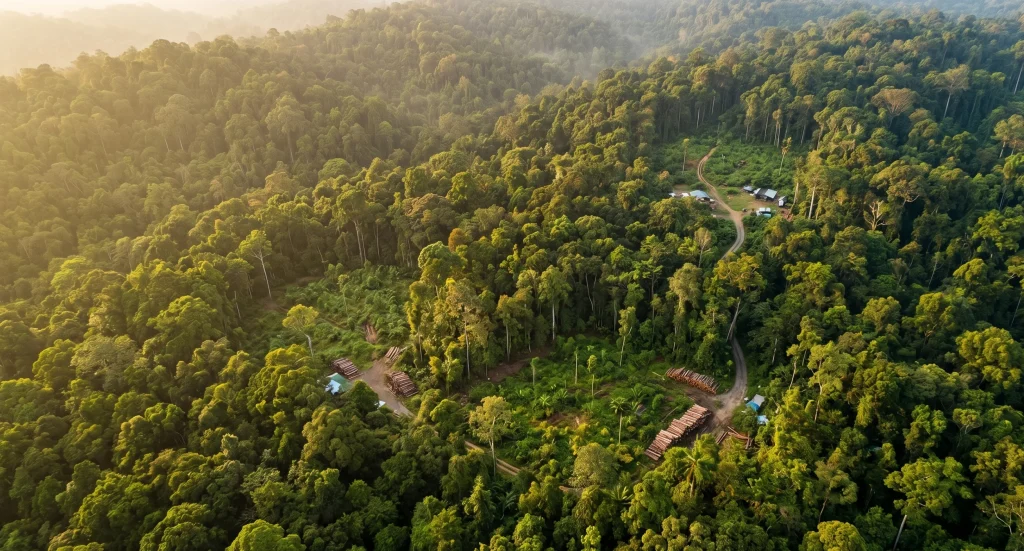
This renewability argument is valid, but it is also the most frequently misused element of timber’s sustainability narrative. Renewability only holds if the forest from which the sustainable timber comes is actually managed for regeneration — if harvest rates do not exceed growth rates, if biodiversity is protected, and if the rights of local communities are respected. Timber from a deforested, illegally logged, or ecologically degraded source is not renewable in any meaningful sense, regardless of the species classification or the material properties of the boards.
Renewability is a condition, not a given. The certification systems that verify responsible forest management — FSC and PEFC — exist precisely because renewability cannot be assumed from the product alone.
Forest Management — The Certification Layer
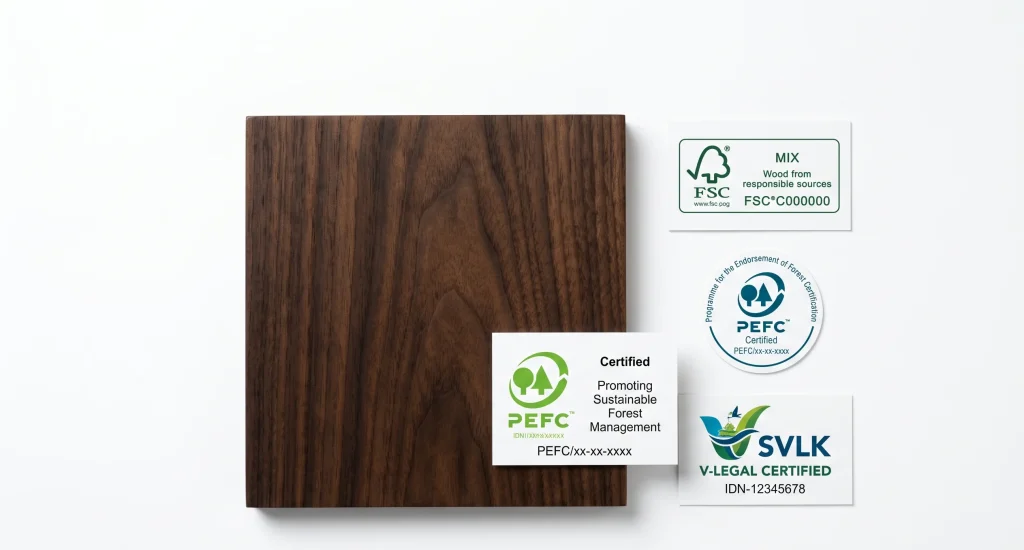
The Forest Stewardship Council (FSC) and the Programme for the Endorsement of Forest Certification (PEFC) are the two globally recognised independent certification systems for responsible forest management. Both operate on the principle of chain-of-custody traceability: certified sustainable timber can be tracked from the forest of origin through every stage of processing and distribution to the point of specification.
FSC was established in 1993 following the Rio Earth Summit, with a specific mandate to address illegal and unsustainable logging — particularly of tropical hardwoods. Its certification requirements cover forest management standards, social and community rights, biodiversity protection, and independent third-party auditing. FSC certification is generally considered the more stringent of the two systems, particularly for tropical species.
PEFC was established in 1999 as a mutual recognition framework for national forest certification systems. It is widely used across European temperate forestry and is accepted across the majority of regulated procurement frameworks in Europe and Asia. For many construction procurement specifications, either FSC or PEFC certification is acceptable; some public procurement frameworks require FSC specifically.
Both systems use chain-of-custody (CoC) certification to ensure that certified claims remain valid throughout the supply chain. A specifier requiring FSC® or PEFC™ certified sustainable timber must confirm not only that the raw material originates from a certified forest, but that every organisation in the supply chain — processor, manufacturer, distributor — holds a valid CoC certificate.
Legality Verification — The Foundation Below Certification
Certification is a quality above legality — it confirms responsible management, not merely legal compliance. In markets where independent certification is not yet universally available, legality verification systems provide the foundational confirmation that sustainable timber has been harvested and traded in compliance with national law.
Indonesia’s SVLK (Sistem Verifikasi Legalitas Kayu — Timber Legality Verification System) is one of the most rigorous mandatory legality verification systems in the world. Unlike voluntary certification schemes, SVLK compliance is a legal requirement for all Indonesian timber and wood product exports. It is the first such system to be formally recognised by the European Union under the FLEGT (Forest Law Enforcement, Governance and Trade) framework — meaning SVLK-certified Indonesian timber is treated as verified legal and compliant under EU import regulations.
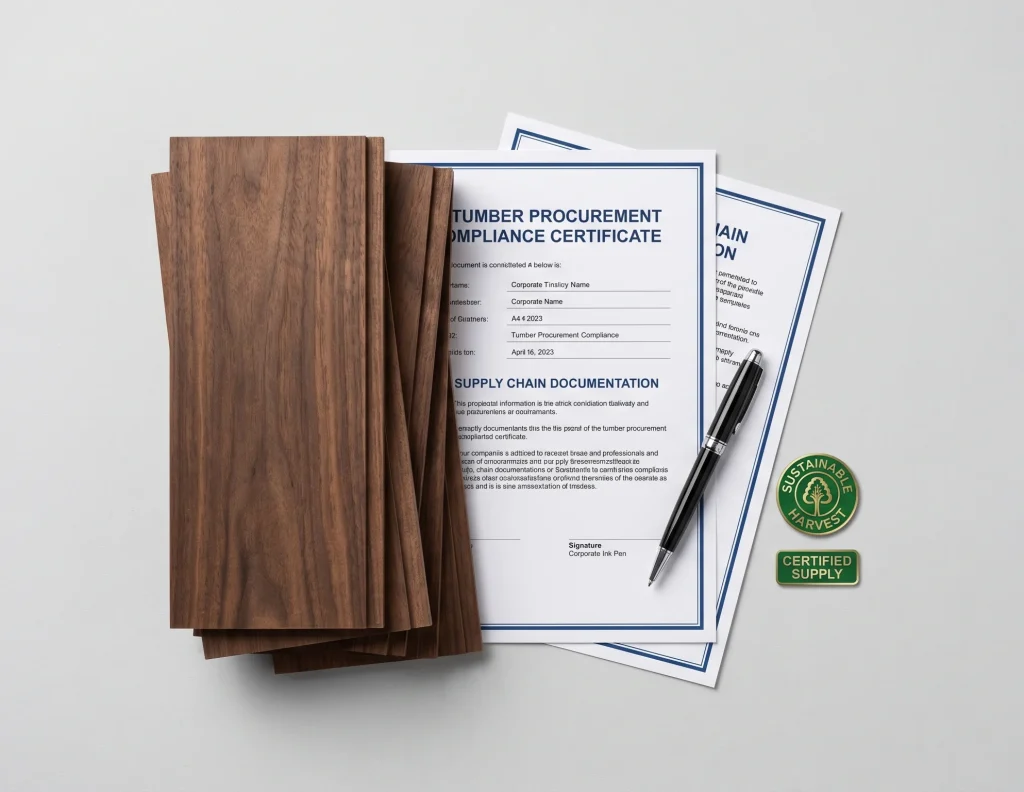
Ultimate FBR carries SVLK certification — confirming that the sustainable timber and the modification process both comply with Indonesia’s mandatory legality verification requirements. This provides the foundational legality documentation required for EU market access, independent of and complementary to FSC® Ready and PEFC™ Ready status.
The EUDR: How EU Regulation Is Reshaping Timber Procurement
The EU Deforestation Regulation (EUDR) — which entered into force in June 2023 and applies to large operators from 30 December 2026 and SMEs from 30 June 2027 — represents the most significant regulatory shift in European timber procurement in a generation. Its implications for sustainable timber specification are substantial and underappreciated in much of the current market.
The EUDR requires that any timber or timber-derived product placed on the EU market must be:
Produced on land that was not deforested or forest-degraded after 31 December 2020. Legal under the laws of the country of production. Accompanied by a due diligence statement submitted to an EU regulatory portal before market placement.
Unlike its predecessor — the EU Timber Regulation (EUTR) — the EUDR applies not just to raw timber but to a wide range of processed wood products: sawn timber, profiled boards, cladding panels, joinery components, furniture, and printed paper, among others. This means that sustainable timber cladding, window frames, decking, and door frames specified for EU construction projects all fall within the EUDR’s scope.
What EUDR Means for Procurement
For procurement managers and specifiers sourcing timber for EU projects, the EUDR imposes a new layer of supply chain due diligence that goes beyond certification status. FSC and PEFC certifications are recognised by the EUDR as indicators that products are legal and deforestation-free — but they do not replace the obligation to submit a due diligence statement or to collect geolocation and traceability data from the supply chain.
In practical terms, this means procurement professionals need suppliers who can provide geolocation data for the forest of origin confirming that the land was not deforested after 31 December 2020, documentation of legal compliance in the country of production, and a traceable chain of custody from forest to delivered product.
For Indonesian timber with SVLK certification — such as Ultimate FBR — the FLEGT recognition of SVLK provides direct compliance with the EUDR’s legality requirement, simplifying the due diligence documentation process considerably compared to tropical hardwood from non-FLEGT countries. Distribution through Houtplex B.V. in the Netherlands provides a structured EU-based entry point for supply chain documentation.
Why Modification Technology Strengthens the Sustainability Case
Certification and legality verification address the sourcing dimension of sustainable timber. A complete sustainability argument must also address performance: how long does the material last, how much maintenance does it require, and what happens at end of life?
A certified sustainable timber product that fails prematurely represents a sustainability failure regardless of its sourcing credentials. Premature replacement means additional resource consumption, additional embodied carbon, and additional waste. The most credible sustainable timber specification combines responsible sourcing with genuine long-term performance.
Bio-Based Feedstock: The Raw Material Argument
The furan resin modification process used in Ultimate FBR is based on furfuryl alcohol — a compound derived from furfural, produced from the dehydration of pentosan-rich agricultural residues: sugarcane bagasse, corn cobs, oat husks, and rice husks. These are by-products of food and agricultural production that would otherwise require disposal. No dedicated land use, no fossil fuel feedstock, no petrochemical synthesis chain.
This bio-based origin is relevant to environmental product declarations (EPDs), green building certification schemes (BREEAM, LEED, DGNB), and corporate procurement policies that assess embodied carbon and feedstock sustainability alongside forest certification. The polymer deposited within the cell wall of an Ultimate FBR board originated as agricultural waste — a provenance that, combined with SVLK, FSC® Ready, and PEFC™ Ready status, produces a modification technology with a sourcing profile more transparent than most alternatives.
No Toxic Chemistry: The End-of-Life Argument
Conventional preservative treatments introduce biocidal heavy metals — copper, chromium, arsenic — that complicate disposal, incineration, and recycling at end of life. Furan resin sustainable timber contains no biocidal compounds, no heavy metals, no persistent organic pollutants. Once cured, the modification chemistry is bio-based, chemically stable, and biologically inert. At end of life, Ultimate FBR can be combusted for energy recovery without the emissions concerns associated with preservative-treated timber, or processed through standard wood waste streams.
Extended Service Life: The Carbon Argument
The most direct sustainability contribution of high-performance sustainable timber is service life extension. A building component that lasts 25 years before replacement has a fundamentally different whole-life environmental footprint from one that lasts 10 years. The embodied carbon is amortised over a longer period, the stored carbon remains locked in for longer, and the replacement cycle — with its own embodied carbon burden — is deferred or eliminated.
The dimensional stability and durability performance of Ultimate FBR — ASE 44.33%, volumetric swelling 2.35%, water uptake 35.07%, Class 2 durability under EN 350, independently verified by IPB University (Indonesia) and the Université de Lorraine (France) — represents a genuinely extended service life profile for exterior and joinery applications compared to untreated hardwood or preservative-treated softwood.
Extended service life also means extended coating intervals. A façade board that moves 2.35% by volume through a moisture cycle stresses its surface coating far less than one moving 10.04% — producing measurably longer finishing intervals, fewer maintenance interventions, and lower ongoing embodied carbon from maintenance operations over the building’s service life.
Sustainable Timber as a Tropical Hardwood Alternative
One of the most significant sustainable timber opportunities available to specifiers today is the substitution of tropical hardwood species — where sourcing risk is highest and supply chain transparency is most difficult to verify — with sustainable timber products whose credentials are traceable, documented, and independently verified.
The Tropical Hardwood Sourcing Problem
Tropical hardwood species have historically been specified for exterior and joinery applications because of their natural durability and density. Species such as iroko, bangkirai, cumaru, and merbau carry natural durability ratings in the Class 1–2 range under EN 350 and have well-established performance track records in demanding exterior environments.
The sourcing challenge is equally well established. Despite FSC and PEFC certification being available for tropical species from responsibly managed sources, illegal logging rates in tropical forest countries — estimated at between 50% and 90% of total logging activity in some regions — mean that the risk of encountering illegally sourced material in the tropical hardwood supply chain remains material. The EUDR significantly raises the bar for due diligence on tropical timber placed on the EU market, making geolocation data, deforestation-free land verification, and traceable chain of custody regulatory requirements rather than voluntary best practice.
The Sustainable Timber Alternative
Furan resin modified hardwood offers a technically credible alternative to tropical hardwood species in the applications where those species have historically been specified — exterior cladding, decking, windows, door frames, and joinery.
| Property | Tropical Hardwood (typical Class 1–2) | Ultimate FBR Modified Hardwood |
|---|---|---|
| Durability class (EN 350) | Class 1–2 (heartwood only) | Class 2 (full cross-section, verified) |
| Dimensional stability | Moderate — species variable | Very high — ASE 44.33% (verified) |
| Density | 650–1,000 kg/m³ (species variable) | 743 kg/m³ (tested) |
| Colour/defect consistency | Variable — natural variation | Uniform — no defects |
| EUDR compliance burden | High — geolocation and traceability complex | SVLK certified — streamlined compliance |
| FSC/PEFC availability | Variable — species and source dependent | FSC® Ready, PEFC™ Ready |
| Fire performance | Euroclass D (typical) | B-s2-d0 achievable |
The durability comparison requires a clarification frequently overlooked in specification: tropical hardwood durability classifications refer to heartwood only. Sawn tropical hardwood boards often contain a proportion of sapwood — Class 5 (not durable) for every species — reducing effective durability below the species classification. The Class 2 classification for Ultimate FBR applies uniformly to the full cross-section of every board, without heartwood proportion uncertainty.
On dimensional stability, sustainable timber typically outperforms tropical hardwood. The verified volumetric swelling of 2.35% for Ultimate FBR is substantially lower than typical figures for tropical hardwood species, providing greater specification confidence for shadow-gap cladding profiles and precision joinery where dimensional consistency over years of service is design-critical.
What “FSC® Ready” and “PEFC™ Ready” Mean in Practice
FSC® Ready and PEFC™ Ready status indicates that the timber substrate meets the eligibility criteria for FSC and PEFC chain-of-custody certification — meaning the raw material originates from a certified or controlled source — but that full chain-of-custody certification across all distribution routes has not yet been formally completed.
For projects where FSC or PEFC chain-of-custody certification is a contractual requirement, confirm with Houtplex B.V. (Netherlands) or Wood United Pte Ltd (Singapore) whether a fully certified supply route is available for the specific project. The FSC® Ready and PEFC™ Ready status means the certification pathway is open; the chain-of-custody documentation can be completed through the supply chain where required.
For projects where legality verification is the primary procurement requirement, the SVLK certification of Ultimate FBR provides direct compliance with EU FLEGT recognition — satisfying the legality dimension of EUDR due diligence without additional documentation burden.
How to Identify Greenwashing in Timber Sustainability Claims
The construction sector’s increasing focus on sustainable timber procurement has created commercial pressure to present sustainable timber products as environmentally responsible whether or not the evidence supports it. Greenwashing in the sustainable timber industry takes several distinct forms.
Vague Certification Language
Terms such as “sustainably sourced”, “from responsible forests”, and “eco-friendly” carry no verifiable standard and no independent verification. Verified sustainable timber carries a specific named certification — FSC®, PEFC™, SVLK — with a certificate number that can be confirmed through the relevant body’s online database. Any supplier who cannot provide a certificate number for a claimed certification status should be treated with caution.
Species Classification Without Provenance
A species durability classification from EN 350 says nothing about the specific boards being procured — whether they contain primarily heartwood or sapwood, whether they originate from a certified forest, or whether the supply chain is traceable. Specifying tropical hardwood by species alone, without confirming certification and provenance, is a sourcing risk that the EUDR now makes a legal compliance risk as well.
Performance Claims Without Independent Data
Sustainability claims based on extended service life are only defensible if the service life claim is supported by independent test data referenced to named standards. Manufacturer self-testing is not independent verification. For Ultimate FBR, performance data — ASE 44.33%, volumetric swelling 2.35%, water uptake 35.07%, density 743 kg/m³, Class 2 durability under EN 350 — has been independently verified by IPB University and the Université de Lorraine, France.
Carbon Claims Without an EPD
Environmental claims about embodied carbon or lifecycle emissions that are not supported by a third-party verified Environmental Product Declaration (EPD) in accordance with EN 15804 are commercial assertions, not verified data. Specifiers working under BREEAM, LEED, or DGNB frameworks should confirm EPD availability for any sustainable timber product where embodied carbon credits are being claimed.
Specifying Sustainable Timber: A Practical Checklist
1. What certification does the product carry — and can it be verified? Confirm the certification name, certificate number, and scope. Verify through the relevant body’s online database. For Ultimate FBR: SVLK certified (EU FLEGT recognised); FSC® Ready and PEFC™ Ready — chain-of-custody certification available through the distribution network on request.
2. Does the certification cover the full supply chain? Confirm that every organisation in the supply chain holds a valid CoC certificate if full FSC or PEFC certification is required by the project specification.
3. Is the product EUDR-compliant for EU market placement? Confirm that the supplier can provide geolocation data, legal compliance documentation, and traceable chain of custody. SVLK certification provides the legality documentation directly through its FLEGT recognition; distribution through Houtplex B.V. in Haaksbergen, Netherlands provides an EU-based supply chain entry point.
4. Is the modification process bio-based and free of biocidal chemistry? For sustainable timber, confirm the feedstock origin and confirm the absence of biocidal compounds, heavy metals, and persistent organic pollutants. Furan resin modification uses furfuryl alcohol derived from agricultural waste — bio-based, non-biocidal, and compatible with timber material health requirements in leading green building certification schemes.
5. Is the sustainable timber durability performance independently verified? Require test data from a named independent testing body, referenced to EN 350:2016. Confirm the classification applies to the full board cross-section. Ultimate FBR’s Class 2 durability under EN 350 has been verified by IPB University and the Université de Lorraine, France.
6. Does the product data support green building certification credits? For BREEAM, LEED, or DGNB projects, confirm which credits the specified timber supports — responsible sourcing, material health, embodied carbon — and what documentation is required.
7. Is the size range compatible with the project requirement? Ultimate FBR is available in 12–32mm × 90–285mm × 900–5900mm. Distribution through Houtplex B.V. in Haaksbergen, Netherlands for European markets and Wood United Pte Ltd in Singapore for Asian and Pacific markets, both part of the Wood United Group.
Frequently Asked Questions about Sustainable Timber
What is sustainable timber?
Sustainable timber is wood sourced from forests managed in a way that maintains ecological integrity, regenerates the resource at least as fast as it is harvested, respects the rights of local communities, and can be verified as meeting these standards through independent third-party certification. In a B2B specification context, sustainable timber means timber accompanied by credible certification — FSC®, PEFC™, or an equivalent nationally recognised system such as Indonesia’s SVLK — and a traceable chain of custody from forest to delivered product. Renewability alone does not make timber sustainable; the management of the specific forest source must also be verified.
How do I know if timber is sustainable?
The most reliable indicator of sustainable timber is a named, verifiable certification — FSC®, PEFC™, or SVLK — with a certificate number confirmable through the relevant body’s public database. Vague commercial language such as “sustainably sourced” carries no verified standard and is not an adequate substitute for named sustainable timber certification. For EU procurement, the EUDR additionally requires geolocation data and due diligence documentation — certification status alone does not fulfil the EUDR’s traceability requirements, though FSC and PEFC are recognised as indicators of legal and deforestation-free sourcing.
What is the difference between FSC and PEFC?
Both FSC and PEFC are independent, internationally recognised certification systems for responsible forest management and chain of custody. FSC was established in 1993 with a focus on tropical forests, operating a single global standard. PEFC was established in 1999 as a mutual recognition framework for national forest certification systems and is widely used across European temperate forestry. Both are accepted under most regulated procurement frameworks in Europe and Asia. FSC is generally considered more stringent for tropical species; PEFC is often preferred by smaller forest owners due to lower certification costs.
Is tropical hardwood ever a sustainable choice?
Yes — tropical hardwood from credibly certified, legally verified sources can be a sustainable specification choice. The challenge is supply chain risk: illegal logging rates in some tropical timber-producing countries remain high, the proportion of tropical timber carrying credible independent certification is lower than in temperate forestry, and the EUDR now imposes significant due diligence requirements for tropical timber placed on the EU market. Where the due diligence burden is difficult to discharge, or where comparable performance can be achieved from a more traceable source, modified timber from a SVLK-certified, FSC® Ready supply chain presents a lower-risk alternative.
What does EUDR mean for timber procurement?
The EU Deforestation Regulation requires that timber placed on the EU market is deforestation-free, legal under the laws of the country of production, and accompanied by a due diligence statement submitted to an EU regulatory portal. Large operators must comply from 30 December 2026; SMEs from 30 June 2027. FSC and PEFC certifications are recognised as indicators of legal and deforestation-free sourcing but do not replace the obligation to gather geolocation data and submit a due diligence statement. For Indonesian timber with SVLK certification, FLEGT recognition provides direct compliance with the EUDR’s legality requirement.
What is SVLK certification?
SVLK (Sistem Verifikasi Legalitas Kayu) is Indonesia’s mandatory timber legality verification system — a government-administered framework requiring all Indonesian timber exporters to demonstrate compliance with national forestry law before export. Unlike voluntary certification schemes, SVLK compliance is a legal requirement. It is the first national system formally recognised by the European Union under the FLEGT framework, meaning SVLK-certified Indonesian timber is treated as verified legal for EU import purposes without additional due diligence. For procurement managers sourcing timber from Indonesia for EU projects, SVLK certification is the foundational legality credential.
Is modified wood more sustainable than untreated hardwood?
Modified wood offers a sustainability advantage across several dimensions: extended service life reducing replacement frequency and resource consumption, reduced maintenance requirements lowering ongoing embodied carbon, and — for furan resin modification — a bio-based, non-biocidal modification chemistry producing no persistent organic pollutants. The sustainability comparison also depends on sourcing: modified timber from a SVLK-certified, FSC® Ready supply chain provides more transparent and verifiable documentation than much of the tropical hardwood available in global trade. Performance and sourcing together — not either in isolation — constitute the complete sustainability case.
What certifications should I look for in sustainable timber for a B2B project?
For most regulated EU construction procurement, FSC® or PEFC™ chain-of-custody certification covering the full supply chain is the standard requirement. For projects subject to EUDR compliance, SVLK certification (for Indonesian timber) provides the legality documentation that simplifies due diligence. For green building certification schemes (BREEAM, LEED, DGNB), responsible sourcing credits typically require FSC or PEFC chain-of-custody certification plus — in some schemes — an Environmental Product Declaration for embodied carbon assessment. Ultimate FBR carries SVLK certification and is FSC® Ready and PEFC™ Ready, with chain-of-custody certification available through the distribution network for projects where full certification is required.
Sourcing certifications:
- SVLK — Indonesia’s mandatory timber legality verification system, EU FLEGT recognised. Satisfies EUDR legality requirement directly.
- FSC® Ready — chain-of-custody certification available through supply chain on request.
- PEFC™ Ready — chain-of-custody certification available through supply chain on request.
EUDR compliance: SVLK’s FLEGT recognition provides direct compliance with the EU Deforestation Regulation’s legality requirement for Indonesian timber on EU markets. Geolocation data and traceability documentation available through Houtplex B.V.
Modification sustainability profile:
- Feedstock: furfuryl alcohol from agricultural waste (sugarcane bagasse, corn cobs, oat husks).
- No biocidal compounds · No heavy metals · No persistent organic pollutants.
- End-of-life: standard wood waste stream or energy recovery — unrestricted.
Performance sustainability argument:
- ASE 44.33% → extended coating intervals → fewer maintenance interventions over service life.
- Class 2 durability (EN 350:2016) without biocidal retreatment.
- Service life 15–25 years in UC 3.2 above-ground exterior conditions.
Independent verification: IPB University (Indonesia) & Université de Lorraine (France).
Supply: Houtplex B.V., Haaksbergen, Netherlands (EU entry point) · Wood United Pte Ltd, Singapore.
Specify Sustainable Timber with Verified Credentials
Timber sustainability in a B2B specification context is not a single credential — it is a framework of interconnected requirements: responsible forest management verified by independent certification, legal compliance confirmed by legality verification, performance substantiated by independent test data, and a supply chain traceable enough to satisfy EUDR due diligence obligations.
Ultimate FBR addresses all four dimensions. SVLK certification provides EU FLEGT-recognised legality verification. FSC® Ready and PEFC™ Ready status enables chain-of-custody certification where required. Bio-based, non-biocidal furan resin modification produces a material health profile compatible with green building certification requirements. And independently verified performance data — Class 2 durability under EN 350, ASE 44.33%, density 743 kg/m³, volumetric swelling 2.35%, water uptake 35.07% — supports the extended service life argument that underpins the whole-life sustainability case.
For project-specific certification documentation, EUDR compliance information, or supply enquiries, contact the Ultimate FBR team via the contact form. European distribution is handled by Houtplex B.V. in Haaksbergen, Netherlands; Asian and Pacific market enquiries by Wood United Pte Ltd in Singapore — both part of the Wood United Group.