
Wood Durability Classes — The EN 350 Guide Every Specifier Needs
Wood durability is one of the most consequential properties in timber specification — and one of the most consistently misread. A durability class number without context tells a specifier very little. Class 2 timber in a well-ventilated rainscreen cladding system performs very differently from Class 2 timber buried in ground contact. A species rated Class 1 in its heartwood may perform no better than Class 5 in its sapwood. And modified wood that achieves a verified durability class through cell-wall modification performs fundamentally differently from preservative-treated timber carrying the same classification.
This guide explains what wood durability actually means under EN 350, how the classification system works, how durability class and use class interact, and how specifiers can use this framework to make defensible material decisions on real projects — with independently verified data rather than species tables and manufacturer claims.
What Is Wood Durability?
Wood durability is the inherent resistance of timber to biological degradation — specifically to attack by decay fungi, bacteria, and wood-boring insects. It is a material property, not a surface treatment. A species with high natural durability resists biological attack because of the extractive compounds present in its heartwood: oils, tannins, resins, and other metabolites that are toxic or unpalatable to the organisms that cause decay.
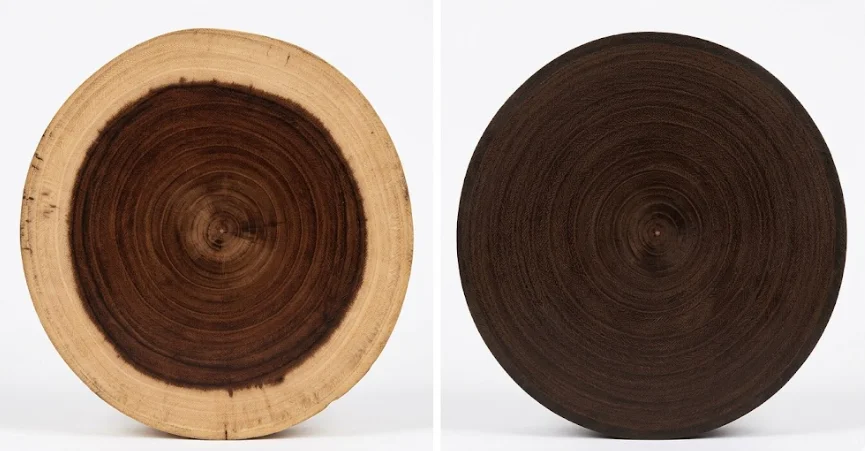
The key phrase is heartwood. Wood durability classifications under EN 350 refer exclusively to the heartwood of a species. Sapwood — the outer, living layers of the trunk — is classified as durability Class 5 (not durable) for every species without exception. This distinction has profound implications for specification: a naturally durable hardwood species may contain a significant proportion of sapwood, particularly in plantation-grown material, and that sapwood offers no durability benefit regardless of the species classification.
Wood durability is not the same as wood hardness, density, or strength — though these properties correlate loosely in some species. A timber can be very hard and dense but biologically vulnerable (some European beech), or moderately soft but naturally durable (western red cedar). Durability is specifically about resistance to the organisms that cause decay, and it is measured and classified through a separate test methodology from strength or dimensional properties.
What Causes Wood to Decay?
Wood decay is caused primarily by fungi — organisms that break down the cell wall polymers of timber to obtain nutrients. The three principal decay types relevant to exterior timber specification are:
Brown rot fungi degrade cellulose and hemicellulose within the cell wall, leaving a brown, crumbly residue. Brown rot is common in softwoods and is responsible for the characteristic cubic cracking pattern seen in failed exterior timber.
White rot fungi degrade both cellulose and lignin, leaving a pale, fibrous residue. White rot is more common in hardwoods. Both brown and white rot require moisture — timber below approximately 20% moisture content is not susceptible to fungal attack.
Soft rot fungi are active in conditions of very high and persistent moisture, particularly in timber in ground contact or immersed in water. Soft rot attacks the outer surface of timber, producing a characteristically soft, degraded zone while the interior remains intact initially.
Understanding which decay mechanism is relevant to a specific application — and whether the exposure conditions will sustain the moisture levels required for fungal activity — is as important as knowing the wood durability class of the specified material.
The EN 350 Durability Classification System
EN 350 — the European standard for the durability and treatability of wood and wood-based products — provides the framework within which timber durability is classified across European markets. The current version, EN 350:2016, extended the classification system from natural timber species to include modified wood and wood-based products — a significant development that brought products like furan resin modified hardwood within the scope of the standard’s classification methodology.
The EN 350 system uses five durability classes:
| Class | Designation | Expected Service Life (above ground) | Example Species (heartwood) |
|---|---|---|---|
| Class 1 | Very durable | 25+ years | Teak, Ipe, Ekki, Jarrah |
| Class 2 | Durable | 15–25 years | Oak, Sweet chestnut, Western red cedar |
| Class 3 | Moderately durable | 10–15 years | Douglas fir, Larch, Scots pine heartwood |
| Class 4 | Slightly durable | 5–10 years | Spruce, Most pines (sapwood), Ash |
| Class 5 | Not durable | 0–5 years | Birch, Beech, All sapwood of any species |
These service life figures represent expected performance in above-ground, unprotected exterior conditions — the standard test scenario from which the classification system was developed. In practice, service life in well-designed assemblies with appropriate drainage, ventilation, and maintenance will exceed these figures for Class 1–3 materials.
How Durability Is Tested Under EN 350
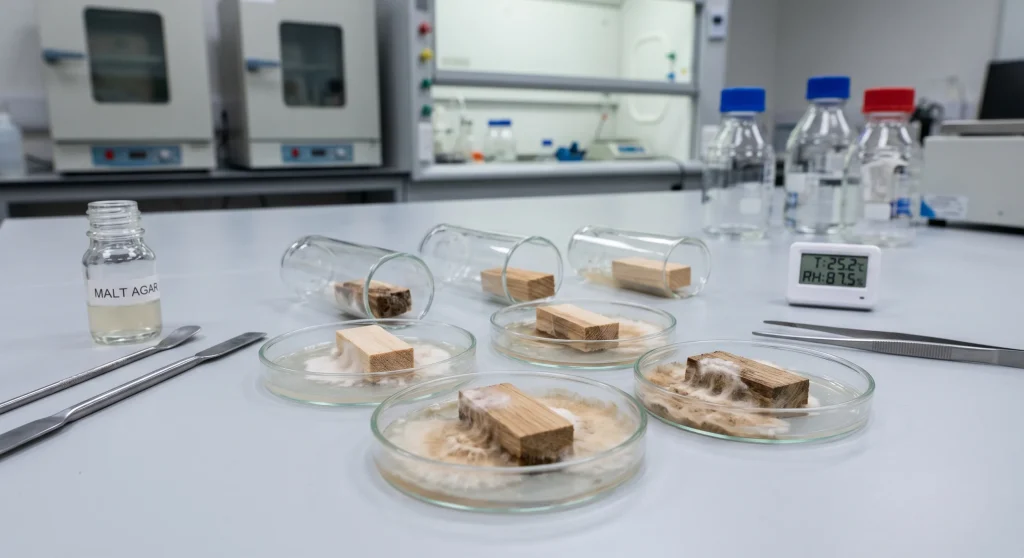
The test methodology underpinning EN 350 durability classification is based on accelerated laboratory fungal exposure testing, supplemented by long-term field stake tests. The primary laboratory methods expose timber specimens to known decay fungi — typically Coniophora puteana (brown rot) and Coriolus versicolor (white rot) — and measure mass loss after a defined exposure period. Performance is expressed relative to a non-durable reference species (typically European beech or Scots pine sapwood) whose response to the same fungi is well characterised.
The relative performance figure — the x-value — determines the wood durability class. An x-value above 0.90 indicates the specimen performed similarly to the non-durable reference (Class 5). An x-value below 0.10 indicates very high resistance (Class 1). The five classes correspond to defined x-value ranges.
For modified wood — including furan resin modified hardwood — EN 350:2016 uses the same test methodology applied to the modified material. This is important: the durability class awarded to a modified wood product reflects the performance of the modified material under the same fungal exposure conditions used to classify natural species. Ultimate FBR achieves Class 2 durability under this methodology, independently verified by IPB University (Indonesia) and the Université de Lorraine (France).
Heartwood, Sapwood, and the Consistency Problem
The EN 350 durability classification for natural species applies to the heartwood only. In practice, the proportion of heartwood in a sawn board depends on the species, the age of the tree at felling, and its growth conditions. Plantation-grown softwoods harvested at relatively young ages may contain very little heartwood — making their species-level durability classification largely irrelevant to the actual performance of the boards being specified.
This is one of the most significant practical limitations of species-based wood durability specification, and one of the clearest arguments for specifying modified wood products where the wood durability classification applies uniformly to the entire cross-section of every board — not just to the heartwood fraction of variable extent.
Ultimate FBR is produced from optimised raw material with consistent quality and no defects. The furan resin modification penetrates the full cross-section of the board, producing a uniform Class 2 wood durability rating throughout — not a rating that applies only to the heartwood of a species that may or may not be present in the boards you actually receive.
The Use Class System: Where the Timber Will Be Used
Wood durability does not exist in isolation. A durability class is only meaningful when set against the exposure conditions of the intended application — and those conditions are defined by a parallel classification system: the Use Class system, established under EN 335.
Use Classes define the biological hazard to which timber will be exposed in service. They describe not the timber, but the environment. A timber with Class 2 natural durability may be entirely adequate in Use Class 2 conditions and entirely inadequate in Use Class 4 conditions — the same species, the same durability rating, two completely different outcomes depending on where and how it is used.
The five Use Classes under EN 335 are:
| Use Class | Service Situation | Biological Hazard | Typical Applications |
|---|---|---|---|
| UC 1 | Interior, always dry | None | Internal joinery, flooring, furniture |
| UC 2 | Interior, risk of occasional wetting | Fungi (in extreme conditions) | Internal joinery in humid areas, roof structures |
| UC 3.1 | Exterior, above ground, protected | Fungi, some insects | Coated cladding with overhang, exterior joinery with coating |
| UC 3.2 | Exterior, above ground, exposed | Fungi, insects, UV | Uncoated cladding, open-joint rainscreen, exposed decking |
| UC 4 | In ground or freshwater contact | Fungi, insects, bacteria | Fence posts, ground-contact framing, dock timbers |
| UC 5 | In seawater contact | Marine borers, fungi | Marine piling, jetties, harbour structures |
For the majority of exterior cladding, decking, window, and door frame applications — the primary specification scenarios for modified hardwood — the relevant Use Class is UC 3.1 or UC 3.2. Applications involving ground contact fall into UC 4, which requires either Class 1 natural durability or appropriate preservative treatment regardless of modification type.
Matching Wood Durability Class to Use Class
The Wood Protection Association publishes guidance on the minimum durability class required for timber in each Use Class. For practical specification purposes, the relationship is as follows:
For Use Class 3.1 and 3.2 — the conditions relevant to exterior cladding, façades, decking, and exterior joinery — a minimum wood durability class of Class 2 is the appropriate specification threshold for timber that will not receive biocidal preservative treatment. Class 2 timber in above-ground exterior conditions is expected to perform for 15–25 years without preservative retreatment, providing the assembly is properly designed with drainage, ventilation, and appropriate end-grain protection.
Class 1 timber exceeds this requirement and is appropriate where conditions are particularly severe, where the assembly detail makes maintenance difficult, or where a client specifies a higher performance threshold. Class 3 timber may be used in UC 3.1 conditions with appropriate surface protection, but requires more intensive maintenance management and carries a higher risk of premature failure if the maintenance schedule lapses.
This framework explains why Class 2 durability — the verified classification for Ultimate FBR under EN 350 — is the correct and sufficient specification for the full range of exterior cladding, decking, and joinery applications. Class 2 is not a compromise; it is the performance level for which Use Class 3 applications are designed, and achieving it through cell-wall modification rather than biocidal treatment provides additional benefits in terms of maintenance simplicity and environmental credentials.
Verified Performance Data: Ultimate FBR Modified Wood
The wood durability performance of Ultimate FBR is not determined by species-table classification alone — it is the product of independently verified laboratory testing conducted under EN 350:2016. Testing has been carried out by IPB University (Indonesia) and the Université de Lorraine (France), with results validated against EN, BS, ASTM, AWPA, and SNI standards.
The following table presents the full verified performance profile, contextualising wood durability within the broader set of properties relevant to exterior and joinery timber specification:
| Performance Property | Untreated Hardwood | Ultimate FBR | Test Standard |
|---|---|---|---|
| Density | Baseline | 743 kg/m³ | Tested |
| Volumetric swelling | 10.04% | 2.35% | EN 350 |
| Water uptake | 109.58% | 35.07% | ASTM |
| Anti-Swelling Efficiency (ASE) | — | 44.33% | Tested |
| Durability classification | Class 3–4 (species dependent) | Class 2 | EN 350:2016 |
| Fire performance | Not classified | B-s2-d0 achievable | EN 13501-1 |
Why the Full Data Profile Matters for Wood Durability Specification
Wood durability class alone does not tell a specifier everything they need to know about how a timber product will perform in service. A Class 2 classification confirms biological resistance to fungal decay — but the moisture uptake and dimensional stability data determine how frequently and severely the conditions for decay are created in the first place.
A timber with Class 2 durability and high water uptake (109.58%) will regularly reach and exceed the moisture content threshold — approximately 20% — at which fungal activity becomes possible. A timber with Class 2 durability and low water uptake (35.07%) will reach that threshold far less frequently, and recover below it more rapidly. In practical terms, the dimensional stability data and the wood durability classification together tell a more complete performance story than either figure in isolation.
The density of 743 kg/m³ is equally relevant to wood durability in service. A denser board is less permeable, presents a more mechanically resistant substrate to biological penetration, and typically weathers more slowly at its surface — all factors that contribute to sustained service performance beyond the baseline durability classification.
Natural Wood Durability vs Modified Wood Durability: A Critical Distinction
The EN 350 classification system was originally developed to categorise the natural wood durability of timber species — the inherent resistance of heartwood to biological attack derived from the extractive chemistry of the species. The 2016 revision extended the system to include modified wood and wood-based products, but the mechanisms producing wood durability in natural and modified timber are fundamentally different, and those differences have significant implications for specification.
How Natural Wood Durability Works
In naturally durable timber, biological resistance derives from extractive compounds deposited in the heartwood as the tree matures. These compounds — tannins, oils, resins, and various phenolic substances — are toxic or repellent to the fungi and insects that cause decay. The wood durability classification of a species reflects the efficacy of these naturally occurring extractives under standardised test conditions.
The limitations of natural wood durability for specification purposes are well established. Natural wood durability applies only to heartwood. As noted, sapwood of any species is Class 5 — non-durable — regardless of the heartwood classification. Boards with significant sapwood content offer far less biological resistance than the species classification implies.
Natural durability varies with provenance. The extractive content of heartwood varies between individual trees, between stands, and between geographic sources of the same species. A board of naturally durable timber from one source may perform differently from a board of the same species from another — a variability that no specification document can fully control.
Natural durability can diminish over time. Some extractive compounds are water-soluble and leach from the timber over years of service. Long-term field studies have demonstrated that the durability of some naturally durable species declines with prolonged exposure, particularly in high-moisture conditions.
How Modified Wood Durability Works
Modified wood achieves biological durability through a fundamentally different mechanism. In furan resin modification, the cell wall is permanently altered by the deposition of a cross-linked polymer that physically occupies the cell wall space available to decay fungi and their enzymes, reducing accessibility to the substrates they need to degrade.
Reduces the equilibrium moisture content of the timber to below the threshold at which fungal activity can be sustained — typically cited as approximately 20% moisture content. Wood that rarely reaches this threshold is inherently less susceptible to decay, regardless of fungal pressure.
Renders the cell wall less nutritionally accessible — the modified cell wall polymers are less digestible for decay organisms than untreated cellulose and hemicellulose.
These mechanisms operate throughout the full cross-section of the modified board — not just in the heartwood, and not just in the outer zone penetrated by a preservative treatment. Every cubic centimetre of an Ultimate FBR board has been modified to the same degree, producing a uniform durability classification that applies without qualification to the entire piece.
The Permanence Advantage
The furan resin polymer within the cell wall of an Ultimate FBR board is covalently bonded to the wood’s structural components. It cannot be leached by rainfall, degraded by UV radiation, or depleted by biological processes. The Class 2 classification awarded to Ultimate FBR at the point of testing reflects the performance of the material throughout its service life — not just its initial performance before a protective mechanism begins to deplete. For specifiers seeking to provide genuine long-term performance assurance to clients, this is a materially different proposition from specifying naturally durable timber or preservative-treated softwood.
Wood Durability in Practice: Common Specification Scenarios
Understanding durability classes and use classes in the abstract is useful. Applying them to real specification scenarios is where the framework generates practical value. The following scenarios illustrate how the EN 350 / EN 335 framework applies to the most common modified hardwood specification contexts.
Exterior Cladding and Rainscreen Façades — UC 3.2
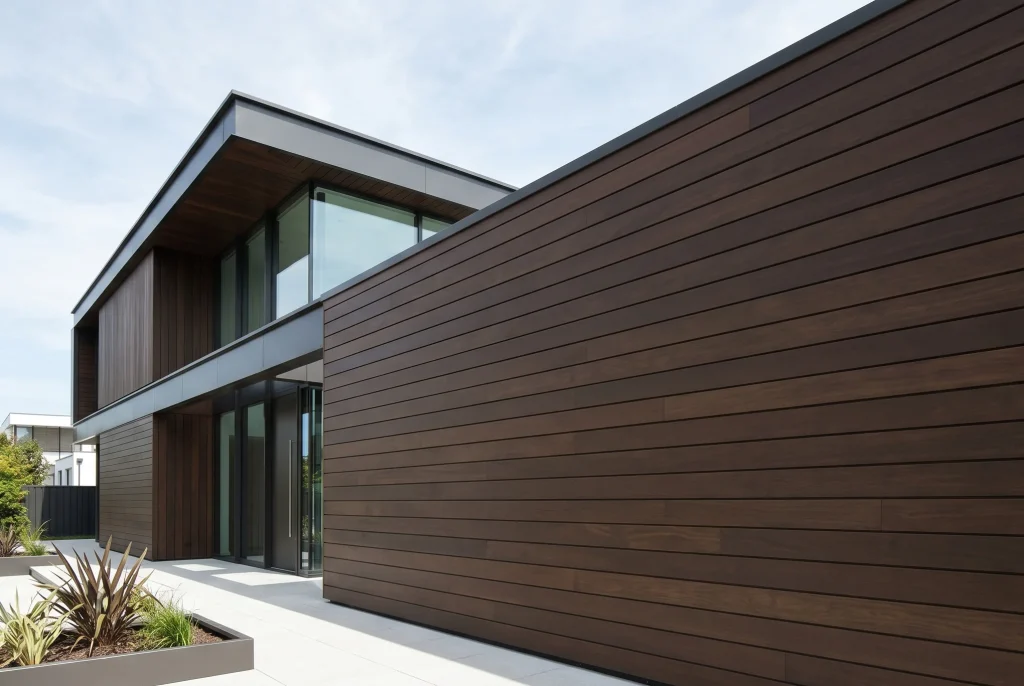
Exterior cladding in an open-joint or shadow-gap rainscreen configuration operates in Use Class 3.2. A minimum durability class of Class 2 is required for timber that will not receive biocidal preservative treatment. Ultimate FBR meets this requirement with its verified Class 2 classification under EN 350:2016. The additional performance characteristics — ASE 44.33%, volumetric swelling of 2.35%, water uptake of 35.07% — further reduce the moisture loading experienced by the cladding boards in service, which in turn reduces the frequency and severity of the conditions under which biological attack could theoretically occur.
Window and Door Frames — UC 3.1 to UC 3.2
Timber window and door frames typically operate in Use Class 3.1 to UC 3.2. Class 2 durability is appropriate across this range, with the added consideration that dimensional stability is as important as biological durability — joint movement and paint film integrity determine service life as much as decay resistance. For joinery manufacturers specifying Ultimate FBR for window and door frame production, the combination of Class 2 durability and ASE 44.33% addresses both the biological and dimensional performance requirements simultaneously.
Exterior Decking — UC 3.2
Exterior decking operates in Use Class 3.2. Class 2 durability is the minimum appropriate specification for decking that will not receive preservative retreatment. The increased density of Ultimate FBR (743 kg/m³) is an additional advantage in the decking context, contributing to surface hardness and resistance to indentation alongside biological durability performance.
Ground Contact Applications — UC 4
For applications involving ground contact — fence posts, ground-contact sill plates, landscaping timbers — the Use Class 4 requirement applies, necessitating Class 1 natural durability or preservative treatment to an appropriate retention level. Ultimate FBR achieves Class 2 durability and is not specified for ground-contact applications. This is a straightforward and honest specification boundary — transparent communication of application limits is more useful to a specifier than overstatement.
Specifying for Wood Durability: A Practical Checklist
1. What is the Use Class of the application? Before looking at durability classes, establish the Use Class. This is determined by the service environment — not by the timber. Get this wrong and the durability class specification that follows may be entirely wrong for the conditions the timber will face.
2. Is the wood durability classification from independent testing or a species table? For modified wood, durability classification should be supported by independent test data from a named testing body. For Ultimate FBR, independent testing has been conducted by IPB University (Indonesia) and the Université de Lorraine (France).
3. Does the wood durability classification apply to the full cross-section? For natural species, durability applies only to heartwood. For furan resin modified timber, the classification applies uniformly throughout the board cross-section — no heartwood proportion uncertainty.
4. Is the wood durability mechanism permanent or depletable? Preservative treatments deplete. Natural extractives can leach. Modified wood with cell-wall polymer bonding does not deplete. Confirm which mechanism underpins the durability claim.
5. Is the test methodology referenced to EN 350:2016? The 2016 revision extended the classification framework to modified wood. Confirm the standard version under which testing was conducted.
6. What certifications confirm legal origin and responsible sourcing? Ultimate FBR carries SVLK certification and is FSC® Ready and PEFC™ Ready — enabling chain-of-custody certification where required by the project specification.
7. Is the size range compatible with the required profile? Ultimate FBR is available in 12–32mm × 90–285mm × 900–5900mm. Distribution is through Houtplex B.V. in Haaksbergen, Netherlands for European markets and Wood United Pte Ltd in Singapore for Asian and Pacific markets, both part of the Wood United Group.
Frequently Asked Questions about Wood Durability
What is wood durability?
Wood durability is the inherent resistance of timber to biological degradation — specifically to attack by decay fungi, bacteria, and wood-boring insects. It is classified under EN 350 on a scale from Class 1 (very durable, 25+ years in above-ground exterior conditions) to Class 5 (not durable, fewer than 5 years). For natural species, durability derives from extractive compounds in the heartwood. For modified wood, durability derives from permanent changes to the cell wall structure — a fundamentally different and more consistent mechanism than natural extractive chemistry.
What is the most durable wood?
Among natural species, teak, ipe, ekki, and jarrah are classified as Class 1 (very durable) under EN 350 — the highest biological durability classification. However, these species are typically slow-growing tropical hardwoods with significant sourcing and sustainability concerns. Modified wood products can achieve comparable durability classifications through controlled modification of managed timber resources. Ultimate FBR achieves Class 2 durability under EN 350 through furan resin modification — sufficient for the full range of exterior cladding, decking, and joinery applications in Use Class 3, without biocidal preservatives and with verified responsible sourcing credentials.
What is the difference between durability class and use class in timber?
Durability class (EN 350) describes the timber — specifically, how resistant its heartwood is to biological attack. Use class (EN 335) describes the environment — specifically, the biological hazard the timber will be exposed to in service. Both must be considered together. A Class 2 timber may be entirely suitable for Use Class 3 applications and entirely unsuitable for Use Class 4 (ground contact) applications. Specification errors most commonly arise from selecting a timber based on its durability class alone without confirming that the class is appropriate for the actual use class of the application.
How is wood durability tested under EN 350?
The primary laboratory test method exposes timber specimens to known decay fungi — typically Coniophora puteana (brown rot) and Coriolus versicolor (white rot) — and measures mass loss after a defined exposure period. Performance is expressed as an x-value relative to a non-durable reference species. The x-value determines the durability class. For modified wood durability classification, the same methodology is applied to the modified material under EN 350:2016. For Ultimate FBR, testing was conducted by IPB University and the Université de Lorraine, France.
How long does Class 2 timber last?
Class 2 timber is classified as durable and is expected to perform for 15–25 years in above-ground exterior conditions (Use Class 3) without biocidal preservative treatment. In well-designed assemblies with appropriate drainage, ventilation, end-grain sealing, and periodic UV-stabilising coating maintenance, actual service life can exceed this range. Class 2 modified wood timber, where the durability mechanism is permanent and structural rather than dependent on a depletable preservative, maintains its biological resistance throughout the service life.
Does treated wood have a durability class?
Yes — under EN 350:2016, modified wood and preservative-treated timber can both be assigned durability classes based on their performance in the same standardised test methodology used for natural species. For preservative-treated timber, the durability class reflects performance during the period when the preservative is active — and the key limitation is that preservative efficacy diminishes over time as the active agent is depleted. For modified wood, the durability class reflects performance that is permanent and structural — it does not deplete. This distinction matters significantly for long-term specification.
Is Class 1 always better than Class 2 for exterior timber specification?
Class 1 durability provides a higher margin of biological resistance and is appropriate for severe exposure conditions, ground contact, or applications where maintenance access is very limited. For the majority of above-ground exterior applications in Use Class 3 — cladding, decking, windows, door frames — Class 2 durability is the appropriate specification threshold and provides the performance needed for the design service life of the assembly. Specifying Class 1 where Class 2 is sufficient adds cost without delivering a corresponding performance benefit. The specification should match the durability requirement of the use class.
EN 350 durability classes (above-ground performance):
| Class | Designation | Expected service life | Example species |
|---|---|---|---|
| Class 1 | Very durable | 25+ years | Teak, Ipe, Ekki |
| Class 2 | Durable | 15–25 years | Oak, Western red cedar |
| Class 3 | Moderately durable | 10–15 years | Douglas fir, Larch |
| Class 4 | Slightly durable | 5–10 years | Spruce, Most pines |
| Class 5 | Not durable | 0–5 years | Beech, All sapwood |
Ultimate FBR: Class 2 (EN 350:2016)
- Achieved through furan resin modification — not biocidal preservative treatment.
- Applies uniformly to the full board cross-section — not heartwood fraction only.
- Permanent — does not deplete over service life.
- Appropriate Use Class: UC 3.1 and UC 3.2 (above-ground exterior).
- Not specified for UC 4 (ground contact).
Independent verification: IPB University (Indonesia) & Université de Lorraine (France).
Additional data: ASE 44.33% · Swelling 2.35% · Water uptake 35.07% · Density 743 kg/m³.
Fire: B-s2-d0 achievable (EN 13501-1).
Certifications: SVLK (EU FLEGT) · FSC® Ready · PEFC™ Ready.
Supply: Houtplex B.V., Netherlands · Wood United Pte Ltd, Singapore.
Specify Wood Durability with Verified Data
Wood durability specification based on species tables alone leaves significant uncertainty in the performance guarantee offered to clients. The heartwood variability of natural species, the provenance-dependence of extractive chemistry, and the depletion characteristics of preservative treatments all introduce risk that verified test data eliminates.
Ultimate FBR achieves Class 2 durability under EN 350:2016 — independently verified by IPB University and the Université de Lorraine, France — through furan resin modification that applies uniformly across the full board cross-section and does not deplete over the service life of the installation. Combined with ASE 44.33%, density 743 kg/m³, water uptake of 35.07%, and achievable Euroclass B-s2-d0 fire performance, this provides a complete, data-backed performance profile for exterior cladding, decking, window and door frame, and joinery applications in Use Class 3.
For technical documentation, project-specific sizing, or supply enquiries, contact the Ultimate FBR team via the contact form. European supply is handled by Houtplex B.V. in Haaksbergen, Netherlands; Asian and Pacific market enquiries by Wood United Pte Ltd in Singapore — both part of the Wood United Group.