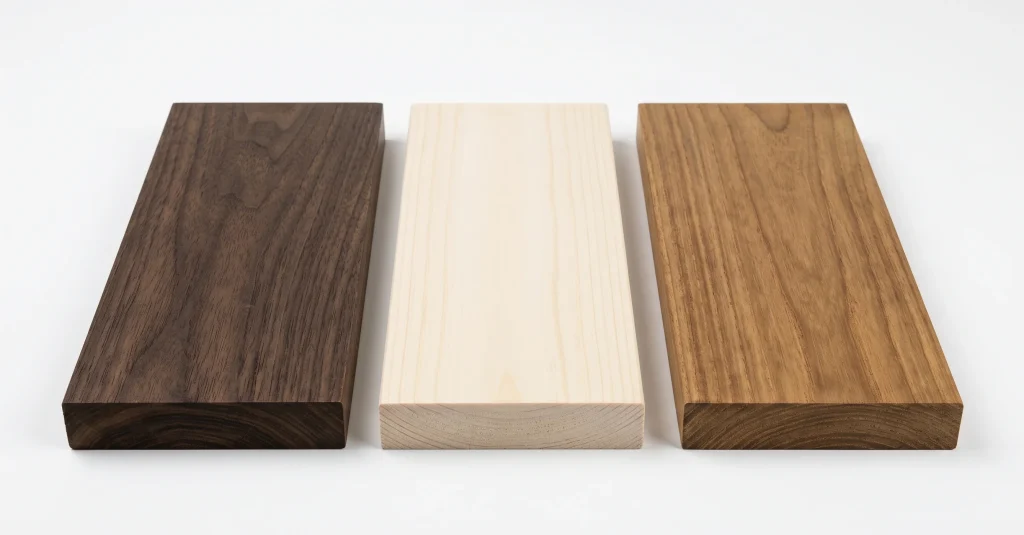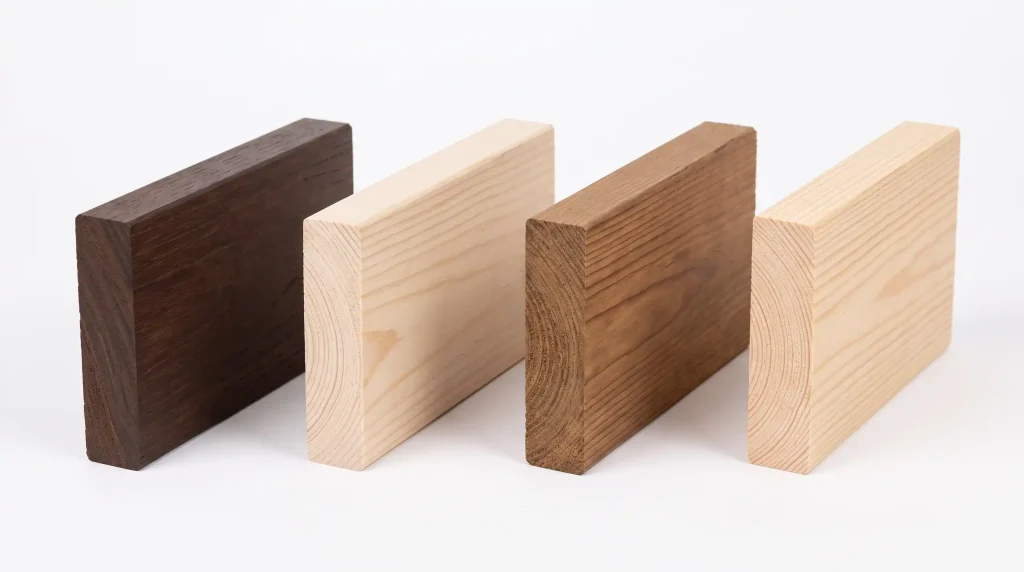
Fire Resistant Timber — Euroclass B Performance, Building Regulations, and Specification Guidance
Fire resistant performance has become one of the most consequential material specification decisions in UK and European construction. Following the Grenfell Tower fire in 2017 and the subsequent revision of Approved Document B, the fire classification of external cladding materials is now a regulatory requirement on a defined and expanding range of building types — not an optional enhancement. For architects and specifiers working on buildings above 11 metres, or on any project where fire safety is a client, insurer, or planning authority requirement, understanding the Euroclass fire resistant performance system and how timber products perform within it is essential specification knowledge.
The specification challenge with timber is that it is an organic, combustible material. Untreated hardwood and softwood typically achieve Euroclass D under EN 13501-1 — a rating that permits a degree of contribution to fire, limits the range of buildings on which it can be used, and requires fire retardant treatment before it can be specified on buildings where higher performance is mandated. The path from Euroclass D to fire resistant Euroclass B — the highest classification achievable for timber — involves either applied fire retardant treatment or, in the case of furan resin modified hardwood, a material-level fire resistant performance that derives from the modification process itself.
This guide explains the Euroclass fire performance classification system, what building regulations require and at which building heights, the distinction between material-level and system-level fire performance, the two principal approaches to achieving Euroclass B in timber, and how furan resin modification produces fire resistant performance without applied retardant chemistry.
The Euroclass Fire Performance Classification System
The Euroclass system — established under EN 13501-1, the European standard for the reaction to fire classification of construction products — provides the framework within which all construction materials in the UK and EU are classified for fire performance. It replaced the legacy UK national classification system (Class 0, 1, 2 under BS 476) as the primary reference in Building Regulations guidance.
The Euroclass system classifies materials from Class A1 (non-combustible — the highest performance) to Class F (no performance determined). For timber and wood-based products, the achievable range extends from Class D (the typical untreated performance) to Class B — the highest classification any organic material can achieve.
The Full Euroclass Classification for Timber
A complete Euroclass fire resistant performance declaration for a timber or wood-based product consists of three elements, each tested independently under EN 13501-1:
| Component | Symbol | What It Measures | Range for Timber |
|---|---|---|---|
| Reaction to fire class | A1, A2, B, C, D, E, F | Contribution to fire — flame spread, heat release | D (untreated) to B (treated or modified) |
| Smoke production | s1, s2, s3 | Amount of smoke generated | s1 (minimal) to s3 (significant) |
| Flaming droplets | d0, d1, d2 | Burning particles or droplets falling from the material | d0 (none) to d2 (significant) |
A full classification statement for a fire resistant timber product therefore reads as three components combined — for example, B-s2-d0 — where B describes flame spread behaviour, s2 describes smoke production, and d0 confirms no flaming droplets or particles. All three elements must be tested and declared together under EN 13501-1 for the classification to be valid.
Why the d0 Designation Matters
The d0 suffix — indicating no flaming droplets or particles — is particularly significant for exterior cladding and decking applications. Flaming droplets from a burning façade represent a secondary ignition mechanism: burning material falling from the cladding can ignite combustible materials at ground level or on adjacent floors below the fire origin, causing fire to spread beyond the immediate zone of the initial ignition event.
A d0 rating eliminates this secondary ignition risk from the cladding material itself. For rooftop decking, balconies, and façade cladding on occupied buildings, the d0 designation provides assurance to building control officers, fire engineers, and insurers that the specified material will not contribute to fire spread through falling burning debris. This distinction is why B-s2-d0 — the classification achievable for Ultimate FBR — represents a more complete fire safety specification than a B-s3-d1 product with equivalent reaction-to-fire class but higher smoke production and flaming droplet risk.
Euroclass B vs Class 0: Understanding the Transition
Many UK construction professionals are more familiar with the legacy Class 0 classification under BS 476 than with the Euroclass system. Class 0 was achieved by passing two separate tests under BS 476 Parts 6 and 7, and was broadly equivalent to Euroclass B in terms of performance level. Class 0 has been phased out of UK Building Regulations guidance in favour of the Euroclass system. Specifiers writing current specifications should reference Euroclass designations under EN 13501-1 rather than BS 476 Class 0 — though they may encounter Class 0 references in legacy documentation or from manufacturers whose certification pre-dates the transition.
What Building Regulations Require: Height Thresholds and Fire Performance
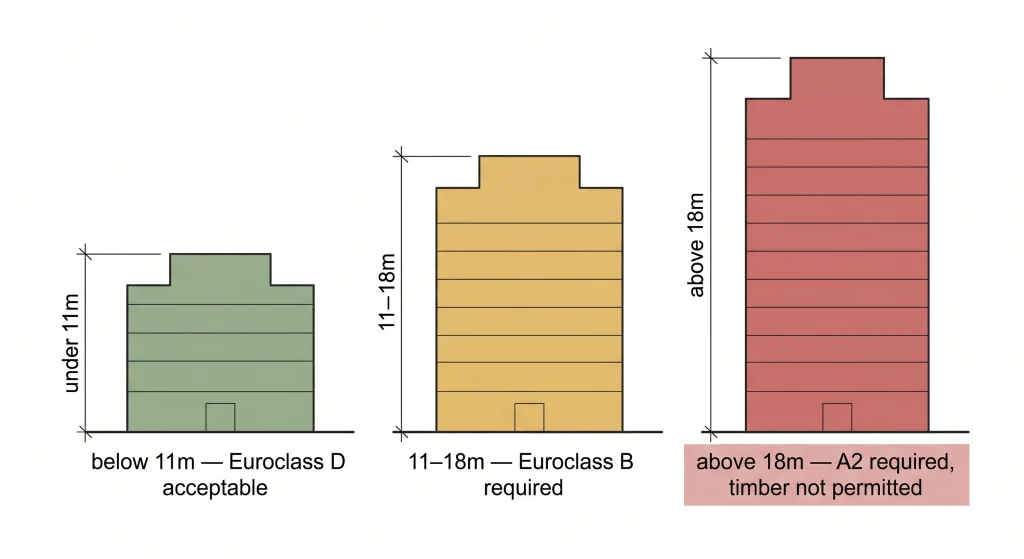
The fire resistant performance requirements for external cladding and decking in England are set out in Approved Document B (Fire Safety), updated following the Grenfell Tower fire and subsequent inquiry. The key thresholds are based on building height measured from ground level to the floor of the highest storey.
Buildings Above 18 Metres
For residential buildings above 18 metres — defined as higher-risk buildings under the Building Safety Act 2022 — external wall systems must achieve Euroclass A2-s1,d0 or better across all components of the assembly. An organic material such as timber cannot achieve Class A2 or A1. Timber cladding — fire retardant treated or otherwise — cannot be used on the external walls of residential buildings above 18 metres in England. Timber may still be used for specific secondary elements such as window frames and door frames, subject to the requirements applicable to those elements.
Buildings Between 11 and 18 Metres
For buildings between 11 and 18 metres in height — including residential, commercial, educational, and healthcare buildings — external cladding systems must achieve Euroclass B or better. For timber cladding, this means achieving Euroclass B classification at material level through fire retardant treatment or — in the case of furan resin modified hardwood — through the modification process itself.
It is critical to note that the Euroclass B requirement applies to the system, not the material in isolation. The performance of the full assembly — cladding board, cavity configuration, cavity barrier specification, and substrate — must be assessed at system level. A material with a Euroclass B material classification may not achieve Euroclass B performance when assessed as part of a specific system configuration. System-level test data or a fire engineering assessment is required to confirm compliance.
Buildings Below 11 Metres
For buildings below 11 metres in height, Approved Document B does not mandate a specific Euroclass fire resistant performance for external cladding. Standard untreated timber cladding (Euroclass D) is acceptable for most applications. However, additional requirements may apply based on proximity to a boundary, occupancy type, and planning conditions. Insurers increasingly require evidence of Euroclass B performance for cladding systems on commercial and multi-occupancy buildings regardless of height, and client risk policies on larger construction programmes often specify Euroclass B as a minimum across all buildings in a development.
Two Approaches to Fire Resistant Timber: Applied Treatment vs Material Modification
There are two fundamentally different ways to achieve Euroclass B fire performance in a timber product. The first — and more common — is the application of a fire retardant treatment to standard timber. The second — available in furan resin modified hardwood — is achieving fire resistant performance as a property of the modified material itself, without any applied retardant chemistry.
Approach 1: Applied Fire Retardant Treatment
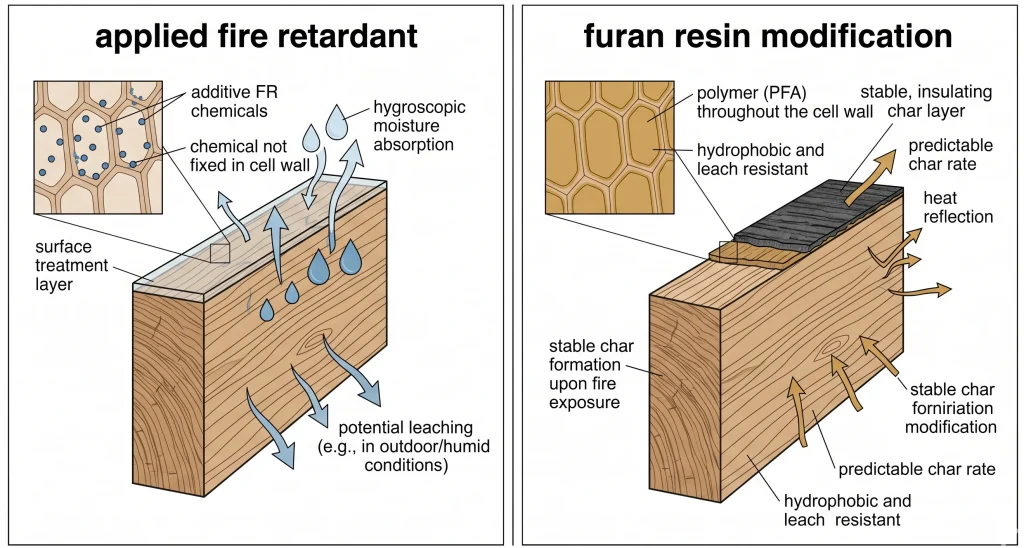
Applied fire retardant treatments work by introducing compounds — typically phosphorus-based or nitrogen-phosphorus combinations — into the timber that interrupt the combustion process. When exposed to heat, these compounds decompose and release gases that dilute combustible volatiles or promote the formation of a protective char layer.
Factory pressure impregnation is the only method that reliably achieves and can be certified to Euroclass B performance for external cladding applications. The treatment solution is forced into the timber under vacuum-pressure conditions, ensuring deep and consistent penetration. Factory pressure-impregnated fire retardant timber can be CE-marked and declared at Euroclass B under the Construction Products Regulation — a legal requirement for fire resistant timber products placed on the EU and UK markets.
Surface application — by brush, spray, or roller — does not achieve the penetration depth or consistency required for Euroclass B certification. Building Control in the UK does not accept surface-applied fire retardants as evidence of Euroclass B compliance for external cladding.
The Limitation of Applied Retardant Treatments
Applied fire retardant treatments — even factory pressure-impregnated products — introduce a maintenance and durability consideration that specifiers must address. Phosphorus-based fire retardants are hygroscopic: they absorb moisture from the atmosphere. In exterior applications, this hygroscopicity can cause surface effloresence, coating adhesion failure, and — in severe cases — leaching of retardant compounds from the timber over time.
For specifiers considering fire retardant treated timber for exterior cladding or decking, confirming the long-term performance and maintenance requirements of the specific treatment chemistry — not just the initial Euroclass B classification — is an essential due diligence step.
Approach 2: Fire Resistant Performance Through Material Modification
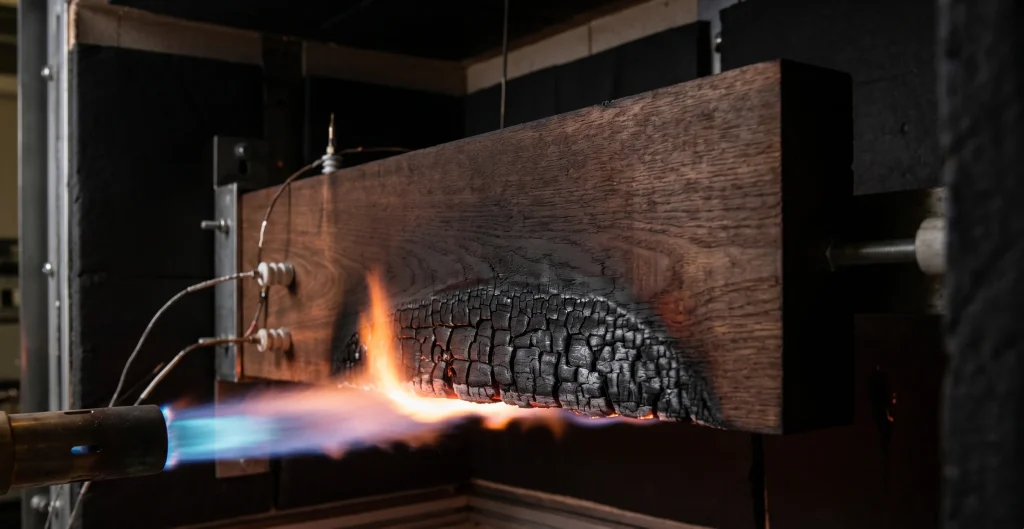
Furan resin modification produces fire resistant characteristics as a property of the modified material itself. The polyfurfuryl alcohol (PFA) polymer deposited within the cell wall during the modification process contributes to fire resistant behaviour through the formation of a stable char layer at the surface when exposed to heat. This char layer acts as an insulating barrier, reducing heat transfer to the underlying timber and slowing the progression of combustion. The char formed from PFA is denser and more cohesive than the char formed from untreated cellulosic material — it holds its geometry rather than fragmenting or spalling, which is why furan resin modified timber achieves the d0 designation rather than producing falling burning debris.
The practical consequence is that Euroclass B-s2-d0 fire performance is achievable for Ultimate FBR without the application of any fire retardant chemistry to the surface of the board. The fire resistant characteristics derive from the modification of the cell wall itself — they are intrinsic to the material and cannot be depleted by weathering or UV exposure in the way that applied retardant treatments can.
Verified Fire and Performance Data: Ultimate FBR
The fire performance and broader performance characteristics of Ultimate FBR have been independently verified by IPB University (Indonesia) and the Université de Lorraine (France), validated against EN, BS, ASTM, AWPA, and SNI standards.
| Performance Property | Untreated Hardwood | Ultimate FBR | Test Standard |
|---|---|---|---|
| Density | Baseline | 743 kg/m³ | Tested |
| Volumetric swelling | 10.04% | 2.35% | EN 350 |
| Water uptake | 109.58% | 35.07% | ASTM |
| Anti-Swelling Efficiency (ASE) | — | 44.33% | Tested |
| Durability classification | Class 3–4 (species dependent) | Class 2 | EN 350:2016 |
| Fire performance | Euroclass D (typical) | B-s2-d0 achievable | EN 13501-1 |
Why the Full Performance Profile Matters for Fire Specification
A fire retardant treated softwood board may achieve Euroclass B at material level, but if its dimensional stability is poor, its coating will fail prematurely. The compromised coating allows moisture into the substrate. The hygroscopic retardant absorbs moisture. The retardant leaches from the timber. The fire resistant performance of the material — initially compliant — degrades over time as the retardant is depleted and the coating protection fails.
Ultimate FBR avoids this failure cascade. The dimensional stability of ASE 44.33% and volumetric swelling 2.35% means the coating faces minimal mechanical stress through moisture cycling. The water uptake of 35.07% — compared to 109.58% for untreated hardwood — means the substrate remains at lower moisture content for longer. And the fire resistant characteristics of the material derive from the modification itself — they are not dependent on the continued integrity of a surface coating or the retention of a hygroscopic chemical treatment.
Applications for Fire Resistant Modified Timber
Exterior Cladding on Buildings Between 11 and 18 Metres
This is the primary regulatory application for Euroclass B fire resistant timber in UK construction. Commercial office buildings, educational facilities, healthcare premises, and residential developments in this height range all require Euroclass B performance from their external cladding systems. Furan resin modified hardwood — with its achievable material-level B-s2-d0 classification — provides a compliant timber cladding option without the maintenance complexity of applied fire retardant treatment.
Rooftop Decking and Balconies
Rooftop decking and balconies on buildings above 11 metres face the same fire performance requirements as external cladding. Untreated timber decking (Euroclass D) is not compliant in these applications. Fire resistant modified hardwood decking achieves Euroclass B-s2-d0 at material level without applied retardant treatment — when the UV-stabilising oil is renewed on the deck surface, the fire resistant performance of the substrate is unaffected.
Commercial Façades Requiring Insurance Compliance
Beyond the regulatory threshold of 11 metres, insurers are increasingly requiring Euroclass B fire performance certification for external cladding systems on commercial buildings regardless of height. The material-level Euroclass B-s2-d0 classification achievable for Ultimate FBR provides the documentation that insurers and building surveyors require — combined with responsible sourcing credentials (SVLK, FSC® Ready, PEFC™ Ready) that regulated procurement frameworks expect.
Fire Performance in the Context of the Wider Specification
Fire performance specification does not exist in isolation. A fire resistant cladding board that warps, cups, or allows coating failure will not maintain the fire performance of the assembly over the building’s service life. The specification of fire resistant modified hardwood addresses this risk directly — the dimensional stability of Ultimate FBR ensures that the cladding assembly maintains its designed geometry through seasonal moisture cycling, and the biological durability of Class 2 under EN 350:2016 ensures the material remains structurally intact across the service life of the installation.
Specifying Fire Resistant Timber: A Practical Checklist
1. What is the required fire performance classification for this building type and height? Establish the Euroclass requirement before selecting a material. Above 18 metres residential: timber is not permitted. Between 11 and 18 metres: Euroclass B required. Below 11 metres: no Approved Document B mandate, but insurer and client requirements may apply. Confirm with Building Control and the fire engineer at the earliest stage.
2. Is fire performance declared at material level or system level, and which does the application require? Material-level Euroclass B-s2-d0 confirms how the timber performs in isolation. For buildings between 11 and 18 metres, system-level confirmation is essential. Confirm whether material-level data alone is sufficient for the specific building configuration, or whether system-level test data or a fire engineering assessment is required.
3. Is fire performance achieved through material modification or applied treatment? For fire retardant treated timber: confirm factory pressure impregnation (the only certifiable method), treatment chemistry hygroscopicity, and maintenance requirements. For furan resin modified timber: confirm that B-s2-d0 is achievable at material level without applied fire retardant chemistry and that the fire resistant characteristics are intrinsic to the modification.
4. Is the full Euroclass designation stated, including all three components? Require the complete three-component designation: reaction class (B), smoke (s1, s2, or s3), and flaming droplets (d0, d1, or d2). A declaration of “Euroclass B” without suffixes is incomplete and unverifiable.
5. Is the fire performance certification referenced to EN 13501-1 and issued by an accredited testing body? Require a certificate referencing EN 13501-1 from a UKAS-accredited or equivalent laboratory. For fire retardant treated timber, confirm CE or UKCA marking under the Construction Products Regulation.
6. Does the fire resistant specification address the complete performance profile? For Ultimate FBR: fire performance B-s2-d0 + ASE 44.33% + volumetric swelling 2.35% + Class 2 durability under EN 350:2016 + water uptake 35.07% — a complete independently verified performance profile.
7. What certifications cover responsible sourcing? Ultimate FBR carries SVLK certification (EU FLEGT recognised), FSC® Ready and PEFC™ Ready — enabling chain-of-custody certification where required.
8. Have cavity barriers been coordinated with the fire resistant cladding system? Cavity barriers must be placed at every floor level and around all openings. Their specification must be coordinated with the cladding system to ensure compatibility. Fire classification of the cladding material does not substitute for correct cavity barrier specification.
9. Has the specification been confirmed with Building Control and, where required, a fire engineer? For buildings between 11 and 18 metres, confirmation with Building Control before specification is finalised is essential. For complex or unusual building configurations, a fire engineering assessment may be required.
Frequently Asked Questions about Fire Resistant Timber
What is fire resistant timber?
Fire resistant timber is wood that has been treated or modified to improve its reaction-to-fire performance — reducing its contribution to flame spread, smoke production, and flaming droplet generation when exposed to fire. In European and UK construction, fire resistant timber is classified under EN 13501-1. The highest classification achievable for any timber product is Euroclass B. Fire resistant timber achieving Euroclass B-s2-d0 demonstrates limited flame spread (B), moderate smoke production (s2), and no flaming droplets or particles (d0).
What Euroclass rating does timber achieve?
Untreated hardwood and softwood typically achieve Euroclass D under EN 13501-1. Through factory pressure-impregnated fire retardant treatment, or through the modification properties of furan resin modified hardwood, timber can achieve Euroclass B — the highest classification available to any organic material. Timber cannot achieve Euroclass A1 or A2, which are reserved for non-combustible and limited combustibility materials. The complete Euroclass declaration always includes three components: reaction class (A1–F), smoke production suffix (s1–s3), and flaming droplets suffix (d0–d2).
Is timber cladding allowed on buildings over 11 metres?
In England, timber cladding is permitted on buildings between 11 and 18 metres in height, subject to the external wall system achieving Euroclass B performance. Timber cladding is not permitted on residential buildings above 18 metres, where Euroclass A2-s1,d0 or better is required across all external wall system components. The requirements in Scotland, Wales, and Northern Ireland differ from those in England — specifiers working across jurisdictions should confirm the applicable regulations in each territory.
What is the difference between Euroclass B and Class 0?
Class 0 was the UK national classification under BS 476 Parts 6 and 7, broadly equivalent in performance level to Euroclass B but assessed under different test methodologies. Class 0 has been phased out of Approved Document B in favour of the Euroclass system. Specifiers should use Euroclass designations under EN 13501-1 in current specifications — Class 0 references should be treated as legacy terminology.
How do you make timber fire resistant?
There are two principal approaches to achieving Euroclass B fire resistant performance. The first is factory pressure-impregnated fire retardant treatment — surface application does not achieve certifiable Euroclass B performance and is not accepted by Building Control. The second approach — available in furan resin modified hardwood such as Ultimate FBR — is achieving fire resistant characteristics through modification of the cell wall itself, producing Euroclass B-s2-d0 performance at material level without applied fire retardant chemistry.
What is the B-s2-d0 fire rating?
B-s2-d0 is a complete Euroclass fire performance classification under EN 13501-1, comprising three independently tested components. B indicates very limited contribution to fire. s2 indicates moderate smoke production. d0 indicates no flaming droplets or particles — burning material does not fall from the product during a fire event. The d0 designation is particularly important for exterior cladding and decking applications, eliminating the secondary ignition risk associated with falling burning debris. B-s2-d0 is the achievable fire performance classification for Ultimate FBR modified hardwood under EN 13501-1, confirmed at material level without applied fire retardant treatment.
Can timber achieve Class A fire rating?
No. Class A1 and A2 are reserved for non-combustible and limited combustibility materials — stone, brick, concrete, certain metal composites. Timber is an organic, combustible material and cannot achieve Class A1 or A2 regardless of treatment. The highest Euroclass classification achievable by any wood-based product is Class B. This means timber cladding cannot be used on residential buildings above 18 metres in England, where Euroclass A2-s1,d0 or better is required across all external wall system components.
Does fire retardant treatment affect the dimensional stability of timber?
Applied fire retardant treatments — particularly phosphorus-based compounds — can increase the hygroscopicity of the treated timber, causing it to absorb moisture more readily than untreated timber of the same species. This can contribute to dimensional movement, surface effloresence, and leaching of retardant compounds over time. Furan resin modified hardwood achieves fire resistant performance through material modification — without introducing hygroscopic compounds — and maintains dimensional stability of ASE 44.33% and volumetric swelling of 2.35% alongside its fire classification. This combination addresses both fire performance and long-term coating integrity in a single material specification.
B-s2-d0 classification breakdown (EN 13501-1):
| Component | Designation | Meaning |
|---|---|---|
| Reaction to fire | B | Very limited contribution to fire — does not significantly propagate flame |
| Smoke production | s2 | Moderate smoke production |
| Flaming droplets | d0 | No flaming droplets or particles — eliminates secondary ignition risk |
UK building height thresholds (Approved Document B):
- Above 18m (residential): Euroclass A2-s1,d0 required — timber not permitted.
- 11m to 18m: Euroclass B required — Ultimate FBR B-s2-d0 compliant at material level.
- Below 11m: No Euroclass mandate from ADB — insurer/client requirements may apply.
Ultimate FBR fire performance:
- Classification: B-s2-d0 achievable (EN 13501-1).
- Achieved through furan resin modification — no applied fire retardant treatment required.
- Fire resistant characteristics are intrinsic to the cell wall modification — not coating-dependent.
- d0 designation: no flaming droplets → no secondary ignition risk from falling burning debris.
Full performance profile alongside fire classification:
ASE 44.33% · Swelling 2.35% · Water uptake 35.07% · Density 743 kg/m³ · Class 2 durability (EN 350:2016).
Independent verification: IPB University (Indonesia) & Université de Lorraine (France).
Certifications: SVLK (EU FLEGT) · FSC® Ready · PEFC™ Ready.
Supply: Houtplex B.V., Netherlands · Wood United Pte Ltd, Singapore.
Specify Fire Resistant Timber with Verified Performance Data
Fire performance specification is not complete at the point of selecting a material with a Euroclass B classification. It requires confirmation of the complete Euroclass designation including smoke and droplet suffixes, verification that the classification is certified by an accredited testing body under EN 13501-1, system-level assessment where required by building height and Approved Document B, and coordination of cavity barriers with the cladding system.
Ultimate FBR modified hardwood delivers Euroclass B-s2-d0 fire performance at material level — without applied fire retardant chemistry — alongside independently verified performance data: ASE 44.33% and volumetric swelling 2.35% for dimensional stability, Class 2 durability under EN 350:2016 for biological resistance, density 743 kg/m³, and water uptake 35.07%. Testing conducted by IPB University and the Université de Lorraine, France, validated against EN, BS, ASTM, AWPA, and SNI standards. SVLK certification and FSC® Ready and PEFC™ Ready status complete the sourcing credentials required for regulated procurement.
For project-specific fire performance documentation, technical data, sizing requirements, or supply enquiries, contact the Ultimate FBR team via the contact form. European supply is through Houtplex B.V. in Haaksbergen, Netherlands; Asian and Pacific markets through Wood United Pte Ltd in Singapore — both part of the Wood United Group.