Modified Timber Comparison: Furan Resin, Acetylation, Thermal Modification and Preservative Treatment
Modified timber covers four distinct technologies — furan resin modification, acetylation, thermal modification, and preservative treatment — each producing different density, dimensional stability, fire performance, and structural suitability outcomes. No single technology leads on every criterion; the correct specification depends on the application, building height, fire classification requirement, and EUDR sourcing obligations of the project.
Modified timber is not a single material. Four commercially distinct technologies — furan resin modification (furfurylation), acetylation, thermal modification, and preservative treatment — each produce a different performance profile, a different effect on density and structural integrity, and a different set of trade-offs for B2B specification. The most common modified timber comparisons available to architects and specifiers cover three of these four technologies: acetylated timber (Accoya), thermally modified timber (Thermory, Lunawood), and furfurylated softwood (Kebony). The fourth — furan resin modified hardwood — is absent from every comparison currently available, despite offering a performance profile that no softwood-based modification technology can match on density, fire performance, and sourcing documentation.
This comparison covers all four technologies using independently verified data, referenced to named standards, with no manufacturer warranty claims presented without qualification. The goal is a decision framework that a specifier can defend.
The Four Modified Timber Technologies: What Each Process Does
Furan resin modification (furfurylation — hardwood) impregnates timber with furfuryl alcohol under vacuum-pressure conditions. Furfuryl alcohol — derived from agricultural waste including sugarcane bagasse and corn cobs — polymerises in situ within the cell wall as polyfurfuryl alcohol (PFA), a thermosetting resin that bonds covalently with cellulose, hemicellulose, and lignin. The result is a denser, harder, more dimensionally stable material. Critically: density increases relative to the untreated baseline. This is the technology used in Ultimate FBR, produced from Indonesian hardwood and verified by IPB University and the Université de Lorraine.
Acetylation (hardwood and softwood) reacts the cell wall’s free hydroxyl groups with acetic anhydride, converting them permanently to acetyl groups. No mass is added and no polymer is deposited — it is a chemical substitution, not an infill. The result is a timber with very high dimensional stability and, for radiata pine substrate, Class 1 durability under EN 350. Density decreases slightly versus the untreated baseline. The most prominent commercial product is Accoya.
Thermal modification exposes timber to temperatures of 160–230°C in a low-oxygen or steam environment, degrading the hemicellulose fraction — the most hygroscopic cell wall component — to reduce moisture uptake and improve dimensional stability. No chemical reagents are introduced. The trade-off is mechanical: the same heat that improves moisture performance reduces bending strength and toughness by approximately 10–30% relative to the untreated baseline, limiting structural suitability. Commercial products include Lunawood (ThermoWood process) and Thermory.
Preservative treatment introduces biocidal compounds — typically copper-based — into the timber under pressure. The cell wall structure is unaltered. Durability depends on the continued presence and efficacy of the biocide, which depletes through weathering and leaching over time. End-of-life disposal is restricted in many jurisdictions due to biocidal content.
Side-by-Side Performance Comparison
The table below covers five material categories across the criteria most relevant to exterior and joinery specification in EU and UK markets. Data for Ultimate FBR is independently verified; data for other technologies is drawn from published manufacturer technical documentation and peer-reviewed research.
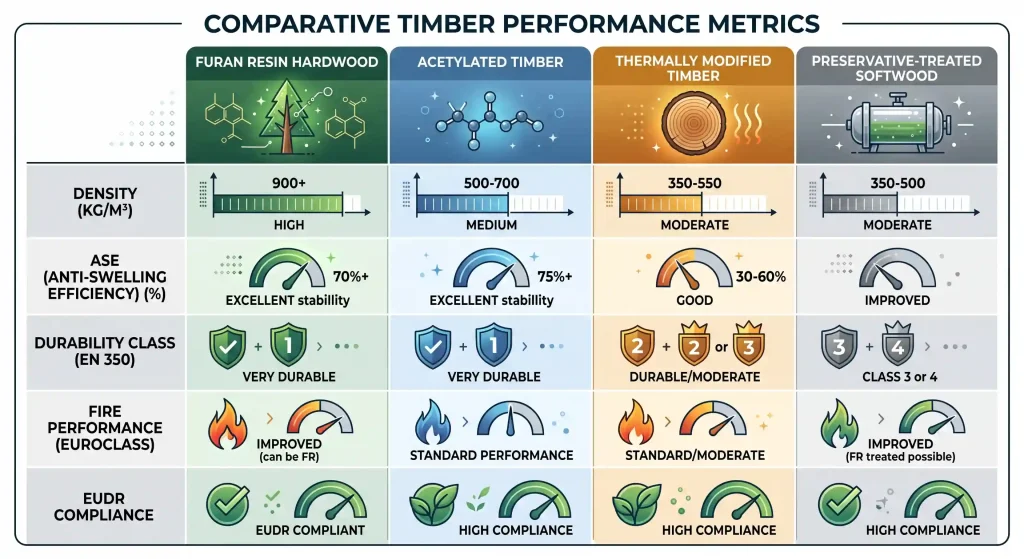
| Property | Furan Resin Hardwood (Ultimate FBR) | Acetylated (Accoya) | Thermally Modified (Lunawood/Thermory) | Preservative-Treated Softwood | Untreated Hardwood |
|---|---|---|---|---|---|
| Modification mechanism | Polymer infill — covalent bonding | Chemical hydroxyl substitution | Hemicellulose degradation by heat | Biocidal impregnation | None |
| Effect on density | Significant increase — 743 kg/m³ (verified) | Slight decrease | Decrease ~5–15% | No change | Baseline |
| Typical ASE range | 44.33% (verified) | 50–65% (published) | 20–40% (published) | N/A | 0% |
| Durability class (EN 350:2016) | Class 2 — full cross-section, verified | Class 1 — radiata pine (typical) | Class 2–3 (typical) | Class 2–3 (treatment dependent) | Class 3–4 (species dependent) |
| Structural suitability | Yes | Yes | Limited — bending strength reduced | Yes | Yes |
| Fire performance (EN 13501-1) | B-s2-d0 achievable | Euroclass D (typical) | Variable | Variable | Euroclass D |
| Biocidal chemistry | None | None | None | Yes — copper-based | None |
| Fixing requirement | Standard stainless/hot-dip galvanised | Stainless/hot-dip required | Standard stainless/galvanised | Hot-dip galvanised required | Standard |
| Feedstock | Hardwood + bio-based modifier (agri-waste) | Softwood (radiata pine) + acetic anhydride | Softwood (pine, ash, spruce) | Softwood | Hardwood |
| EUDR compliance burden | Low — SVLK FLEGT recognised | Low–medium | Low–medium | Low | High (tropical species) |
| Sourcing certification | SVLK · FSC® Ready · PEFC™ Ready | FSC certified | Typically FSC/PEFC | Variable | Variable |
| End-of-life | Standard wood waste / energy recovery | Standard wood waste / energy recovery | Standard wood waste / energy recovery | Restricted — biocidal content | Standard |
Reading the Comparison: What the Data Means for Specification
Density — the underrated criterion
Every comparison of modified timber technologies focuses heavily on dimensional stability (ASE) and durability class. Density receives less attention — but for decking, cladding, and joinery applications where surface hardness, indentation resistance, and fastener pull-through strength matter, it is a specification-relevant criterion.
Furan resin modification is the only technology in this comparison that increases density relative to the untreated baseline. Ultimate FBR is verified at 743 kg/m³ — firmly in the hardwood range. Thermal modification reduces density: the same heat that improves stability degrades the hemicellulose fraction that contributes to wood mass and hardness. Acetylation produces a slight density reduction. For commercial decking and high-traffic cladding where surface wear resistance matters, this distinction is consequential.
ASE — stability versus stability
Acetylated timber achieves the highest ASE values of any commercial modification technology — typically 50–65% for Accoya in published technical data. Furan resin modification achieves 40–50%, with Ultimate FBR independently verified at 44.33%. Thermal modification achieves 20–40%.
For most exterior cladding and decking in standard UK and European exposure conditions, ASE 44.33% provides dimensional stability well above what a well-detailed assembly requires. The additional stability margin of acetylated timber becomes relevant in extreme exposure — coastal locations, north-facing elevations with minimal solar drying, frames without protective overhangs — where the extra 10–15 percentage points may justify the trade-off of slightly reduced density and mandatory stainless steel fixings.
Fire performance — a decisive differentiator
Neither acetylated nor thermally modified timber achieves Euroclass B fire classification at material level under EN 13501-1. Both typically achieve Euroclass D — the standard classification for untreated timber.
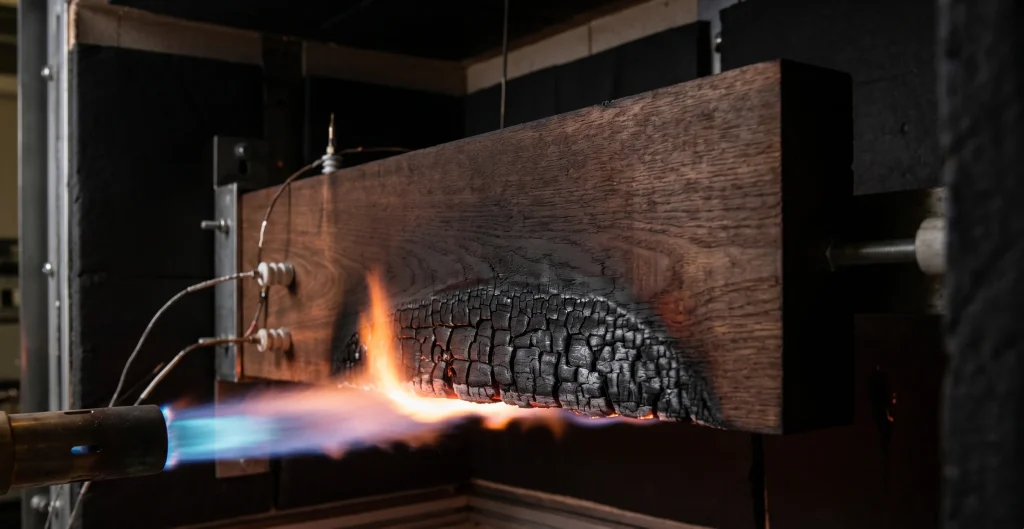
Euroclass B-s2-d0 is achievable for Ultimate FBR modified hardwood through the modification chemistry itself: the polyfurfuryl alcohol polymer contributes to stable char formation under fire exposure, producing limited flame propagation (B), moderate smoke (s2), and no flaming droplets (d0). For exterior cladding and decking on buildings between 11 and 18 metres — where Approved Document B requires Euroclass B — this is a decisive specification differentiator that no competing modification technology currently matches at material level.
EUDR sourcing — the 2026 compliance variable
Modified timber from European or North American forestry — thermally modified pine, spruce, and ash — carries a relatively low EUDR compliance burden. Acetylated timber from radiata pine occupies a middle position. Indonesian hardwood with SVLK certification occupies an advantageous position: SVLK’s EU FLEGT recognition means the legality dimension of EUDR compliance is addressed by the SVLK V-Legal document, simplifying due diligence relative to tropical hardwood without FLEGT recognition. Distribution through Houtplex B.V. in Haaksbergen, Netherlands provides an EU-based supply chain entry point for Due Diligence Statement submission.
Application-Based Selection: Which Technology for Which Use Case
Where furan resin modified hardwood leads
Exterior cladding on buildings 11–18m (Euroclass B required): The only modification technology achieving Euroclass B-s2-d0 at material level without applied fire retardant treatment — combined with ASE 44.33% and Class 2 durability.
Commercial decking and high-traffic applications: Density 743 kg/m³ — harder than thermally modified alternatives — provides surface indentation resistance measurably better than products where modification reduces density.
EUDR-constrained procurement: SVLK FLEGT recognition provides a more operationally straightforward EUDR compliance pathway, with Houtplex B.V. providing EU distribution infrastructure for DDS submission.
Exterior joinery (windows, doors, frames): ASE 44.33% and Class 2 durability without biocidal retreatment. Compatible with standard exterior fixings — no mandatory stainless steel specification required.
Where acetylated timber leads
Precision joinery in extreme exposure: ASE 50–65% — the highest dimensional stability of any commercial modification technology. For window frames on coastal or highly exposed elevations, acetylated timber holds the advantage where the additional stability margin is worth the fixing specification implications.
Projects contractually specifying Class 1 durability: Where Class 1 is a non-negotiable contractual requirement rather than a performance threshold, acetylated timber is the appropriate specification.
Where thermally modified timber leads
Lower-cost cladding in non-structural, low-rise applications: The most cost-accessible modified timber technology for exterior cladding where surface hardness and structural loading are not specification requirements.
Interior applications in demanding humidity environments: Saunas, pool surrounds, high-humidity changing rooms — where stability improvement is sufficient, structural limitations are irrelevant, and lower cost per cubic metre is a genuine benefit.
Frequently Asked Questions about Modified Timber
What is the difference between Accoya and Kebony?
Accoya uses acetylation — chemical substitution of hydroxyl groups with acetic anhydride — on FSC-certified radiata pine, producing Class 1 durability and very high dimensional stability (ASE 50–65%) with a slight density reduction. Kebony uses furfurylation on softwood species including pine and spruce, producing improved durability and hardness on a lower-density substrate. Ultimate FBR applies furan resin modification to hardwood, producing a denser and harder result with independently verified ASE 44.33% and Euroclass B-s2-d0 fire performance — a combination unavailable from either Accoya or Kebony at material level.
Which modified timber is best for exterior cladding?
For cladding on buildings between 11 and 18 metres where Euroclass B is required, modified timber achieving Euroclass B-s2-d0 at material level — Ultimate FBR — is the only option among commercial modification technologies that does not require applied fire retardant treatment. Below 11 metres where Euroclass D is acceptable, thermally modified timber is the most cost-accessible option; acetylated timber offers the highest dimensional stability for extreme exposure conditions.
Is Accoya better than thermally modified wood?
Accoya achieves higher ASE (50–65% vs 20–40%), Class 1 durability, and maintains bending strength better than thermally modified wood — making it more appropriate for precision joinery and structural applications. Thermally modified timber is chemical-free, lower in cost, and adequate for above-ground cladding where Class 2–3 durability is sufficient. For applications requiring fire performance above Euroclass D, neither technology achieves this at material level without applied treatment — which is where furan resin modified hardwood provides a distinct advantage.
How long does modified timber last?
Service life depends on technology, application Use Class, and installation detailing. Accoya’s commercial warranty is 50 years above ground; Kebony and Lunawood typically publish 30-year service life expectations. Furan resin modified hardwood with Class 2 durability under EN 350:2016 — such as Ultimate FBR — is designed for 15–25 years in above-ground Use Class 3.2 conditions without biocidal retreatment. For all modified timber products, detailing quality — drainage, cavity ventilation, end-grain protection — is as influential as material classification in determining actual service life.
What is the most dimensionally stable modified timber?
Acetylated timber (Accoya) achieves the highest published ASE values — typically 50–65%. Furan resin modification achieves 40–50%, with Ultimate FBR independently verified at 44.33%. Thermal modification achieves 20–40%. For most above-ground cladding, decking, and joinery in standard European exposure conditions, furan resin modification at 44.33% provides more than adequate dimensional stability. Acetylation’s additional margin becomes relevant in extreme exposure conditions.
Can modified timber be used for structural applications?
Furan resin modification and acetylation do not significantly reduce bending strength — both can be used in structural and load-bearing applications. Thermal modification reduces bending strength and impact resistance by approximately 10–30% relative to the untreated baseline; thermally modified timber should not be specified for structural use without engineering assessment. Ultimate FBR is appropriate for non-structural exterior applications including cladding, decking, window frames, door frames, and joinery.
How does modified timber compare to tropical hardwood?
Tropical hardwood species — ipe, cumaru, iroko — offer Class 1–2 natural durability and high density without modification. The 2025 CITES Appendix II listing of ipe and cumaru adds permit requirements to every shipment; the EU Deforestation Regulation adds geolocation and DDS requirements for all tropical timber placed on the EU market. Modified timber from SVLK-certified Indonesian supply provides comparable or superior performance with a more operationally manageable EUDR compliance pathway. For fire performance, furan resin modified hardwood at Euroclass B-s2-d0 outperforms tropical hardwood (typically Euroclass D) without any applied treatment.
Specify the Technology That Matches the Application
Modified timber comparison is not a ranking exercise — it is a specification tool. Acetylated timber leads on dimensional stability for extreme exposure joinery. Thermally modified timber leads on cost for non-structural, low-rise cladding. Furan resin modified hardwood leads on density, fire performance, and EUDR compliance pathway for commercial cladding, regulated-height buildings, and applications where sourcing documentation is a project constraint.
Ultimate FBR delivers Class 2 durability under EN 350:2016 uniform throughout the board, ASE 44.33%, density 743 kg/m³, and Euroclass B-s2-d0 fire performance — tested by IPB University and the Université de Lorraine — alongside SVLK certification and FSC® Ready and PEFC™ Ready sourcing credentials. Available in 12–32mm × 90–285mm × 900–5900mm through Houtplex B.V. in Haaksbergen, Netherlands and Wood United Pte Ltd in Singapore.
For technical documentation or project-specific supply enquiries, contact the team via the contact form.