Timber Door Frames — Specifying Modified Hardwood for Long-Term Performance
Timber door frames fail when the frame material moves too much and absorbs moisture too readily — causing paint film cracking, seal failure, hardware misalignment, and sill rot. The specification decision that prevents these outcomes rests on two independently verifiable figures: the dimensional stability of the frame material and its biological durability classification without retreatment.
Why Timber Door Frames Fail: The Dimensional Stability Mechanism
Timber absorbs water vapour and liquid water through the free hydroxyl groups in its cell wall — the same mechanism that drives dimensional movement in window frames, cladding boards, and decking. In a door frame, the consequences of this movement are more mechanically constrained than in other applications, because the frame must maintain precise geometry relative to a moving leaf, a fixed threshold, and hardware with defined tolerance ranges.
The cascade of failure that follows from dimensional instability in an exterior door frame proceeds in four distinct stages.
Paint film failure. Every moisture cycling event stretches and relaxes the coating applied over the frame surface. Paint films have finite elasticity. Once micro-cracking begins — at the junction between frame and threshold, the corners of the rebate, the end grain at the sill — moisture infiltration accelerates, the coating loses adhesion, and delamination follows. The refinishing interval for a dimensionally unstable frame is set by the movement of the substrate, not by the coating manufacturer’s specification.
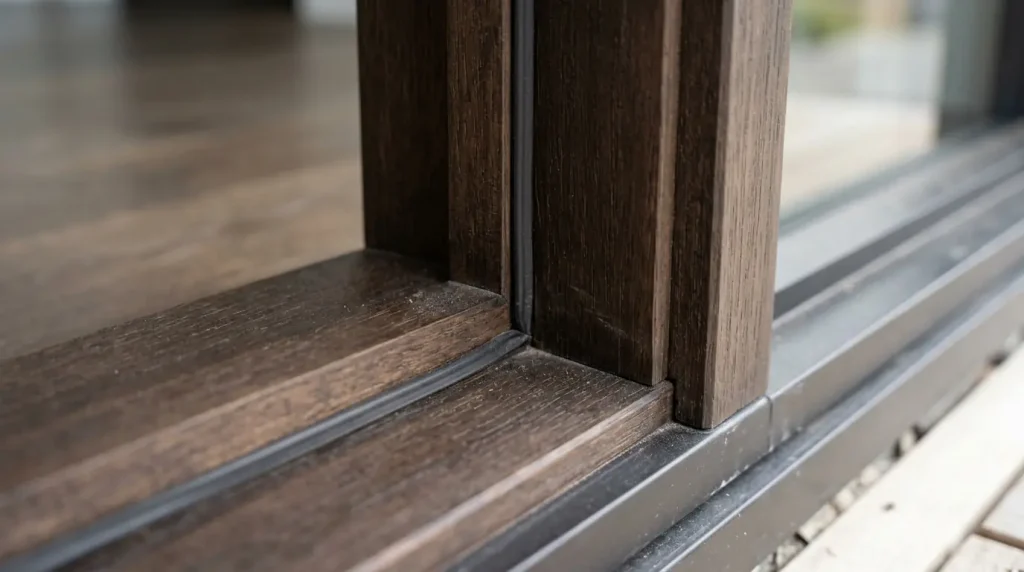
Seal and weatherstrip failure. The weatherstrip between the door leaf and the frame is designed to accommodate small amounts of differential movement. When the frame moves beyond the tolerance of these components — which happens faster with unstable substrates in severe exposure — the seal opens, draughts and moisture infiltrate, and the thermal performance of the doorset deteriorates.
Hardware misalignment. A multipoint locking system is designed to engage at precise points defined by the frame geometry at installation. When the frame swells in wet weather and contracts in dry, the geometry changes. Locking points that engaged cleanly in autumn may require force in winter. Each adjustment is a maintenance intervention; each period of misalignment is a security and weathertightness exposure.
Sill rot. The door sill is the most moisture-vulnerable component of any exterior timber door frame. It is subject to rain splash, foot traffic, pooling water at the threshold, and end-grain exposure where water is absorbed fastest. In an inadequately durable frame material, fungal attack begins at the sill end grain and progresses inward. By the time surface evidence is visible, structural integrity has already been compromised.
Standards for Timber Door Frames
Exterior timber door frames in UK and European markets are governed by overlapping standards that define performance requirements, test methods, and material quality thresholds.
BS EN 14351-1:2006+A2:2016 is the principal harmonised standard for windows and external pedestrian doorsets. It defines the performance characteristics that manufacturers must declare — resistance to wind load, air permeability, watertightness, thermal transmittance, and resistance to repeated opening and closing. For door frames specifically, resistance to repeated operating cycles — the mechanical durability of the frame under the loading of daily use over the design life — is a declared characteristic distinct from window frame requirements.
BS 644:2009 covers the specification of fully finished factory-assembled timber windows and doorsets. It references material requirements including species selection, moisture content at delivery, and joinery quality. Like the window equivalent, BS 644 does not specify a minimum dimensional stability requirement expressed as an Anti-Swelling Efficiency figure — the dimensional stability burden falls on the specifier to verify independently.
EN 350:2016 classifies the biological durability of timber for the use class relevant to the application. For exterior door frames in above-ground, sheltered exposure — Use Class 3.1 — minimum Class 2 durability is appropriate for timber without biocidal retreatment. For frames in more exposed conditions where the sill is subject to intermittent wetting — Use Class 3.2 — the same Class 2 minimum applies, but with greater consequence if not met.
The gap in the standards framework that most directly affects door frame specification is that none of these standards specifies a minimum ASE or volumetric swelling figure for the frame material. Specifiers who require dimensional stability data must obtain it directly from the timber manufacturer or modifier — referenced to a named test standard and verified by an independent testing body.
Modified Hardwood for Timber Door Frames: Verified Performance Data
Furan resin modification addresses the root causes of door frame failure at the cell wall level. The polyfurfuryl alcohol polymer deposited during modification permanently reduces the free hydroxyl groups available to attract water, physically bulks the cell wall to reduce moisture uptake volume, and produces a material whose performance has been independently verified by IPB University (Indonesia) and the Université de Lorraine (France) against EN, BS, ASTM, AWPA, and SNI standards.
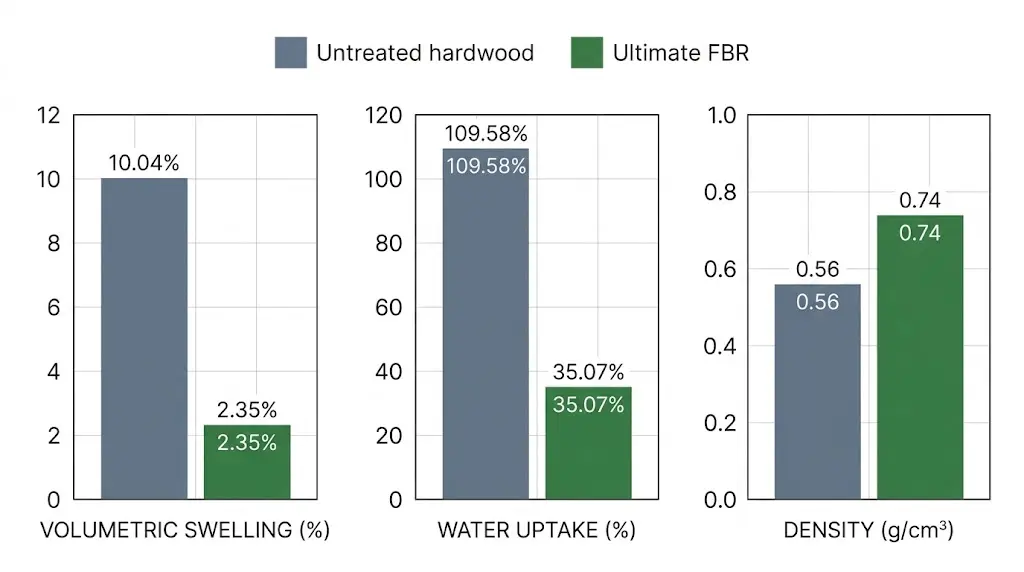
The performance of timber door frames produced from Ultimate FBR modified hardwood compares to the untreated baseline as follows:
| Performance property | Untreated hardwood | Ultimate FBR | Test standard |
|---|---|---|---|
| Density | Baseline | 743 kg/m³ | Tested |
| Volumetric swelling | 10.04% | 2.35% | EN 350 |
| Water uptake | 109.58% | 35.07% | ASTM |
| Anti-Swelling Efficiency (ASE) | — | 44.33% | Tested |
| Durability classification | Class 3–4 (species dependent) | Class 2 | EN 350:2016 |
| Fire performance | Not classified | B-s2-d0 achievable | EN 13501-1 |
What the Figures Mean for Door Frame Specification
ASE 44.33% / Volumetric swelling 2.35% determines hardware alignment over the service life of the doorset. A 70mm door frame section in untreated hardwood at 10.04% volumetric swelling moves approximately 3.5mm across its width between dry and saturated conditions. The same section in Ultimate FBR at 2.35% moves approximately 0.8mm. That 2.7mm differential is the difference between a multipoint locking system that engages reliably throughout the year and one that requires seasonal adjustment.
Water uptake 35.07% vs 109.58% means the frame responds far less dramatically to rain events, condensation, and seasonal humidity changes — spending less time at elevated moisture content, and therefore less time in the range above approximately 20% at which fungal activity can occur.
Class 2 durability (EN 350:2016) — verified by independent testing, applying uniformly to the full frame section cross-section — confirms that the material will resist fungal attack in Use Class 3.1 and 3.2 conditions for the design life of the installation, without biocidal retreatment.
Density 743 kg/m³ gives the frame section appropriate resistance to mechanical damage from door impact, hardware installation stress, and the repeated loading of daily operating cycles.
Door Frame Material Comparison
| Property | Untreated hardwood | Furan resin modified (Ultimate FBR) | Acetylated timber | Thermally modified |
|---|---|---|---|---|
| Dimensional stability | Low — significant movement | Very high — ASE 44.33%, swelling 2.35% | Very high — ASE 50–65% (typical) | Moderate–high — ASE 20–40% |
| Durability class (EN 350) | Class 3–4 (species dependent) | Class 2 (full cross-section, verified) | Class 1 (typical) | Class 2–3 (typical) |
| Density | Baseline | 743 kg/m³ (increased) | Slightly decreased | Decreased |
| Water uptake | 109.58% (baseline) | 35.07% | Very low | Moderate |
| Fixing requirement | Standard | Standard stainless/galvanised | Stainless/galvanised required | Standard stainless/galvanised |
| Fire performance | Standard | B-s2-d0 achievable | Euroclass D (typical) | Variable |
| EUDR compliance | High (tropical) / Medium (temperate) | Low — SVLK FLEGT recognised | Low–medium | Low–medium |
| Sourcing certification | Variable | SVLK · FSC® Ready · PEFC™ Ready | FSC certified | Typically FSC/PEFC |
Acetylation vs furan resin for door frames: Acetylated timber achieves marginally higher ASE values (50–65% vs 44.33%) and may be appropriate for door frames in very extreme exposure — coastal locations, north-facing with minimal solar drying. The trade-off is mandatory stainless steel fixings throughout due to residual material acidity, and a slight density reduction. For the majority of door frame applications in standard UK and European conditions, ASE 44.33% provides more than adequate stability, and furan resin modification offers improved density and fire performance that acetylation does not.
Thermal modification for door frames: Thermally modified timber achieves ASE 20–40% — lower than either chemical modification technology. For door frames subject to the mechanical demands of daily operating cycles and the precision requirements of multipoint hardware, the reduced density and bending strength of thermally modified timber is a specification limitation. The frame must maintain geometry under hardware loading as well as moisture cycling; thermal modification’s reduced mechanical properties make it less appropriate for this application.
Applications for Modified Hardwood Timber Door Frames
Residential Exterior Door Frames
For residential main entrance and rear door frames, frame material choice determines the maintenance schedule and hardware reliability over the installation’s service life. An untreated hardwood frame in a moderately exposed location typically requires refinishing every 3–5 years, with hardware adjustment as dimensional movement accumulates. A furan resin modified hardwood frame — with volumetric swelling of 2.35% compared to 10.04% — holds its geometry far more consistently, extending the refinishing interval and reducing hardware adjustment frequency.
For renovation projects in conservation areas where timber door frames are a planning requirement, modified hardwood provides the same natural timber appearance with substantially better dimensional stability and reduced maintenance burden — often a significant factor in client acceptance of higher initial material cost.
Commercial and Hospitality Door Frames
Commercial exterior door frames face more demanding operating conditions: higher cycle counts, heavier leaf weights, and more frequent threshold cleaning. The density of 743 kg/m³ provides appropriate resistance to mechanical loads from commercial-grade hardware. The dimensional stability of ASE 44.33% ensures that multipoint locking systems remain in alignment through seasonal moisture cycling that causes progressive misalignment in less stable frame materials.
Fire-Regulated Applications
For door frames on buildings above 11 metres in height, or where the project specification requires minimum fire performance classification for the frame material, the achievable Euroclass B-s2-d0 fire performance of Ultimate FBR under EN 13501-1 is a specification advantage that untreated hardwood and most competing modified timber products cannot match. Confirming that the frame material achieves the required Euroclass at material level — rather than relying on system-level testing alone — is a specification detail that building control officers and fire engineers increasingly require.
Specifying Timber Door Frames: A Seven-Point Checklist
1. What is the dimensional stability, expressed as both ASE and absolute volumetric swelling? For Ultimate FBR: ASE 44.33%, volumetric swelling 2.35% (versus 10.04% untreated) — independently verified by IPB University and the Université de Lorraine.
2. What is the water uptake under test conditions? For Ultimate FBR: 35.07% versus 109.58% for untreated hardwood — a 68% reduction driving improved coating longevity and hardware alignment.
3. What is the durability classification, and does it apply to the full frame section? For Ultimate FBR: Class 2 under EN 350:2016, applying uniformly throughout the frame section — not dependent on heartwood fraction.
4. What moisture content is the material delivered at? BS 644:2009 specifies moisture content requirements for factory-assembled timber doorsets. Frame material delivered significantly above the equilibrium moisture content of the installation environment will shrink after installation, opening joints and reducing seal performance.
5. Is the modification compatible with the specified coating system and hardware? Furan resin modified hardwood is compatible with standard exterior wood coatings and standard stainless steel and hot-dip galvanised fixings. The dark substrate colour should be considered when specifying light-coloured finishes — confirm primer requirements with the coating supplier.
6. What fire performance is required at frame material level? Euroclass B-s2-d0 is achievable for Ultimate FBR under EN 13501-1 — a classification most untreated hardwood and competing modified timber products cannot match at material level.
7. What certifications cover responsible sourcing, and is EUDR compliance documentation available? Ultimate FBR carries SVLK certification (EU FLEGT recognised), FSC® Ready and PEFC™ Ready status. EUDR Due Diligence Statement documentation is available through Houtplex B.V. in Haaksbergen, Netherlands.
Frequently Asked Questions about Timber Door Frames
What is the best wood for door frames?
The best timber for door frames depends on exposure conditions, required maintenance interval, fire performance specification, and sourcing obligations. For exterior door frames where long-term coating performance, consistent hardware alignment, and Class 2 biological durability are required, furan resin modified hardwood delivers the most complete verified performance profile. Timber door frames in Ultimate FBR achieve ASE 44.33%, volumetric swelling 2.35%, water uptake 35.07%, and Class 2 durability — independently verified figures that no single untreated hardwood species can match consistently across all delivered sections.
How long do timber door frames last?
Service life for exterior timber door frames depends on frame material, exposure conditions, coating system, and maintenance regime. Well-maintained untreated hardwood door frames in sheltered conditions can last 30–50 years with periodic refinishing. Furan resin modified hardwood door frames are designed to extend the coating service interval substantially, reducing refinishing frequency and associated cost. Class 2 durability under EN 350 confirms a minimum design life of 15–25 years without biocidal retreatment in above-ground exterior conditions.
Do timber door frames need maintenance?
All exterior timber door frames require some maintenance. Untreated hardwood frames typically require refinishing every 3–5 years in standard UK and European exposure conditions, with hardware adjustment as dimensional movement accumulates. Furan resin modified hardwood door frames hold their coating significantly longer due to reduced substrate movement. Maintenance consists of UV-stabilising coating renewal and periodic hardware check — simpler than the schedule associated with preservative-treated alternatives.
What wood is best for external door frames?
For external door frames subject to full weather exposure, key performance criteria are dimensional stability, biological durability, and density for hardware loading. Among modified timber products, furan resin modified hardwood — such as Ultimate FBR — addresses all three with independently verified data: ASE 44.33%, Class 2 durability under EN 350:2016, and density 743 kg/m³. Among naturally durable species, tropical hardwoods such as iroko and teak carry Class 1–2 durability but face CITES and EUDR compliance burdens that have increased substantially in 2025–2026.
What is the most durable wood for door frames?
Among modified timber products, acetylated timber typically achieves Class 1 durability; furan resin modified hardwood achieves verified Class 2 — adequate for all above-ground exterior door frame applications in Use Class 3.1 and 3.2 conditions, without biocidal retreatment, and with a more manageable EUDR compliance pathway than most tropical hardwood species.
How often do timber door frames need painting?
Untreated hardwood door frames in standard UK exposure conditions typically require refinishing every 3–5 years on exposed elevations. Furan resin modified hardwood door frames, with volumetric swelling of 2.35% compared to 10.04% for untreated hardwood, apply substantially less coating stress through each moisture cycle. With properly specified microporous coating systems, refinishing intervals of 7–10 years or more are realistic for modified hardwood door frames in standard exposure conditions.
How do you specify a timber door frame?
A technically complete exterior timber door frame specification addresses five areas: frame material (modification type or species, ASE and volumetric swelling data, durability class, moisture content at delivery); frame profile (section dimensions, rebate depth, weatherstrip groove, threshold specification); coating system (primer, intermediate, topcoat — compatibility confirmed, end grain sealed); hardware (multipoint locking system, hinge specification — all specified for frame geometry at equilibrium moisture content); and installation details (frame set-back, threshold drainage, damp-proof course continuity, cavity closure). Ultimate FBR technical documentation is available on request via the contact form.
Can modified hardwood be used for fire-rated door frames?
Modified hardwood can form part of a fire-rated doorset assembly, but the specific Euroclass designation of the frame material and the system-level performance of the complete doorset must be confirmed at design stage. Euroclass B-s2-d0 is achievable for Ultimate FBR modified hardwood under EN 13501-1 at material level. For fire-rated doorset applications, system-level test data covering the specific frame, leaf, and hardware configuration must be available. The material-level B-s2-d0 classification provides a strong foundation, but system-level compliance confirmation is required for regulatory purposes.
Specify Timber Door Frames That Hold Their Geometry
The cumulative cost of a poorly specified exterior timber door frame — refinishing, seal replacement, hardware adjustment, and eventual frame replacement — is rarely visible in the original specification budget but accumulates steadily over the installation’s service life. The material decision that prevents that accumulation is made once, and it rests on two independently verified numbers: the dimensional stability of the frame material and its biological durability class.
Ultimate FBR modified hardwood delivers both: ASE 44.33% and volumetric swelling 2.35% for dimensional stability, Class 2 durability under EN 350:2016 for biological resistance, density 743 kg/m³ for mechanical integrity — independently tested by IPB University and the Université de Lorraine. SVLK certification and FSC® Ready and PEFC™ Ready status complete the sourcing credentials for regulated procurement.
For technical documentation, profile size enquiries, or supply contact, reach the Ultimate FBR team via the contact form. European supply through Houtplex B.V. in Haaksbergen, Netherlands; Asian and Pacific markets through Wood United Pte Ltd in Singapore — both part of the Wood United Group.