Hardwood Decking — Specifying Modified Wood for Exterior Performance
The hardwood decking specification landscape shifted materially in 2025. The addition of ipe and cumaru to CITES Appendix II — the international convention that regulates trade in threatened species — placed two of the most widely specified tropical hardwood decking species under formal trade controls for the first time. For procurement managers and architects who have routinely specified these species on the basis of their natural durability and density credentials, the implications are significant: supply chain documentation requirements have increased, sourcing risk has risen, and the case for specifying a verified alternative has become measurably stronger.
The timing coincides with increasing regulatory pressure on timber procurement through the EU Deforestation Regulation — which applies to decking and joinery components as well as raw timber — and a growing expectation among project clients and green building certification schemes that sustainable sourcing documentation is complete, not approximate.
This article examines how to specify hardwood decking that meets the performance requirements of demanding exterior applications — durability, dimensional stability, surface hardness, fire performance — without the sourcing risk and compliance burden that tropical hardwood now carries. All performance data referenced is independently verified.
What Makes a Hardwood Decking Specification Defensible?
A hardwood decking specification that holds up under scrutiny — from a client, a contractor, a building control officer, or a procurement auditor — must address five distinct performance criteria. Each is measurable. Each is verifiable. And each has a direct consequence for the long-term performance and maintenance cost of the installed deck.
1. Durability Classification
Durability classification under EN 350 defines the biological resistance of the timber to fungal decay — the primary failure mechanism for exterior hardwood decking in above-ground Use Class 3.2 conditions. For decking that will not receive biocidal preservative retreatment, a minimum Class 2 durability rating is the appropriate specification threshold.
Class 2 indicates a service life of 15–25 years in above-ground exterior conditions without preservative treatment — sufficient for the design life of most residential and commercial decking installations. Class 1 exceeds this requirement and is appropriate for particularly severe exposure or where maintenance access is restricted, but is not a prerequisite for well-detailed decking in standard exterior conditions.
The critical caveat for natural hardwood species is that EN 350 durability classifications refer to heartwood only. Sapwood — present to varying degrees in every sawn board — is Class 5 (not durable) for every species without exception. A procurement specification that relies on species-level durability data without confirming heartwood content in the delivered material is accepting a performance risk that the specification document does not acknowledge.
2. Dimensional Stability
Decking operates in Use Class 3.2 — the most demanding above-ground exposure category — with the deck surface subject to full rain exposure, solar heating, and repeated wet-dry cycling through seasonal and diurnal weather patterns. Dimensional instability under these conditions causes boards to cup across their width, warp along their length, and develop surface checking — all of which compromise both the appearance and the structural integrity of the deck surface.
The quantitative measure of dimensional stability in modified wood is Anti-Swelling Efficiency (ASE): the percentage reduction in volumetric swelling relative to an untreated control specimen of the same species. A higher ASE means a more dimensionally stable board — one that maintains its installed geometry more reliably through moisture cycling.
3. Surface Hardness and Density
Decking is subject to concentrated point loads from furniture, foot traffic, and — in commercial applications — wheeled equipment and trolleys. Surface hardness determines how well the board resists indentation, scratching, and wear over its service life. Density (kg/m³) is the most reliable proxy for hardness in solid timber: denser boards are harder boards.
This is where the distinction between furan resin modification and thermal modification is most commercially relevant. Thermal modification improves dimensional stability but reduces density and bending strength compared to the untreated baseline — the same heat treatment that improves moisture performance degrades the hemicellulose fraction that contributes to mechanical strength. Furan resin modification increases density and hardness compared to the untreated baseline, making it more suitable than thermally modified timber for exterior decking applications where surface wear resistance matters.
4. Fire Performance
For commercial decking, rooftop terraces, balconies, and any hardwood decking associated with buildings above 11 metres, fire performance classification is a specification requirement rather than a preference. Untreated hardwood typically achieves Euroclass D under EN 13501-1 — acceptable for low-rise residential applications but insufficient for many commercial and higher-rise contexts.
5. Responsible Sourcing Documentation
For regulated procurement — which covers the majority of commercial construction projects in European and Asian markets — sourcing documentation is a prerequisite, not an optional extra. The EUDR, FSC, PEFC, and project-specific procurement policies all impose documentation requirements that must be satisfied before a timber product can be placed on an EU construction project.
The Tropical Hardwood Decking Problem in 2026
Tropical hardwood species have historically dominated the premium hardwood decking market for good reasons: species such as ipe, cumaru, bangkirai, and merbau offer natural Class 1–2 durability under EN 350, very high density, and proven track records in demanding exterior environments. These are genuine performance credentials, not marketing claims.
The sourcing problem has always existed alongside those performance credentials. Illegal logging rates in tropical timber-producing countries remain high. Chain-of-custody verification through supply chains originating in remote tropical forest operations has always been more difficult to complete than procurement specifications typically acknowledge. And the proportion of tropical hardwood in global trade carrying credible independent certification has historically been lower than for temperate species.
The CITES Appendix II Listing — 2025
The 2025 addition of ipe (Handroanthus and Tabebuia species) and cumaru (Dipteryx species) to CITES Appendix II represents a formal escalation of the regulatory burden on these species. CITES Appendix II listing does not prohibit trade — it requires that trade is documented and that export permits confirm the timber does not threaten the survival of the species in the wild.
In practice, this means that every shipment of ipe or cumaru hardwood decking into an EU or UK market now requires a valid CITES export permit from the country of origin and a CITES import permit at the point of entry. Procurement managers who specify these species must ensure that their supply chains can produce this documentation reliably — a requirement that adds time, cost, and administrative complexity to the sourcing process.
For architects and specifiers who routinely include ipe or cumaru in project specifications without verifying supply chain compliance, the CITES listing creates a new compliance exposure. Specifying a CITES-listed species without confirming permit availability is no longer a documentation gap — it is a potential legal non-compliance at the project level.
The EUDR Dimension
The EU Deforestation Regulation compounds the CITES compliance burden for tropical hardwood decking. EUDR requires geolocation data for the forest of origin, legal compliance documentation, and a due diligence statement — for every timber product placed on the EU market, including hardwood decking boards and joinery components. For tropical hardwood species from high-risk countries, assembling this documentation reliably and at project scale is a material procurement challenge.
The convergence of CITES Appendix II listing and EUDR due diligence requirements makes 2026 the most challenging year in recent memory for tropical hardwood decking procurement on regulated European projects. The specification case for a verified alternative — one with documented legal origin, responsible sourcing certification, and equivalent or superior performance — has never been stronger.
Modified Hardwood Decking: Verified Performance Data
The performance of Ultimate FBR modified hardwood for exterior decking has been independently verified by IPB University (Indonesia) and the Université de Lorraine (France) — two internationally recognised academic research institutions. Results have been validated against EN, BS, ASTM, AWPA, and SNI standards. The data below compares Ultimate FBR against the untreated hardwood baseline of the same species.
| Performance Property | Untreated Hardwood | Ultimate FBR | Test Standard |
|---|---|---|---|
| Density | Baseline | 743 kg/m³ | Tested |
| Volumetric swelling | 10.04% | 2.35% | EN 350 |
| Water uptake | 109.58% | 35.07% | ASTM |
| Anti-Swelling Efficiency (ASE) | — | 44.33% | Tested |
| Durability classification | Class 3–4 (species dependent) | Class 2 | EN 350 |
| Fire performance | Not classified | B-s2-d0 achievable | EN 13501-1 |
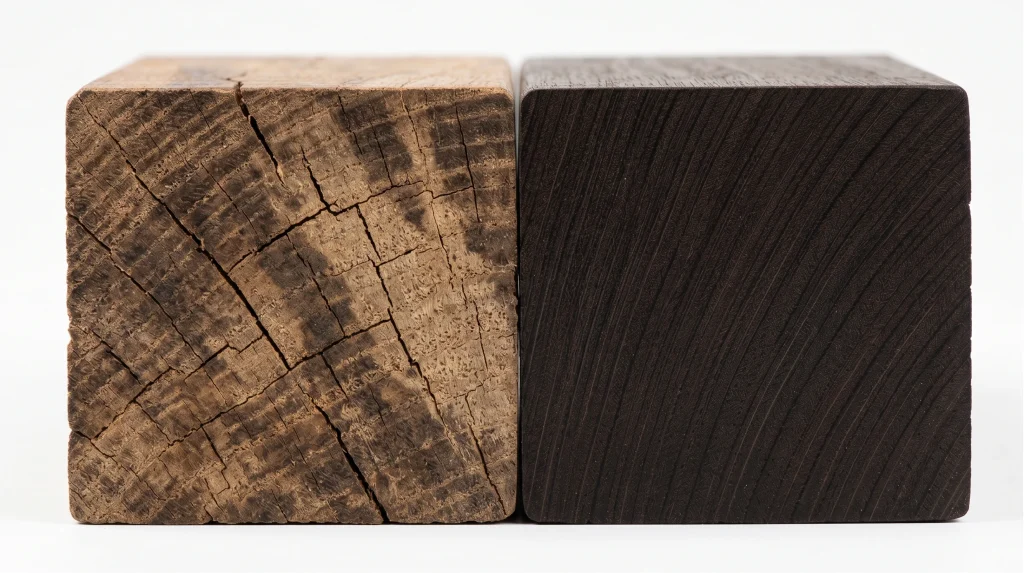
What These Figures Mean for Hardwood Decking Specification
Density: 743 kg/m³ At 743 kg/m³, Ultimate FBR sits firmly within the hardwood density range — well above the threshold at which surface hardness and indentation resistance become meaningful specification differentiators. For commercial decking applications where furniture drag, wheeled equipment, and high foot traffic are routine, a board at this density will resist surface damage far more effectively than a thermally modified alternative where density is reduced by the modification process.
Higher density also correlates with lower permeability — denser boards absorb moisture more slowly, dry more quickly after rain events, and therefore spend less time in the moisture content range at which fungal activity is possible. Density is not simply a hardness proxy; it is a durability mechanism in its own right for exterior decking applications.
ASE: 44.33% — Volumetric swelling: 2.35% Hardwood decking is installed with expansion gaps precisely because untreated timber swells. The gap that accommodates wet-winter swelling becomes a hazard in dry-summer conditions; the gap sized for a dry summer disappears in wet weather, loading boards against each other and their fixings. No single gap specification performs correctly across the full moisture range of an untreated hardwood — the movement is simply too variable.
With volumetric swelling of 2.35% compared to 10.04% for untreated hardwood, Ultimate FBR boards move a fraction of what untreated timber would under the same moisture exposure. Gap specifications remain valid across seasonal moisture cycling. Board edges stay consistent. Fixings are not subject to the repeated loading and unloading that causes fatigue and loosening in dimensionally unstable boards. The ASE of 44.33% — independently verified — is the quantitative basis for this specification confidence.
Water uptake: 35.07% vs 109.58% Untreated hardwood of this species absorbed more than its own weight in water under test conditions. Ultimate FBR absorbed 35.07% — a reduction of approximately 68%. In a decking context, reduced water uptake means the board surface dries more rapidly after rain, remains below the critical moisture content threshold for fungal activity for longer periods, and is less susceptible to the surface checking and end-grain splitting that follows from repeated rapid moisture absorption and release.
Durability: Class 2 (EN 350) Class 2 durability — verified without the use of biocidal preservatives, and applying uniformly to the full cross-section of every board — is the appropriate and sufficient classification for above-ground exterior decking in Use Class 3.2. The modification is structural and permanent: unlike preservative-treated timber, the durability performance of Ultimate FBR does not deplete over the service life of the installation.
Fire performance: B-s2-d0 achievable Euroclass B-s2-d0 under EN 13501-1 — achievable for Ultimate FBR — indicates very limited contribution to fire propagation, moderate smoke production, and no flaming droplets or particles. For commercial hardwood decking on buildings above 11 metres, rooftop terraces, and balconies where building regulations specify minimum fire performance for external combustible materials, this classification provides a compliant modified hardwood option without reliance on applied fire retardant coatings.
Hardwood Decking Technology Comparison
The hardwood decking market now offers four broad material categories, each with a distinct performance and sourcing profile. Understanding how they compare across the criteria relevant to B2B specification is essential for making a defensible material decision.
| Property | Tropical Hardwood (ipe/cumaru) | Furan Resin Modified (Ultimate FBR) | Thermally Modified | Preservative-Treated Softwood |
|---|---|---|---|---|
| Durability class (EN 350) | Class 1–2 (heartwood only) | Class 2 (full cross-section, verified) | Class 2–3 (typical) | Class 2–3 (treatment dependent) |
| Density | 900–1,100 kg/m³ (species variable) | 743 kg/m³ (tested) | Reduced vs baseline | Baseline softwood |
| Dimensional stability | Moderate — species variable | Very high — ASE 44.33% | Moderate–high | Low |
| Fire performance | Euroclass D (typical) | B-s2-d0 achievable | Variable | Variable |
| Surface hardness | Very high | High | Reduced | Low |
| Sourcing risk (2026) | High — CITES, EUDR burden | Low — SVLK, FSC® Ready, PEFC™ Ready | Low–medium | Low |
| Biocidal chemistry | None | None | None | Yes — copper-based |
| Fixing compatibility | Standard stainless / galvanised | Standard stainless / galvanised | Standard stainless / galvanised | Hot-dip galvanised required |
Several observations are worth highlighting for the specifier. Tropical hardwood density — particularly for ipe, which can exceed 1,000 kg/m³ — is higher than furan resin modified hardwood. For applications where maximum surface hardness is the primary criterion and sourcing documentation can be reliably completed, tropical hardwood remains a technically valid specification. The question in 2026 is whether the sourcing burden — CITES permits, EUDR due diligence, FSC or PEFC chain-of-custody verification — can be discharged reliably at project scale.
Thermally modified timber offers good dimensional stability but at reduced density and bending strength. For decking applications where surface hardness and indentation resistance matter — commercial terraces, rooftop decks, high-traffic residential installations — the density reduction from thermal modification is a specification limitation that furan resin modification does not share.
Preservative-treated softwood remains the lowest-cost initial specification but carries the highest whole-life cost burden: biocidal retreatment requirements, intensive coating maintenance schedules, and a service life that typically falls short of Class 2 modified or natural hardwood alternatives.
Hardwood Decking Applications: Where Modified Wood Performs
Residential Exterior Hardwood Decking
For residential garden hardwood decking, terraces, and outdoor living areas, the specification case for furan resin modified timber rests on three converging factors: dimensional stability that maintains gap geometry through seasonal moisture cycling, Class 2 durability that eliminates biocidal retreatment from the maintenance schedule, and a surface hardness that resists the indentation from furniture that plagues thermally modified and softwood alternatives.
The uniform dark-brown colour produced by the furan resin modification process — consistent across every board, with no knots, no sapwood variation, and no colour differential between pieces — delivers the visual consistency that high-end residential hardwood decking specifications demand. Unlike naturally variable hardwood species, where colour and grain character differ between boards, Ultimate FBR presents a uniform surface that holds its appearance without the greying management that some clients find objectionable in untreated hardwood.
Commercial and Hospitality Terraces
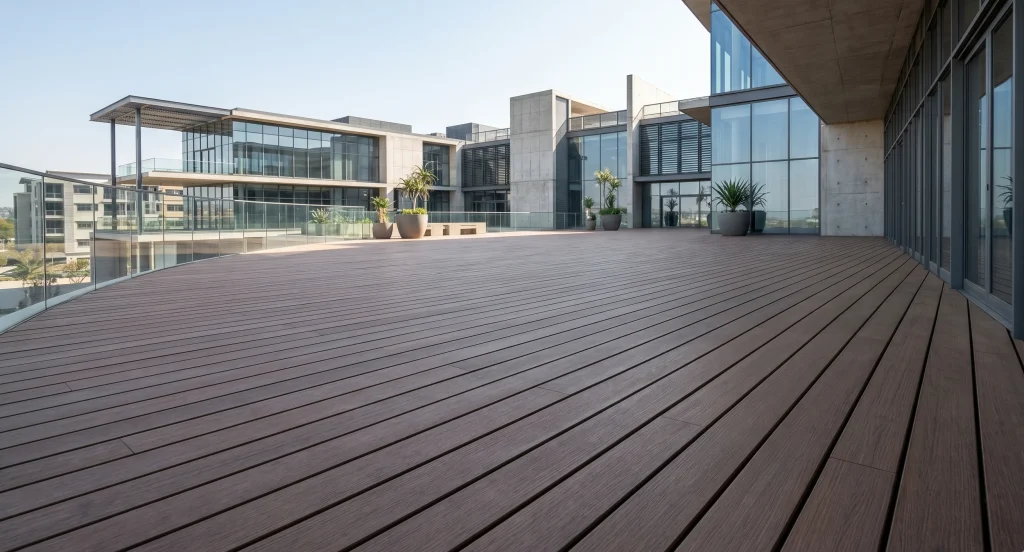
Commercial hardwood decking on hospitality terraces, retail exterior spaces, and public realm installations faces a more demanding performance brief than residential applications: higher foot traffic, wheeled equipment, furniture drag, and more frequent cleaning operations with chemical cleaning agents. The density of 743 kg/m³ provides the surface hardness appropriate for these conditions. The dimensional stability of ASE 44.33% ensures that gap specifications remain valid through the full range of seasonal exposure, avoiding the tripping hazards and board edge deterioration that variable-gap installations develop over time.
For commercial hospitality projects where the hardwood decking is a visible design element — rooftop bars, terrace restaurants, hotel courtyards — the uniform colour and defect-free surface of modified hardwood is a specification asset that standard species-variable hardwood cannot consistently deliver.
Rooftop Decks and Elevated Terraces
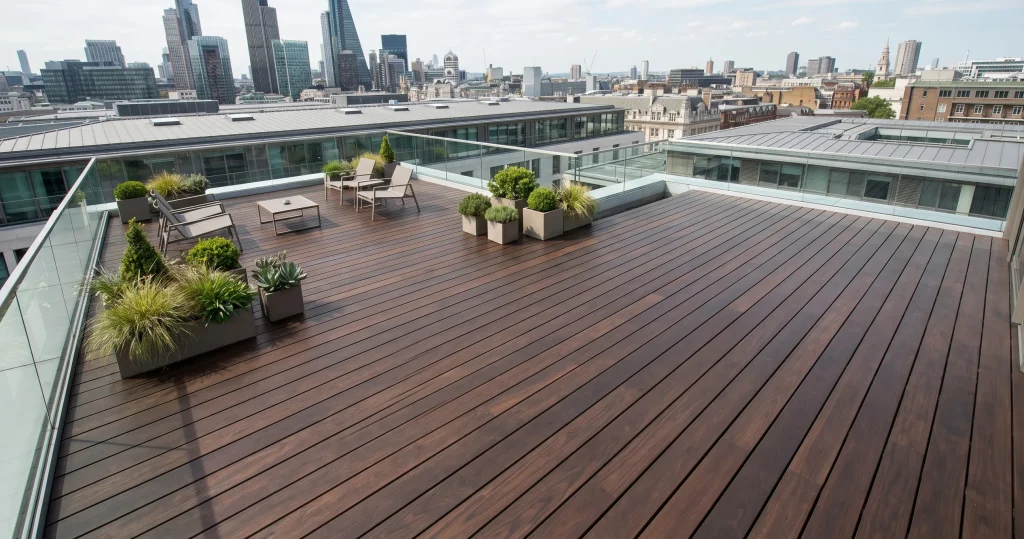
Rooftop hardwood decking and elevated terraces present the most demanding combination of fire performance, structural, and weather exposure requirements of any decking application. Building regulations in most European markets now impose minimum fire performance requirements for materials used on external areas of buildings above a defined height threshold — typically 11 metres in the UK and equivalent thresholds across EU member states.
The achievable Euroclass B-s2-d0 fire performance of Ultimate FBR — with no flaming droplets (d0), very limited fire propagation (B), and moderate smoke production (s2) — provides a material-level fire classification appropriate for rooftop and elevated decking applications where Euroclass B or equivalent is specified. Combined with the dimensional stability and durability data, this makes furan resin modified hardwood one of the most complete specification options available for elevated decking on regulated buildings.
Specifying Hardwood Decking: A Practical Checklist
1. What is the verified durability classification, and does it apply to the full cross-section? Require EN 350 durability data from a named independent testing body. For Ultimate FBR, Class 2 durability has been independently verified by IPB University and the Université de Lorraine, France — applying uniformly to the full board cross-section.
2. What is the ASE, and what is the absolute volumetric swelling figure? ASE expresses relative improvement — the absolute volumetric swelling figure tells you how much the board will actually move in service. For Ultimate FBR hardwood decking: ASE 44.33%, volumetric swelling 2.35% (vs 10.04% untreated). These are the figures that feed directly into gap design and fixing specification.
3. What is the density, and is it appropriate for the traffic loading anticipated? For residential garden hardwood decking with standard furniture and foot traffic, a density above 600 kg/m³ is generally adequate. For commercial terraces, rooftop decks, and high-traffic public realm applications, a density of 700 kg/m³ or above is appropriate. Ultimate FBR is independently verified at 743 kg/m³.
4. What fire performance classification is required, and is it achievable at material level? Confirm the fire performance requirement for the building type, height, and occupancy at the earliest stage of specification. For applications where Euroclass B is required, confirm that the material-level classification — B-s2-d0 for Ultimate FBR under EN 13501-1 — is achievable.
5. What sourcing documentation does the project require, and can it be reliably produced? For EU projects, confirm EUDR compliance documentation can be provided. For projects specifying CITES Appendix II species (ipe, cumaru), confirm that valid CITES export and import permits can be produced for the specific shipment. For Ultimate FBR: SVLK certification provides EU FLEGT-recognised legal compliance; FSC® Ready and PEFC™ Ready status enables chain-of-custody certification where required.
6. What size range is available, and what fixing system is specified? Ultimate FBR hardwood decking is available in 12–32mm × 90–285mm × 900–5900mm. Furan resin modified hardwood is compatible with standard stainless steel and hot-dip galvanised fixings — no specific fixing grades required due to material chemistry.
7. Can supply volume and schedule be maintained at project scale? Ultimate FBR is distributed through Houtplex B.V. in Haaksbergen, Netherlands and Wood United Pte Ltd in Singapore — both part of the Wood United Group and structured for volume procurement at project scale.
Frequently Asked Questions about Hardwood Decking
What is the best hardwood for decking?
There is no single best hardwood for all hardwood decking applications — the appropriate specification depends on the performance requirements, fire classification, sourcing obligations, and maintenance budget of the specific project. For applications where verified durability, high dimensional stability, and responsible sourcing documentation are all required, furan resin modified hardwood delivers a more complete specification package than any single naturally durable species. Ultimate FBR achieves Class 2 durability (EN 350), ASE 44.33%, density 743 kg/m³, and achievable Euroclass B-s2-d0 fire performance — independently verified — alongside SVLK certification and FSC® Ready and PEFC™ Ready status.
How long does hardwood decking last?
Service life for hardwood decking depends on the material specification, the assembly detailing, the exposure conditions, and the maintenance regime. Naturally durable tropical hardwood species such as ipe and cumaru can last 25–40 years or more in above-ground exterior conditions with appropriate maintenance. Furan resin modified hardwood with Class 2 durability under EN 350, installed with appropriate detailing for drainage and ventilation, is designed to deliver a service life in the same range — without biocidal retreatment requirements — through a modification mechanism that does not deplete over time. For both natural and modified hardwood decking, detailing quality and maintenance compliance are as influential as material specification in determining actual service life.
Does hardwood decking need maintenance?
All exterior hardwood decking requires some maintenance — the nature and frequency depend on the material and the performance expectations. Natural tropical hardwood decking requires periodic cleaning and the application of a penetrating oil to maintain surface appearance. Furan resin modified hardwood does not require biocidal retreatment — the Class 2 durability is structural and permanent. A UV-stabilising oil is recommended to manage surface appearance and slow natural greying, but this is a cosmetic requirement rather than a structural one. The maintenance schedule for a well-specified modified hardwood deck is significantly less demanding than for preservative-treated softwood alternatives.
What is the most durable decking material?
Among solid timber options, naturally durable tropical hardwood species — ipe, teak, cumaru — carry Class 1 biological durability under EN 350 and have proven service lives of 25–40+ years. Furan resin modified hardwood achieves Class 2 durability through a permanent modification of the cell wall, offering comparable service life in Use Class 3.2 exterior decking applications without the sourcing and compliance burden that tropical hardwood now carries in European regulated procurement. Among modified timber categories, furan resin modification offers a durability and density combination that thermally modified timber cannot match for high-traffic or commercial decking applications.
Is hardwood decking worth it compared to composite?
For B2B projects where natural material aesthetics, long-term durability, and responsible sourcing documentation are specification requirements, solid hardwood decking delivers advantages that composite materials do not. Composite decking offers low maintenance and consistent appearance but typically does not achieve the fire performance classifications required for regulated commercial and higher-rise applications, and cannot be certified to FSC or PEFC chain-of-custody standards as a solid timber product. For projects targeting BREEAM, LEED, or DGNB credits, solid hardwood decking from a verified supply chain — such as Ultimate FBR distributed through Houtplex B.V. in the Netherlands and Wood United Pte Ltd in Singapore — provides documentation that composite products cannot offer.
What hardwood decking is the hardest wearing?
Surface hardness in timber hardwood decking is primarily a function of density. Among tropical hardwood species, ipe (900–1,100 kg/m³) is consistently rated among the hardest commercially available decking timbers. Among modified hardwood products, furan resin modification increases density compared to the untreated baseline — Ultimate FBR tests at 743 kg/m³ — making it significantly harder wearing than thermally modified timber and comparable to many mid-range naturally durable hardwood species. For commercial hardwood decking applications where surface wear resistance is a primary criterion, furan resin modified hardwood at 743 kg/m³ represents a substantively different specification from thermally modified alternatives.
How do I specify hardwood decking for a commercial project?
Commercial hardwood decking specification requires decisions across five areas: material (durability class, density, dimensional stability, fire performance — all referenced to named standards and independent test data); profile (board width, thickness, and groove specification); substructure (joist spacing, bearer dimensions, drainage falls — minimum 1:80 fall recommended); fixings (stainless steel or hot-dip galvanised); and sourcing documentation (EN 350 durability data, EUDR compliance, FSC or PEFC chain-of-custody certification). For Ultimate FBR hardwood decking, technical documentation is available on request via the contact form.
Can ipe decking still be specified after CITES Appendix II listing?
Ipe can still be legally traded and specified following its 2025 CITES Appendix II listing — the listing regulates rather than prohibits trade. However, every shipment now requires a valid CITES export permit from the country of origin and a CITES import permit at the point of EU or UK entry. Procurement managers specifying ipe must confirm that their supply chain can reliably produce CITES permits for the specific shipment and timing required by the project programme. For procurement teams that find the CITES compliance burden difficult to discharge reliably, verified modified hardwood decking from a SVLK-certified, FSC® Ready supply chain presents a lower-risk alternative with comparable performance credentials.
| Property | Tropical hardwood (ipe/cumaru) | Ultimate FBR |
|---|---|---|
| Durability class | Class 1–2 (heartwood only) | Class 2 — full cross-section, verified |
| Density | 900–1,100 kg/m³ (variable) | 743 kg/m³ (tested) |
| ASE | Not published | 44.33% |
| Volumetric swelling | ~8–14% (species variable) | 2.35% |
| Fire performance | Euroclass D (typical) | B-s2-d0 achievable |
| CITES (2025) | Ipe + cumaru: Appendix II | Not applicable |
| EUDR compliance | High documentation burden | SVLK — streamlined |
| Sourcing | FSC/PEFC variable | SVLK · FSC® Ready · PEFC™ Ready |
Use Class: UC 3.2 (above ground, fully exposed).
Key differentiator vs thermally modified decking: Furan resin modification increases density (743 kg/m³) — thermally modified decking decreases density, reducing surface hardness for high-traffic applications.
Independent verification: IPB University (Indonesia) & Université de Lorraine (France).
Sizes: 12–32mm × 90–285mm × 900–5900mm.
Supply: Houtplex B.V., Netherlands · Wood United Pte Ltd, Singapore.
Specify Hardwood Decking with Confidence
The hardwood decking specification that holds up over a 25-year service life is one built on verified performance data, not species tables and supplier assurances. Durability classification referenced to EN 350 and confirmed by an independent testing body. Dimensional stability expressed as an absolute volumetric swelling figure, not a relative marketing claim. Fire performance classified under EN 13501-1 at material level. And sourcing documentation complete enough to satisfy EUDR due diligence, CITES compliance where applicable, and chain-of-custody certification requirements.
Ultimate FBR hardwood decking delivers on all four dimensions: Class 2 durability independently verified by IPB University and the Université de Lorraine; ASE 44.33% and volumetric swelling 2.35% confirmed by testing to EN and ASTM standards; achievable Euroclass B-s2-d0 fire performance; and SVLK certification with FSC® Ready and PEFC™ Ready status — distributed through Houtplex B.V. in Haaksbergen, Netherlands and Wood United Pte Ltd in Singapore, both part of the Wood United Group.
For project-specific technical documentation, sizing requirements, or supply enquiries, contact the Ultimate FBR team via the contact form.