Hardwood Cladding — Why Species Choice Is Only Half the Specification Decision
Hardwood cladding carries a durability assumption that is only partly warranted. Natural hardwood species such as oak, iroko, and cumaru do offer better biological resistance than most softwoods — but the EN 350 durability classification that underpins that reputation applies exclusively to the heartwood, the timber is subject to sourcing variability that no specification document can fully control, and the dimensional stability performance that determines whether the cladding system holds its geometry over twenty years of moisture cycling is rarely verified or published by species alone.
For B2B specifiers and procurement managers, the question is not “which hardwood species?” but “which hardwood, and what do we know about its verified performance?” Independently tested dimensional stability data, a durability classification that applies to the full board cross-section, and supply chain documentation that satisfies EUDR requirements are the criteria that distinguish a defensible specification from an assumption.
This article examines what those criteria mean in practice, where natural hardwood species consistently fall short, and what verified performance data shows when furan resin modified hardwood is evaluated against the specification criteria that matter most for exterior cladding in Use Class 3.2 conditions.
What Is Hardwood Cladding and Why Does Material Choice Determine Long-Term Performance?
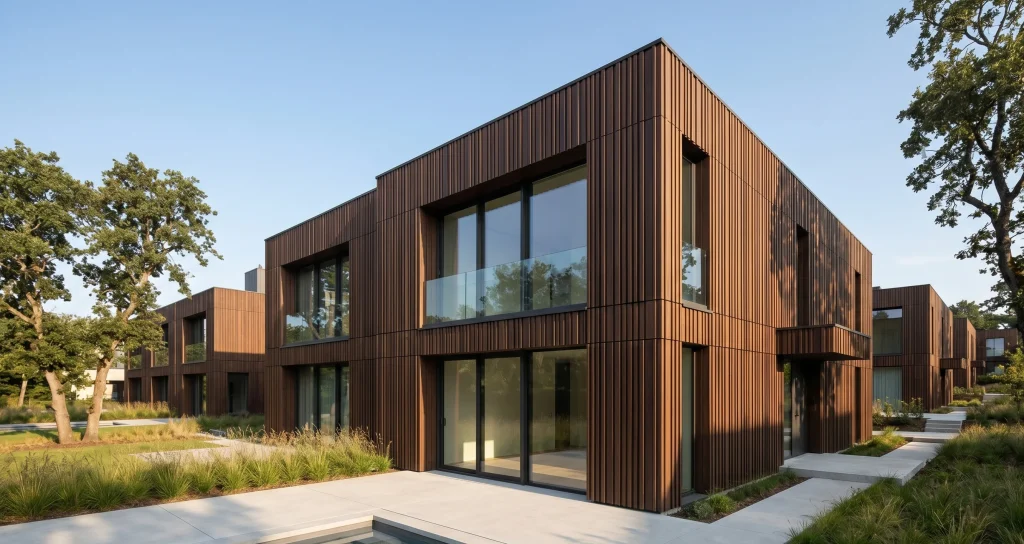
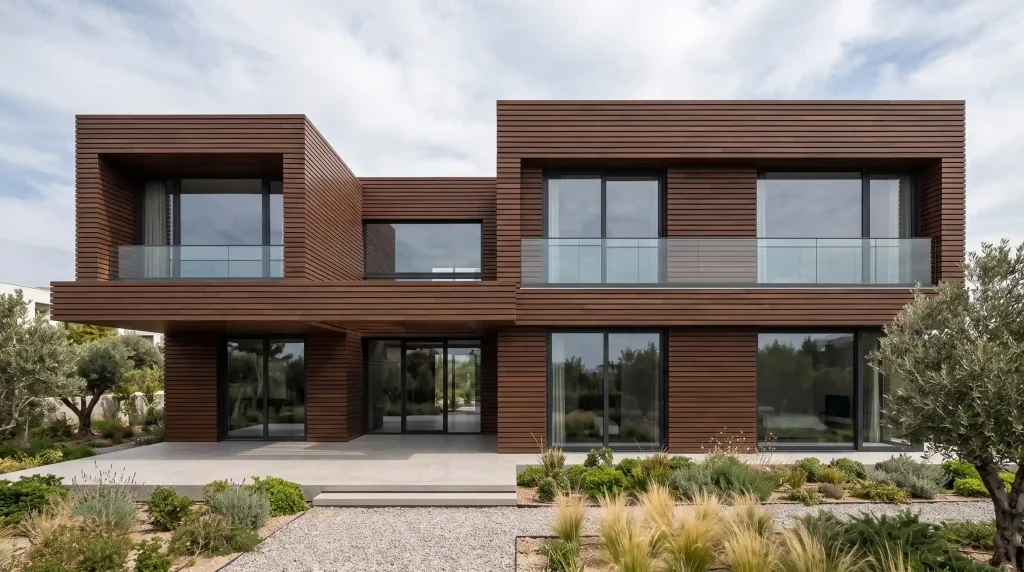
Hardwood cladding is an external wall finish system in which dense, biologically durable timber boards are fixed to a ventilated substructure to form the outermost layer of the building envelope. The distinction from softwood cladding is primarily one of density, natural durability, and — in theory — service life. In practice, the performance delivered by hardwood cladding depends as much on the specific properties of the individual board as on the species classification of the timber.
The service environment for exterior cladding is defined under EN 335 as Use Class 3.2: above ground, fully exposed to weather, with both faces of the board subject to moisture loading. The BS EN 350:2016 durability classification applies to heartwood only — sapwood is not considered durable in any species and should be excluded from cladding boards unless preservative treated. This is the first critical point for hardwood cladding specification: the durability class in a species data sheet describes the heartwood, and the proportion of heartwood in any given board depends on species, tree age at felling, and growth conditions — none of which are controlled by a species specification alone.
A cladding board of European oak at durability Class 2 may contain 60% heartwood or 20% heartwood depending on how the tree was grown and where in the trunk it was sawn. The specification says “oak, Class 2”; the delivered material may perform significantly below that classification in the sapwood-rich sections.
The Problem with Natural Hardwood Cladding: Durability, Variability, and Sourcing Risk
Natural hardwood species have been the premium specification choice for exterior cladding for generations — and the performance credentials of the best naturally durable species are genuine. A Class 1 or 2 hardwood left untreated can perform for decades with minimal intervention, provided it is heartwood, in a well-detailed assembly, with appropriate end-grain protection and adequate cavity ventilation. It is not reliably true for a species-specified cladding board where heartwood proportion is unverified.
The problems that lead to premature hardwood cladding failure fall into three categories.
Dimensional instability. Natural hardwood species are hygroscopic. Their free hydroxyl groups attract and bind water molecules, causing the cell wall to swell when moisture content rises and contract when it falls. The volumetric swelling of a natural hardwood in Use Class 3.2 conditions — exposed to wet winters, dry summers, and the differential moisture loading between the board’s weathered face and its sheltered cavity face — drives board cupping, joint gap variation, and surface coating failure. An Anti-Swelling Efficiency (ASE) figure or absolute volumetric swelling coefficient is the single most useful material property for predicting long-term cladding system performance — yet it is rarely published for naturally occurring species.
Heartwood fraction variability. The durability classification a specifier relies on when writing “European oak, Class 2” into a specification applies to heartwood only. In commercially available hardwood cladding — particularly plantation-grown or younger-rotation species — the heartwood proportion varies between boards, batches, and suppliers. A specification that does not require a minimum heartwood percentage, or an independent certification that the full cross-section meets the stated durability class, accepts performance variability that will not be visible until the cladding system begins to fail.
Sourcing risk under EUDR and CITES. For tropical hardwood species offering the strongest natural durability credentials — iroko, cumaru, ipe, merbau — the regulatory environment in 2026 has changed materially. The EU Deforestation Regulation requires geolocation data, legal compliance documentation, and a formal Due Diligence Statement for every shipment placed on the EU market. Ipe and cumaru, listed under CITES Appendix II in 2025, additionally require export and import permits for every shipment. The compliance burden for these species has increased substantially.
Furan Resin Modified Hardwood: What Verified Performance Data Shows
Furan resin modification addresses the root causes of natural hardwood cladding failure directly, at the cell wall level. The modification process impregnates the timber with furfuryl alcohol — derived from agricultural waste including sugarcane bagasse and corn cobs — and cures it in situ as polyfurfuryl alcohol polymer. This permanently reduces the free hydroxyl groups available to attract water, physically bulks the cell wall to reduce the volume available for water uptake, and produces a material whose performance has been independently verified by IPB University (Indonesia) and the Université de Lorraine (France).
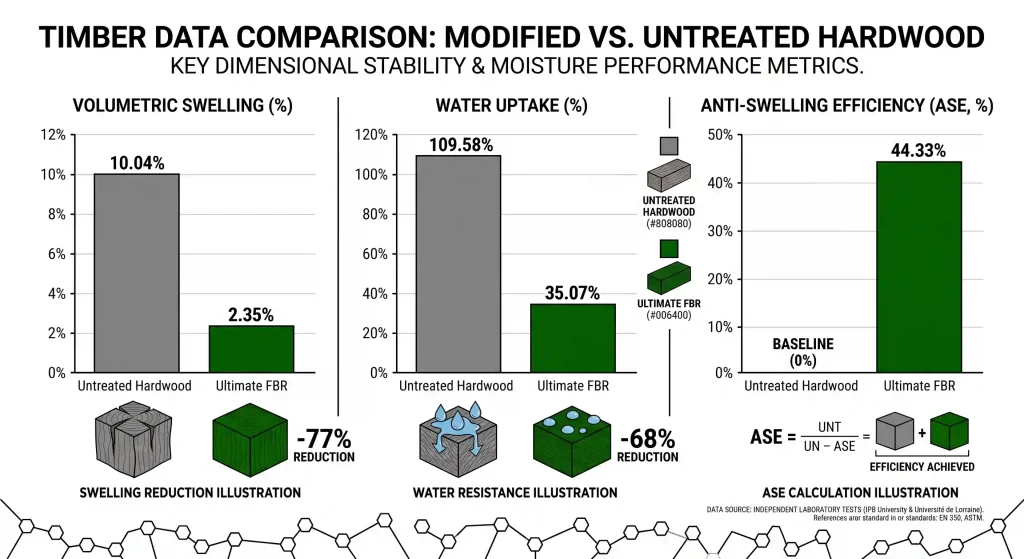
The performance of hardwood cladding produced from Ultimate FBR modified timber has been validated against EN, BS, ASTM, AWPA, and SNI standards. The data below compares Ultimate FBR against the untreated hardwood baseline:
| Performance property | Untreated hardwood | Ultimate FBR | Test standard |
|---|---|---|---|
| Density | Baseline | 743 kg/m³ | Tested |
| Volumetric swelling | 10.04% | 2.35% | EN 350 |
| Water uptake | 109.58% | 35.07% | ASTM |
| Anti-Swelling Efficiency (ASE) | — | 44.33% | Tested |
| Durability classification | Class 3–4 (species dependent) | Class 2 | EN 350:2016 |
| Fire performance | Not classified | B-s2-d0 achievable | EN 13501-1 |
Reading the Numbers for Cladding Specification
ASE 44.33% / volumetric swelling 2.35% feeds directly into gap design and long-term system geometry. Untreated hardwood at 10.04% volumetric swelling will open and close shadow gaps visibly, stress fixings through repeated wet-dry cycles, and crack surface coatings at board edges. Ultimate FBR at 2.35% moves a fraction of that amount. For a shadow-gap rainscreen profile, this difference determines whether the system geometry remains consistent across a 25-year service life.
Density 743 kg/m³ places Ultimate FBR in the hardwood density range appropriate for Use Class 3.2 cladding. Higher density correlates with slower moisture uptake, reduced permeability, and better resistance to surface damage from cleaning, impact, and weathering. Thermally modified timber — which reduces density through the modification process — does not offer this combination of stability and hardness.
Class 2 durability (EN 350:2016) — verified by independent testing, applying uniformly to the full board cross-section — confirms suitability for Use Class 3.2 above-ground cladding without biocidal preservative retreatment. The modification is structural and permanent: unlike natural hardwood where durability depends on heartwood fraction, or preservative-treated timber where durability depends on a depletable active agent, furan resin modification produces a uniform Class 2 rating throughout every board.
Hardwood Cladding Material Comparison
| Property | Natural hardwood (oak/iroko) | Furan resin modified (Ultimate FBR) | Thermally modified | Preservative-treated softwood |
|---|---|---|---|---|
| Durability class | Class 1–2 (heartwood only) | Class 2 (full cross-section, verified) | Class 2–3 (typical) | Class 2–3 (treatment dependent) |
| Density | 600–900 kg/m³ (species variable) | 743 kg/m³ (tested) | Reduced vs baseline | Baseline softwood |
| ASE | Not published | 44.33% (verified) | 20–40% (typical) | N/A |
| Volumetric swelling | 8–14% (species variable) | 2.35% (verified) | 4–7% (typical) | High |
| Fire performance | Euroclass D (typical) | B-s2-d0 achievable | Variable | Variable |
| Heartwood fraction | Variable — unverified in delivered boards | Full cross-section — uniform | Full cross-section | N/A |
| EUDR compliance burden | High (tropical) / Medium (temperate) | Low — SVLK FLEGT recognised | Low–medium | Low |
| Biocidal chemistry | None | None | None | Yes — copper-based |
| Sourcing certification | Variable | SVLK · FSC® Ready · PEFC™ Ready | Typically FSC/PEFC | Variable |
The Thermal Modification Trade-Off
Thermally modified timber achieves its improved moisture performance by degrading the hemicellulose fraction of the cell wall — a process that simultaneously reduces density and bending strength. For cladding applications where surface hardness and resistance to impact, cleaning equipment, and heavy footfall matter, thermally modified timber’s reduced density is a specification limitation that furan resin modification does not share. Ultimate FBR at 743 kg/m³ is measurably denser than thermally modified alternatives, and its surface hardness reflects that.
Fire Performance in Hardwood Cladding
The extension of the combustible cladding ban to buildings with a storey at 11m or more — from 1 June 2022 — means that Euroclass B or better is required for exterior cladding systems on a wide range of residential, commercial, and educational buildings. Untreated hardwood at Euroclass D does not meet this threshold.
For exterior cladding specification, the practical implications are:
Above 18m residential: Timber cladding is not permitted. Euroclass A2-s1,d0 or better is required across all external wall system components.
11–18m (residential, commercial, educational): Euroclass B or better is required for the external cladding system. Fire retardant treated timber can achieve Euroclass B through factory pressure impregnation — but introduces hygroscopic chemistry, requires specific coating systems to retain performance, and needs maintenance protocols to sustain the declared fire classification.
Below 11m: No Euroclass mandate from Approved Document B for most building types, though insurer requirements and client risk policies increasingly specify Euroclass B regardless of height.
The Euroclass B-s2-d0 classification achievable for Ultimate FBR modified hardwood under EN 13501-1 derives from the modification chemistry itself. The polyfurfuryl alcohol polymer in the cell wall contributes to stable char formation under fire exposure, producing the d0 designation — no flaming droplets — without a secondary treatment layer. For hardwood cladding on buildings between 11 and 18 metres, material-level Euroclass B is available without the maintenance implications of applied fire retardant treatment.
Specifying Hardwood Cladding: A Seven-Point Checklist
1. Confirm durability classification applies to the full board cross-section. Require either a minimum heartwood percentage guarantee or an independent durability classification applying to the full cross-section. For Ultimate FBR: Class 2 (EN 350:2016), uniform throughout the board, verified by IPB University and the Université de Lorraine.
2. Obtain ASE and absolute volumetric swelling data. For Ultimate FBR hardwood cladding: ASE 44.33%, volumetric swelling 2.35% — both independently verified. These figures feed directly into gap design and fixing spacing for the cladding assembly.
3. Confirm fire performance requirement and achievable Euroclass. Establish the building height and occupancy type, confirm the Euroclass requirement with Building Control, and verify that the specified material can achieve that classification at material level. For cladding between 11 and 18m: Euroclass B-s2-d0 is achievable for Ultimate FBR without applied fire retardant treatment.
4. Confirm EUDR compliance documentation capability. For EU project procurement from 30 December 2026, every in-scope timber product requires a Due Diligence Statement through TRACES NT. For Ultimate FBR: SVLK certification provides FLEGT-recognised legality verification; geolocation and DDS documentation is available through Houtplex B.V. in Haaksbergen, Netherlands.
5. Verify responsible sourcing certification. Confirm FSC® or PEFC™ chain-of-custody certification where required. Ultimate FBR is FSC® Ready and PEFC™ Ready.
6. Confirm fixing compatibility and cavity specification. Furan resin modified hardwood uses standard stainless steel or hot-dip galvanised fixings. Cavity minimum 25mm, increasing to 38mm or more on highly exposed sites.
7. Confirm size range and supply chain for project programme. Ultimate FBR hardwood cladding is available in 12–32mm × 90–285mm × 900–5900mm. European distribution through Houtplex B.V. in Haaksbergen, Netherlands; Asian and Pacific supply through Wood United Pte Ltd in Singapore — both part of the Wood United Group.
Frequently Asked Questions about Hardwood Cladding
What is the best hardwood for cladding?
No single species is best for all hardwood cladding applications. The appropriate material depends on the required durability class, dimensional stability, fire performance threshold, and sourcing documentation obligations. Among currently available options, furan resin modified hardwood cladding from SVLK-certified supply — such as Ultimate FBR — delivers independently verified performance across all four criteria: Class 2 durability (EN 350:2016), ASE 44.33% and volumetric swelling 2.35%, Euroclass B-s2-d0 achievable (EN 13501-1), and EUDR-compliant sourcing through Houtplex B.V. in the Netherlands.
How long does hardwood cladding last?
The default service life target for external timber cladding in British and European Standards is 30 years, achievable with Class 2 or better durability, appropriate detailing with a minimum 25mm ventilated cavity, adequate end-grain protection, and a surface coating maintenance programme. Furan resin modified hardwood with Class 2 durability, installed to BS 8605 guidance, is designed to deliver this service life without biocidal retreatment — with the dimensional stability advantage that coating intervals are extended compared to untreated hardwood alternatives.
Does hardwood cladding need maintenance?
All exterior hardwood cladding requires some maintenance. Natural hardwood typically requires surface coating renewal every 3–5 years on exposed elevations. Furan resin modified hardwood does not require biocidal retreatment — the Class 2 durability is structural and permanent. UV-stabilising coating is recommended for surface appearance, but maintenance is cosmetic rather than structural. The extended coating interval from reduced dimensional movement (volumetric swelling 2.35% versus 10.04% for untreated hardwood) is a measurable whole-life maintenance cost reduction.
What is the hardest wood for cladding?
Surface hardness is primarily a function of density. Among tropical hardwoods, ipe (900–1,100 kg/m³) is one of the densest commercially available species. Among modified hardwood products, furan resin modification increases density compared to the untreated baseline — Ultimate FBR tests at 743 kg/m³ — making it harder than thermally modified alternatives where density decreases. For cladding applications where surface hardness matters — ground-floor elevations, commercial installations, exposure to cleaning equipment — 743 kg/m³ places Ultimate FBR in the mid-hardwood range above most thermally modified products.
Is hardwood cladding fire rated?
Untreated hardwood typically achieves Euroclass D under EN 13501-1 — not rated for buildings between 11 and 18 metres where Euroclass B is required. Fire retardant treated hardwood can achieve Euroclass B through factory pressure impregnation. Ultimate FBR furan resin modified hardwood achieves Euroclass B-s2-d0 at material level without applied fire retardant chemistry. The d0 designation — no flaming droplets — eliminates the secondary ignition risk from falling burning debris, relevant for occupied buildings above the 11m threshold.
What durability class do I need for hardwood cladding?
For exterior cladding in Use Class 3.2 — above ground, fully exposed — a minimum EN 350 durability class of Class 2 is the appropriate threshold for timber without biocidal preservative retreatment. Class 2 indicates a service life of 15–25 years in above-ground exterior conditions. For hardwood cladding where the durability classification must apply to the full board cross-section rather than only to heartwood, furan resin modified hardwood provides a verified Class 2 rating uniform throughout every board — confirmed by IPB University and the Université de Lorraine under EN 350:2016.
How does modified hardwood cladding compare to natural hardwood for long-term performance?
Modified hardwood cladding outperforms natural hardwood on two critical long-term criteria: dimensional stability and consistency. Natural hardwood species have variable heartwood proportions, variable extractive content, and variable dimensional stability depending on growth conditions and provenance. Furan resin modification produces uniform dimensional stability (ASE 44.33%, swelling 2.35%) and uniform Class 2 durability throughout every board, independent of heartwood fraction. For a cladding system that must maintain designed geometry and coating performance across 25 years of moisture cycling, verified uniform performance data is a more reliable specification foundation than species tables.
Specify Hardwood Cladding on Verified Performance, Not Species Assumption
A hardwood cladding specification built on species tables and durability class assumptions carries risks that only become visible years into service — when boards have cupped, joints have opened, coatings have failed. Ultimate FBR delivers independently verified performance across the criteria that determine long-term cladding system performance: Class 2 durability under EN 350:2016 uniform throughout the board, ASE 44.33% and volumetric swelling 2.35%, density 743 kg/m³, and Euroclass B-s2-d0 fire performance achievable without applied fire retardant treatment. SVLK certification and FSC® Ready and PEFC™ Ready status complete the sourcing credentials for EU project procurement.
For technical documentation, sample requests, or supply enquiries, contact the team via the contact form. European distribution through Houtplex B.V. in Haaksbergen, Netherlands; Asian and Pacific markets through Wood United Pte Ltd in Singapore.