Exterior Timber Cladding — Why Modified Hardwood Outperforms Thermally Modified Timber
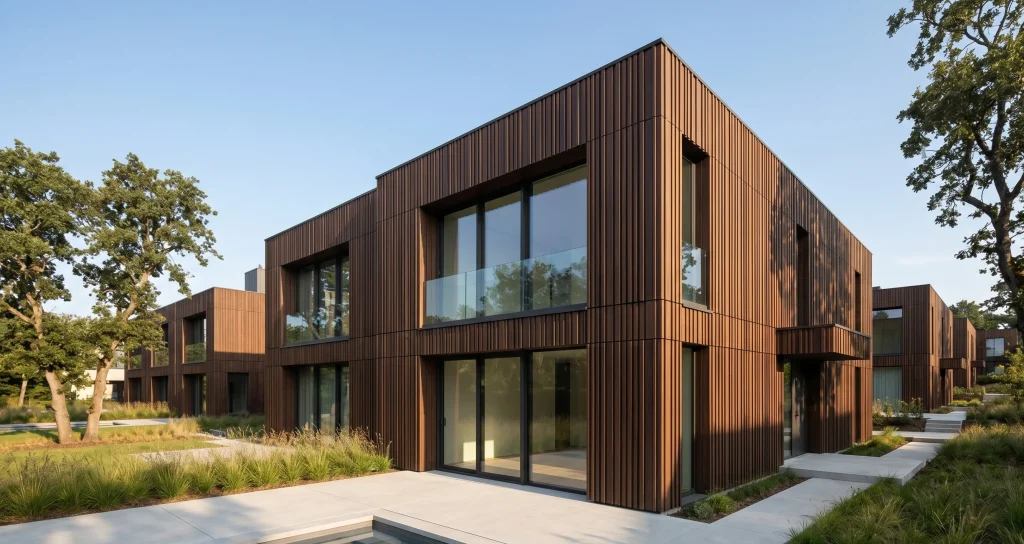
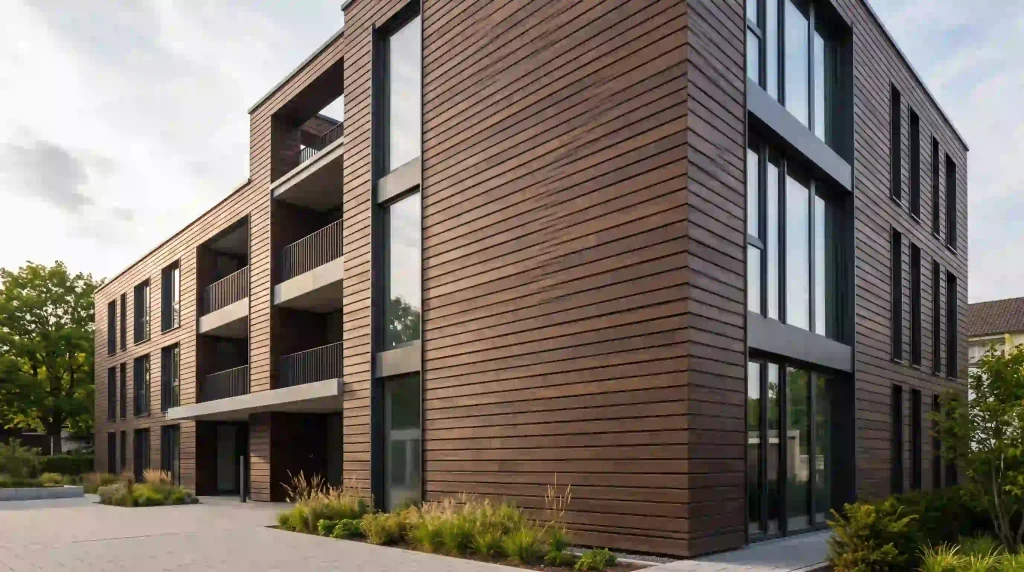
Exterior timber cladding is not a single specification decision. It is five simultaneous decisions — on durability, dimensional stability, fire performance, sourcing compliance, and mechanical properties — that most specifiers collapse into one question about species or brand. The result, too often, is a façade that looks correct at handover and begins to reveal specification gaps within two to five years of service.
This article focuses on the criterion that existing specification guides consistently omit: independently verified performance data for furan resin modified hardwood in exterior timber cladding applications, and what that data shows when measured against the thermally modified alternatives that currently dominate the market.
What Exterior Timber Cladding Requires: The Five Performance Criteria
Exterior timber cladding in above-ground Use Class 3.2 conditions — fully exposed to weather, with both board faces subject to moisture loading — must satisfy five measurable performance criteria simultaneously. Meeting four out of five is not sufficient: a cladding system that performs well on durability, stability, and sourcing but fails on fire classification cannot be placed on a building above 11 metres.
Durability class. EN 350:2016 classification at Class 2 or above — verified by an independent testing body, applying to the full board cross-section, not to heartwood fraction only.
Dimensional stability. Anti-Swelling Efficiency (ASE) and absolute volumetric swelling coefficient — the figures that determine gap consistency, coating longevity, and cavity geometry maintenance over decades of moisture cycling.
Fire performance. Euroclass reaction-to-fire classification under EN 13501-1 — at material level, not system level only — relevant from 11 metres building height under Approved Document B.
Sourcing compliance. EUDR Due Diligence Statement capability, FSC® or PEFC™ chain-of-custody certification, and — for Indonesian timber — SVLK FLEGT recognition for legality verification.
Density and mechanical properties. Load-bearing capacity under wind pressure and fixing pull-through, surface hardness under cleaning and impact, and structural integrity of the fixing zone at the board edge.
The critical insight — absent from most exterior timber cladding guides — is that thermally modified timber, currently dominant in this market, performs well on only three of these five criteria. It delivers adequate durability, reasonable dimensional stability, and good sourcing credentials. It does not deliver fire performance above Euroclass D at material level, and it reduces density and bending strength compared to the untreated baseline — a limitation that furan resin modification does not share.
Modified Hardwood vs Thermally Modified: What the Data Actually Shows
The comparison between furan resin modified hardwood and thermally modified timber for exterior timber cladding is rarely made with verified data. The table below uses independently verified data for Ultimate FBR and published manufacturer ranges for thermally modified products, referenced to named test standards.
| Property | Furan Resin Modified Hardwood (Ultimate FBR) | Thermally Modified Softwood (typical range) | Untreated Softwood | Test Standard |
|---|---|---|---|---|
| Effect on density | Significant increase — 743 kg/m³ (verified) | Decrease ~5–15% vs baseline | Baseline | Tested |
| ASE | 44.33% (verified) | 20–40% (published range) | 0% | Tested / published |
| Volumetric swelling | 2.35% (verified) | ~4–7% (typical) | 10.04% baseline | EN 350 |
| Water uptake | 35.07% (verified) | Reduced vs baseline | 109.58% baseline | ASTM |
| Durability class (EN 350:2016) | Class 2 (full cross-section, verified) | Class 2–3 (typical) | Class 3–4 | EN 350:2016 |
| Structural suitability | Yes — bending strength maintained | Limited — reduced by heat treatment | Yes | — |
| Fire performance (EN 13501-1) | B-s2-d0 achievable | Euroclass D (without treatment) | Euroclass D | EN 13501-1 |
| Feedstock | Hardwood + bio-based modifier (agri-waste) | Softwood — heat only, no reagents | Softwood | — |
| EUDR compliance burden | Low — SVLK FLEGT recognised | Low–medium | Variable | — |
| Sourcing | SVLK · FSC® Ready · PEFC™ Ready | Typically FSC/PEFC | Variable | — |
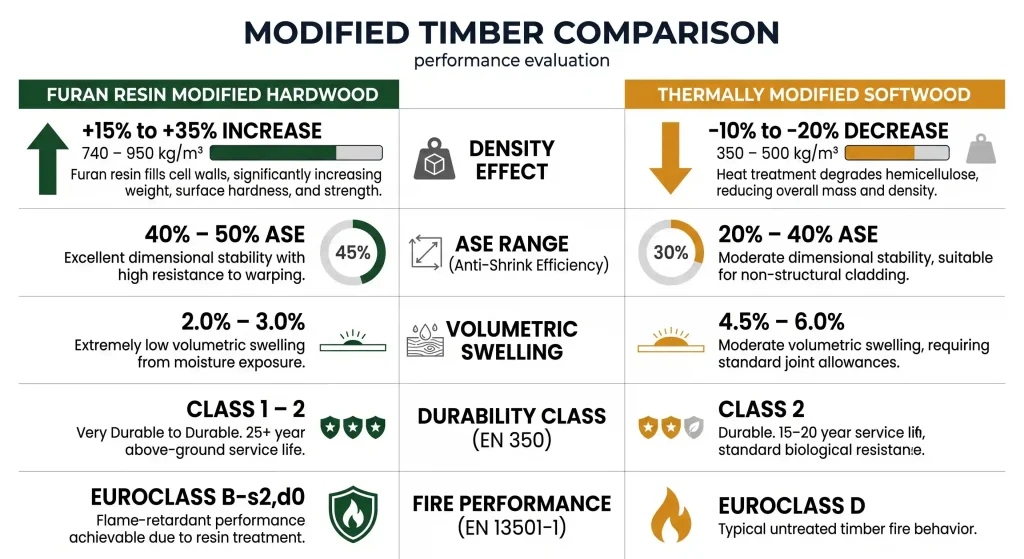
Reading the Comparison for Exterior Cladding Specification
On density: Thermal modification degrades the hemicellulose fraction — the process that improves moisture performance also reduces the mass and hardness of the board. Ultimate FBR tests at 743 kg/m³, substantially above the post-modification density of most thermally modified softwood products. For cladding where board hardness under cleaning, impact from debris, and fixing pull-through strength matter — particularly on ground-floor elevations and commercial façades — this difference is specification-relevant.
On dimensional stability: Both technologies improve ASE compared to untreated timber. Furan resin modification achieves 44.33% ASE and 2.35% volumetric swelling; thermally modified timber typically achieves 20–40% ASE with correspondingly higher absolute swelling. For a 140mm-wide exterior cladding board, this difference translates directly into gap variation, shadow-gap consistency, and coating stress accumulation over the service life.
On fire performance: Thermally modified timber typically achieves Euroclass D at material level — the same classification as untreated timber. Fire retardant treatment can improve this, but introduces hygroscopic chemistry that can affect coating adhesion and requires maintenance protocols to sustain declared fire performance. Furan resin modification produces Euroclass B-s2-d0 achievable at material level without applied fire retardant — the polyfurfuryl alcohol polymer contributes to stable char formation under fire exposure. For exterior timber cladding on buildings between 11 and 18 metres where Approved Document B requires Euroclass B, this is the most consequential specification distinction in the current market.
Verified Performance Data: Ultimate FBR in Exterior Timber Cladding
The performance data for exterior timber cladding produced from Ultimate FBR modified hardwood has been independently verified by IPB University (Indonesia) and the Université de Lorraine (France) and validated against EN, BS, ASTM, AWPA, and SNI standards.
| Performance property | Untreated hardwood | Ultimate FBR | Test standard |
|---|---|---|---|
| Density | Baseline | 743 kg/m³ | Tested |
| Volumetric swelling | 10.04% | 2.35% | EN 350 |
| Water uptake | 109.58% | 35.07% | ASTM |
| Anti-Swelling Efficiency (ASE) | — | 44.33% | Tested |
| Durability classification | Class 3–4 (species dependent) | Class 2 | EN 350:2016 |
| Fire performance | Euroclass D (typical) | B-s2-d0 achievable | EN 13501-1 |
ASE 44.33% / swelling 2.35% means that for a 140mm exterior cladding board, seasonal moisture cycling produces approximately 1.6mm of dimensional movement — compared to approximately 7mm for an untreated hardwood board of the same width under equivalent conditions. Shadow gaps that are 6mm at installation will remain within 7–8mm in wet conditions with furan resin modified hardwood. With untreated hardwood, the same gap may approach 13mm or close entirely depending on installation moisture content. Gap consistency is not an aesthetic preference in shadow-gap rainscreen cladding — it is a moisture management function.
Water uptake 35.07% vs 109.58% means the board surface dries more rapidly after rain events, spends less time at the moisture content levels associated with fungal activity, and applies less repeated stress to the surface coating.
Class 2 durability (EN 350:2016) — verified without biocidal preservatives, applying to the full cross-section of every board — confirms biological resistance appropriate for Use Class 3.2 above-ground exterior cladding across the design life of the installation. Unlike natural hardwood species where heartwood proportion varies between boards, the Class 2 classification for Ultimate FBR is uniform throughout every delivered board.
Fire Performance for Exterior Timber Cladding
The fire performance requirement for exterior timber cladding in England is determined by Approved Document B, with the principal threshold at 11 metres building height. Buildings with a storey at 11m or more require external cladding systems achieving Euroclass B or better — untreated hardwood and thermally modified timber at Euroclass D do not satisfy this threshold without fire retardant treatment.
Below 11m: Euroclass D is acceptable for most residential and commercial building types. Both thermally modified and furan resin modified hardwood satisfy this requirement.
11m to 18m: Euroclass B is required. Furan resin modified hardwood achieving Euroclass B-s2-d0 at material level — without applied fire retardant chemistry — provides a compliant exterior timber cladding option with no additional maintenance obligation for fire performance retention. Applied fire retardant treatment can achieve Euroclass B on thermally modified timber, but introduces hygroscopic chemistry affecting coating adhesion and requires maintenance monitoring to sustain declared fire performance.
Above 18m (residential): Euroclass A2-s1,d0 or better is required. Timber cladding — including treated timber — is not permitted.
The d0 suffix in B-s2-d0 confirms no flaming droplets or particles under test conditions — eliminating the secondary ignition risk from falling burning debris that d1 or d2 products carry. For buildings with occupied terraces, ground-floor pedestrian zones, or adjacent lower roofs, d0 is a meaningful specification distinction beyond the headline Euroclass.
EUDR and Sourcing: The 2026 Compliance Variable for Exterior Cladding
The EU Deforestation Regulation applies to exterior timber cladding boards placed on the EU market from 30 December 2026. Every profiled board and shadow-gap strip is an in-scope product requiring a Due Diligence Statement through TRACES NT, geolocation data for the forest of origin, and deforestation-free verification against the 31 December 2020 baseline.
Thermally modified softwood from Nordic forestry carries a generally low EUDR compliance burden — temperate supply chains in Finland, Estonia, and Scandinavia are typically well documented.
Tropical hardwood cladding species — iroko, cumaru, ipe — carry the highest EUDR compliance burden, compounded by the 2025 CITES Appendix II listing of ipe and cumaru, which adds permit requirements to every shipment.
Furan resin modified hardwood from SVLK-certified Indonesian supply occupies an advantageous position. SVLK’s EU FLEGT recognition means the legality dimension of EUDR compliance is addressed by the SVLK V-Legal document. Distribution through Houtplex B.V. in Haaksbergen, Netherlands provides an EU-based supply chain entry point for Due Diligence Statement submission. FSC® Ready and PEFC™ Ready status enables chain-of-custody certification where required.
For EU project procurement, confirming EUDR DDS capability with the distributor is now a specification prerequisite alongside fire classification and durability class.
Specifying Exterior Timber Cladding: A Seven-Point Checklist
1. Confirm durability class applies to the full board cross-section. For cladding where durability is a specification criterion, require independent durability classification applying uniformly to the full board. For Ultimate FBR: Class 2 (EN 350:2016), verified by IPB University and the Université de Lorraine.
2. Obtain ASE and absolute volumetric swelling figures. For Ultimate FBR exterior timber cladding: ASE 44.33%, volumetric swelling 2.35% (versus 10.04% untreated). These feed directly into shadow-gap design and coating system specification.
3. Confirm density and structural properties for the application. For cladding where surface hardness and fixing pull-through strength matter, confirm the board density. Ultimate FBR is verified at 743 kg/m³ — higher than most thermally modified alternatives.
4. Establish the fire performance requirement and confirm it is achievable at material level. Confirm building height, occupancy type, and Approved Document B requirements with Building Control. For cladding on buildings between 11 and 18 metres: Euroclass B-s2-d0 is achievable for Ultimate FBR without applied fire retardant treatment.
5. Confirm ventilated cavity specification and system-level fire assessment. Minimum 25mm ventilated cavity is standard; 38–50mm advisable in higher exposure. Cavity barriers must be coordinated with ventilation continuity. System-level fire assessment is required for buildings between 11 and 18 metres alongside material-level classification.
6. Confirm EUDR compliance documentation capability. From 30 December 2026, every exterior timber cladding product placed on the EU market requires a Due Diligence Statement. For Ultimate FBR, EUDR compliance documentation is available through Houtplex B.V. in Haaksbergen, Netherlands.
7. Confirm size range and supply chain for project programme. Ultimate FBR exterior timber cladding is available in 12–32mm × 90–285mm × 900–5900mm. European distribution through Houtplex B.V., Netherlands; Asian and Pacific supply through Wood United Pte Ltd, Singapore.
Frequently Asked Questions about Exterior Timber Cladding
What is the best exterior timber cladding material?
The most appropriate material depends on building height, fire performance requirements, dimensional stability priorities, and sourcing compliance obligations. For exterior timber cladding on buildings between 11 and 18 metres where Euroclass B is required at material level, furan resin modified hardwood — such as Ultimate FBR — is the only modified timber technology currently achieving B-s2-d0 without applied fire retardant, combined with independently verified ASE 44.33% and Class 2 durability. Below 11 metres where Euroclass D is acceptable, thermally modified timber offers a more cost-accessible option.
How long does exterior timber cladding last?
The target service life for external timber cladding under British and European standards is typically 30 years, achievable with Class 2 or better durability, minimum 25mm ventilated cavity, correct detailing at junctions and base, and periodic UV-stabilising coating renewal. Furan resin modified hardwood with Class 2 durability under EN 350:2016 is designed to deliver this service life without biocidal retreatment, with extended coating maintenance intervals compared to untreated hardwood alternatives.
Does exterior timber cladding need maintenance?
All exterior timber cladding requires periodic maintenance. Thermally modified timber and furan resin modified hardwood both require UV-stabilising coating renewal; neither requires biocidal retreatment. Untreated hardwood requires more frequent refinishing — typically 3–5 years on exposed elevations — due to greater dimensional movement applying more stress to the coating. The maintenance interval for furan resin modified exterior timber cladding at volumetric swelling 2.35% is substantially longer than for untreated hardwood at 10.04%.
What durability class do I need for exterior cladding?
For exterior timber cladding in Use Class 3.2 — above ground, fully exposed — a minimum EN 350:2016 durability class of Class 2 is appropriate for timber without biocidal preservative retreatment. For cladding where the classification must apply to the full board cross-section rather than heartwood only, furan resin modified hardwood provides uniform Class 2 throughout every board, independently verified under EN 350:2016 by IPB University and the Université de Lorraine.
Is timber cladding allowed on buildings above 11 metres?
In England, exterior timber cladding is permitted on buildings between 11 and 18 metres in height, subject to the external wall system achieving Euroclass B or better. Timber cladding is not permitted on the external walls of residential buildings above 18 metres, where Euroclass A2-s1,d0 or better is required. Requirements in Scotland, Wales, and Northern Ireland differ — the applicable Approved Document should be confirmed for each jurisdiction.
What is the most stable timber for exterior cladding?
Among chemical modification technologies, acetylated timber (e.g. Accoya) achieves the highest published ASE values — 50–65% — making it the most dimensionally stable option by this single criterion. Among commercially available options including thermally modified timber, furan resin modified hardwood (Ultimate FBR: ASE 44.33% verified) offers a more balanced profile — better stability than thermally modified timber (20–40% ASE), fire performance at Euroclass B-s2-d0, and density maintained above the untreated baseline. For exterior timber cladding where stability and fire performance are both required, furan resin modification provides the more complete specification.
How does EUDR affect exterior timber cladding specification?
The EU Deforestation Regulation applies to exterior timber cladding boards from 30 December 2026. Every product requires a Due Diligence Statement through TRACES NT, geolocation data, and deforestation-free verification. Confirming DDS documentation capability with the distributor is now a specification prerequisite alongside fire classification. Ultimate FBR’s SVLK FLEGT recognition addresses the legality dimension of EUDR compliance; distribution through Houtplex B.V. in the Netherlands provides the EU supply chain entry point for DDS submission.
Specify Exterior Timber Cladding on Verified Performance
The exterior timber cladding specification that delivers consistent shadow gaps, minimal coating stress, compliant fire performance, and EUDR-ready sourcing documentation requires matching the technology to the building’s actual performance criteria. For buildings below 11 metres where Euroclass D is acceptable and cost is the primary driver, thermally modified softwood is a defensible choice. For buildings between 11 and 18 metres, commercial façades requiring surface hardness, or procurement under EUDR due diligence obligations, furan resin modified hardwood provides a performance profile that thermally modified timber cannot match.
Ultimate FBR delivers Class 2 durability under EN 350:2016 uniform throughout the board, ASE 44.33% and volumetric swelling 2.35%, density 743 kg/m³, and Euroclass B-s2-d0 fire performance achievable without applied fire retardant treatment — tested by IPB University and the Université de Lorraine, France. SVLK certification and FSC® Ready and PEFC™ Ready status complete the sourcing credentials for EU project procurement.
For technical documentation, profile specifications, or supply enquiries, contact the team via the contact form. European distribution through Houtplex B.V. in Haaksbergen, Netherlands; Asian and Pacific markets through Wood United Pte Ltd in Singapore.