Composite Decking Alternative — When Modified Hardwood Is the Better Specification
Composite decking suits projects where maintenance-free operation is the absolute priority. It is not suitable when the specification requires Euroclass B fire performance at material level, FSC or PEFC chain-of-custody certification for BREEAM credits, or lower surface heat retention on commercial terraces. For those requirements, furan resin modified hardwood is the verified alternative.
Composite decking — primarily WPC (Wood-Plastic Composite) boards made from blended wood fibre and thermoplastic polymer — has grown to dominate a significant portion of new decking installations on commercial developments in the UK. The commercial logic is straightforward: composite eliminates biocidal retreatment, resists biological decay without annual maintenance, and delivers consistent appearance batch-to-batch.
These are genuine advantages. But they are accompanied by a set of limitations that are rarely disclosed with the same clarity in supplier material — and that become specification constraints on an increasing number of regulated commercial, hospitality, and public realm projects in 2026.
Why Composite Decking Attracts B2B Specifiers — and Where It Underdelivers
WPC composite decking has earned its market position through genuine performance advantages over untreated softwood. Understanding what those advantages are — and where they end — is the basis of any defensible specification decision.
Surface heat retention. WPC composite boards absorb and retain solar heat more aggressively than solid timber. On south-facing commercial terraces, hospitality rooftop decks, and public realm installations where bare-foot use or prolonged occupancy is expected, surface temperature is a user experience and occupant comfort criterion — one that composite consistently underperforms against solid hardwood. This is a physical consequence of polymer content: the thermoplastic matrix that gives composite its moisture resistance also increases solar heat absorption.
Structural flex under load. Some composite boards flex more than solid hardwood under wide-span or heavily loaded installations. For commercial decking subject to point loads from furniture, wheeled equipment, and heavy foot traffic, the bending stiffness of composite boards is typically lower than solid hardwood at equivalent thickness. Joist spacing specification must account for this, or the installed surface will flex visibly under load — a performance characteristic that solid modified hardwood at 743 kg/m³ density does not share.
FSC and PEFC chain-of-custody certification. This is the most consequential limitation for regulated procurement. FSC and PEFC chain-of-custody certification schemes track solid wood products through a verified forest-to-product supply chain. WPC composite decking — manufactured from blended wood fibre and polymer — cannot be certified to FSC CoC or PEFC CoC as a solid timber product. For projects targeting BREEAM Excellent or Outstanding ratings where responsible sourcing credits require FSC or PEFC CoC-certified solid timber, composite decking does not qualify for those specific credits.
Fire performance. Standard WPC composite decking typically achieves Euroclass D or E under EN 13501-1. For decking on buildings above 11 metres — rooftop terraces, elevated commercial decks — where Approved Document B requires Euroclass B or better, standard composite does not comply at material level without additional fire treatment or system-level testing.
End-of-life complexity. At end of life, WPC composite boards present a more complex waste classification than solid timber. They cannot be composted, biomass combustion options are limited by polymer content, and mechanical recycling pathways are not universally available.
Modified Hardwood vs Composite Decking: The Full Comparison
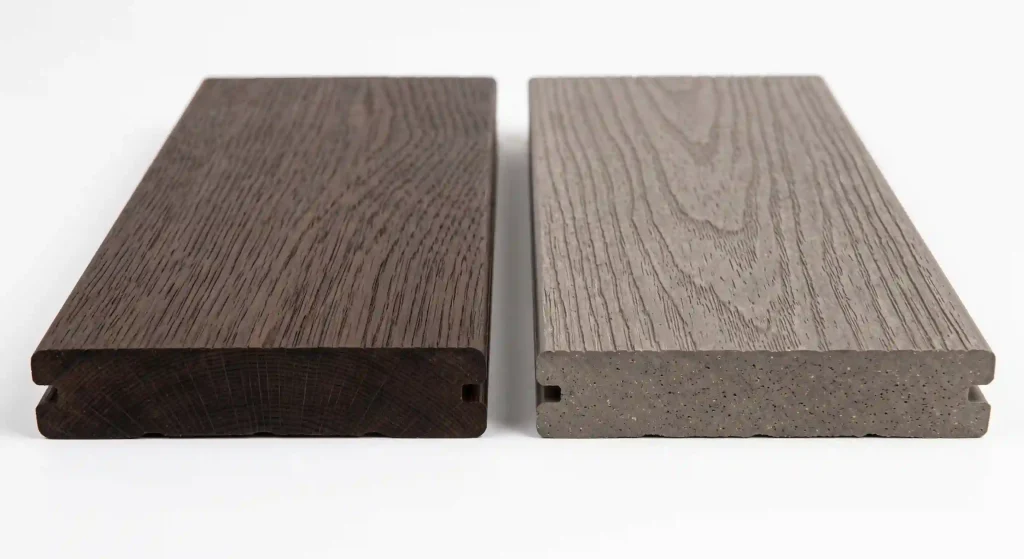
The comparison below covers the criteria most relevant to B2B commercial decking specification in UK and EU markets. Data for Ultimate FBR is independently verified; data for composite reflects published WPC product characteristics.
| Property | Furan Resin Modified Hardwood (Ultimate FBR) | WPC Composite Decking (typical range) |
|---|---|---|
| Material composition | Solid hardwood — cell wall polymer modification | Wood fibre (50–65%) + HDPE polymer (25–35%) + additives |
| Density | 743 kg/m³ (verified) | Typically 900–1,400 kg/m³ (varies by formulation) |
| Surface hardness | High — solid hardwood | Moderate — lower bending stiffness under point loads |
| Dimensional stability (ASE) | 44.33% (verified) | Polymer matrix — thermal expansion, not hygroscopic |
| Durability class (EN 350:2016) | Class 2 — full cross-section, verified | Not classified under EN 350 (non-timber product) |
| Fire performance (EN 13501-1) | B-s2-d0 achievable | Typically Euroclass D–E (formulation dependent) |
| Surface heat retention | Low — solid timber thermal properties | High — polymer content increases solar heat absorption |
| FSC/PEFC CoC certification | FSC® Ready · PEFC™ Ready · SVLK | Not available as solid timber product |
| BREEAM responsible sourcing | Supports Mat 03 credits (solid FSC/PEFC timber) | Does not qualify for solid timber responsible sourcing credits |
| EUDR compliance | Low burden — SVLK FLEGT recognised | Out of primary EUDR scope (not solid timber) |
| End-of-life | Standard wood waste / energy recovery | Complex — polymer content limits composting and combustion options |
| Maintenance requirement | UV-stabilising coating renewal — no biocidal retreatment | Periodic cleaning — no coating required |
| Biocidal chemistry | None | None |
| Natural appearance | Solid timber — genuine grain, natural colour | Simulated timber grain — polymer surface |
Verified Performance Data: Ultimate FBR as a Composite Decking Alternative
The performance data for composite decking alternative specification using Ultimate FBR modified hardwood has been independently verified by IPB University (Indonesia) and the Université de Lorraine (France) against EN, BS, ASTM, AWPA, and SNI standards.
| Performance property | Untreated hardwood | Ultimate FBR | Test standard |
|---|---|---|---|
| Density | Baseline | 743 kg/m³ | Tested |
| Volumetric swelling | 10.04% | 2.35% | EN 350 |
| Water uptake | 109.58% | 35.07% | ASTM |
| Anti-Swelling Efficiency (ASE) | — | 44.33% | Tested |
| Durability classification | Class 3–4 (species dependent) | Class 2 | EN 350:2016 |
| Fire performance | Euroclass D (typical) | B-s2-d0 achievable | EN 13501-1 |
On dimensional stability vs composite: WPC composite expands and contracts thermally — not hygroscopically. Ultimate FBR at ASE 44.33% and volumetric swelling 2.35% has very low hygroscopic movement. Both materials require correct gap allowances at installation; modified hardwood is more predictable in mixed thermal-moisture environments and far more responsive to the EN 350 durability framework that regulated procurement references.
On durability vs composite: Composite does not receive a biological durability classification under EN 350:2016 — it is not a solid timber product. Its resistance to decay derives from the polymer matrix. Ultimate FBR carries Class 2 durability under EN 350:2016, verified by independent testing, applying uniformly to the full board cross-section, and permanent over the service life of the installation.
On fire performance: This is the decisive distinction for regulated applications. Standard WPC composite achieves Euroclass D or E at material level. Furan resin modified hardwood achieves Euroclass B-s2-d0 — without applied fire retardant, at material level, including the d0 designation confirming no flaming droplets. For rooftop terraces and elevated commercial decks above 11 metres, modified hardwood provides a compliant option that composite cannot match at material level.
The Specification Advantages That Composite Cannot Match
FSC and PEFC Chain-of-Custody Certification
For projects seeking BREEAM, LEED, or DGNB credits for responsible material sourcing, the distinction between FSC-certified solid timber and WPC composite is material. BREEAM’s Mat 03 responsible sourcing credit scheme awards points for solid timber products with verified FSC or PEFC chain-of-custody certification from forest to delivered product. WPC composite decking is not eligible for the same solid timber FSC or PEFC CoC credits, regardless of the timber fibre content.
Ultimate FBR is FSC® Ready and PEFC™ Ready — chain-of-custody certification is available through the distribution network where required — alongside SVLK certification (EU FLEGT recognised). For specifiers writing sustainable material procurement clauses that require FSC or PEFC CoC certification on decking, modified hardwood satisfies the requirement and composite does not.
Thermal Comfort on Commercial Terraces
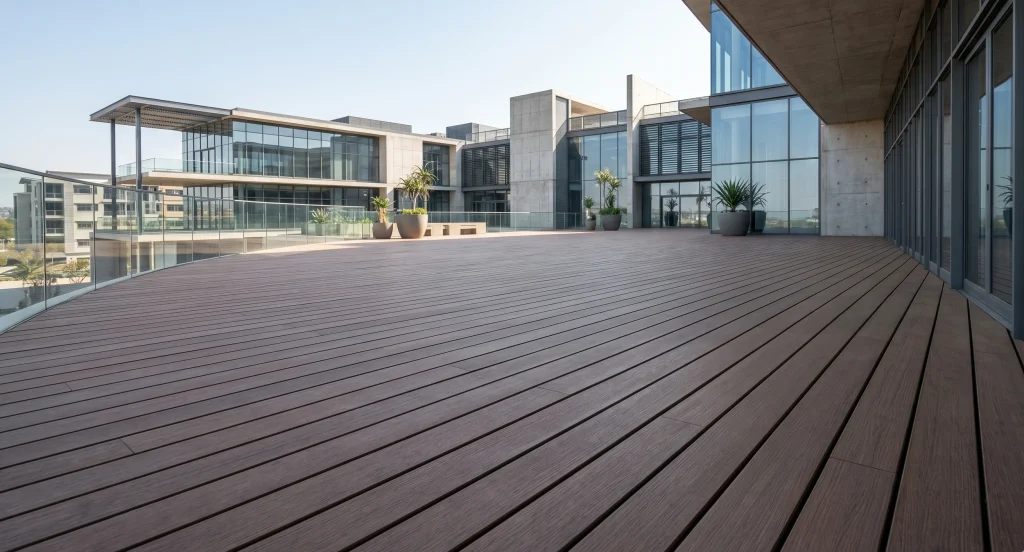
On south and west-facing commercial terraces and hospitality decks where summer occupancy is a design priority, the thermal performance of the deck surface matters. WPC composite boards — with polymer content that absorbs and retains solar radiation — consistently reach surface temperatures significantly above those of solid timber in direct sun. For bare-foot hospitality use and any deck where prolonged contact between the board surface and building users is expected in summer, solid modified hardwood at 743 kg/m³ delivers substantially lower surface temperatures than equivalent composite products.
Natural Material Specification
For architects and clients where genuine natural timber appearance — visible grain, organic colour, authentic material presence — is a design requirement or a planning condition, WPC composite cannot substitute. The simulated timber grain of composite boards is a surface characteristic, not a material property. Modified hardwood provides the authentic natural appearance of solid timber, with the performance credentials that untreated hardwood cannot reliably deliver.
Application-Based Decision: When to Choose Modified Hardwood Over Composite
Choose furan resin modified hardwood when:
The project requires FSC or PEFC chain-of-custody certification for BREEAM, LEED, or DGNB responsible sourcing credits. The building is above 11 metres and Euroclass B fire performance is required for the decking surface. The project is a hospitality terrace, rooftop bar, or commercial deck where surface heat retention in summer sun is a client comfort concern. The design requires authentic natural timber appearance that composite cannot provide. EUDR due diligence documentation requirements apply to all wood-derived products on the project.
Choose composite decking when:
Maintenance-free operation — no coating renewal under any circumstances — is the absolute priority and the client has confirmed this. The project is below 11 metres, Euroclass D is acceptable, and FSC or PEFC CoC certification is not a procurement requirement. The project brief explicitly requires WPC composite for consistency with adjacent installed composite elements. Budget constraints make the lower installed cost of mid-range composite the determining factor and lifecycle cost analysis is not part of the brief.
The hybrid approach:
For large-scale commercial developments with mixed specification requirements, both materials can serve the same project. Composite for sheltered ground-level areas where maintenance-free operation is the priority; composite decking alternative in modified hardwood where elevated decks, FSC certification, or Euroclass B fire performance are required.
Frequently Asked Questions about Composite Decking Alternatives
What is the best alternative to composite decking?
The most appropriate composite decking alternative depends on the performance requirements and procurement obligations of the specific project. For commercial decking where Euroclass B fire classification is required, FSC or PEFC certification is a procurement condition, or natural timber appearance is a design requirement, furan resin modified hardwood — such as Ultimate FBR — provides independently verified Class 2 durability (EN 350:2016), ASE 44.33%, density 743 kg/m³, and achievable Euroclass B-s2-d0 fire performance, alongside SVLK certification and FSC® Ready and PEFC™ Ready sourcing credentials.
Is composite decking better than real wood?
Composite decking has genuine advantages over untreated timber: no biocidal retreatment requirement, resistance to biological decay without annual maintenance, and consistent appearance. However, it has limitations that modified solid hardwood addresses: composite typically achieves Euroclass D fire performance at material level (versus B-s2-d0 achievable for furan resin modified hardwood); cannot be FSC or PEFC chain-of-custody certified as a solid timber product; retains solar heat more aggressively in summer; and has lower bending stiffness under point loads than solid hardwood at equivalent thickness. For regulated commercial projects where any of these factors are specification criteria, modified hardwood is the stronger specification.
What are the disadvantages of composite decking?
The principal limitations of WPC composite decking for regulated B2B specification are: fire performance typically limited to Euroclass D at material level without additional treatment; ineligibility for FSC or PEFC chain-of-custody certification as a solid timber product (relevant for BREEAM, LEED, and DGNB responsible sourcing credits); higher surface heat retention in direct sun compared to solid timber; lower bending stiffness under point loads than solid hardwood; and restricted end-of-life disposal options due to polymer content. For projects where any of these criteria are specification requirements, modified hardwood provides a technically superior alternative.
Is composite decking fire rated?
Standard WPC composite decking typically achieves Euroclass D or E under EN 13501-1 — insufficient for buildings above 11 metres where Approved Document B requires Euroclass B. Some composite products achieve improved fire classification through fire retardant additives, but material-level Euroclass B-s2-d0 classification — as achievable for furan resin modified hardwood — is not typically available from standard WPC composite without specific fire-rated product selection and system-level testing. For elevated decking applications requiring Euroclass B, modified hardwood is a more straightforward compliant specification.
Can composite decking be FSC certified?
WPC composite decking cannot be FSC or PEFC chain-of-custody certified as a solid timber product. FSC and PEFC CoC certification tracks solid wood products through a verified forest-to-product supply chain. WPC composite — manufactured from blended wood fibre and thermoplastic polymer — does not qualify for the same solid timber certification pathway. For BREEAM Mat 03 responsible sourcing credits that require FSC or PEFC CoC-certified solid timber, composite decking is not eligible. Ultimate FBR modified hardwood is FSC® Ready and PEFC™ Ready, with CoC certification available through the distribution network on request.
How does composite decking compare to modified timber on maintenance?
Both WPC composite decking and furan resin modified hardwood eliminate the biocidal retreatment requirement of preservative-treated softwood. Composite requires periodic cleaning — pressure washing to remove organic growth and surface staining — but no coating renewal. Furan resin modified hardwood requires periodic UV-stabilising coating renewal to maintain surface appearance, but no biocidal retreatment; Class 2 biological durability is structural and permanent. For clients who define “low maintenance” as no coating renewal, composite has an advantage. For clients who accept periodic coating renewal in exchange for better fire performance, FSC eligibility, and lower surface heat retention, modified hardwood delivers a more complete specification.
What decking material is best for a rooftop terrace?
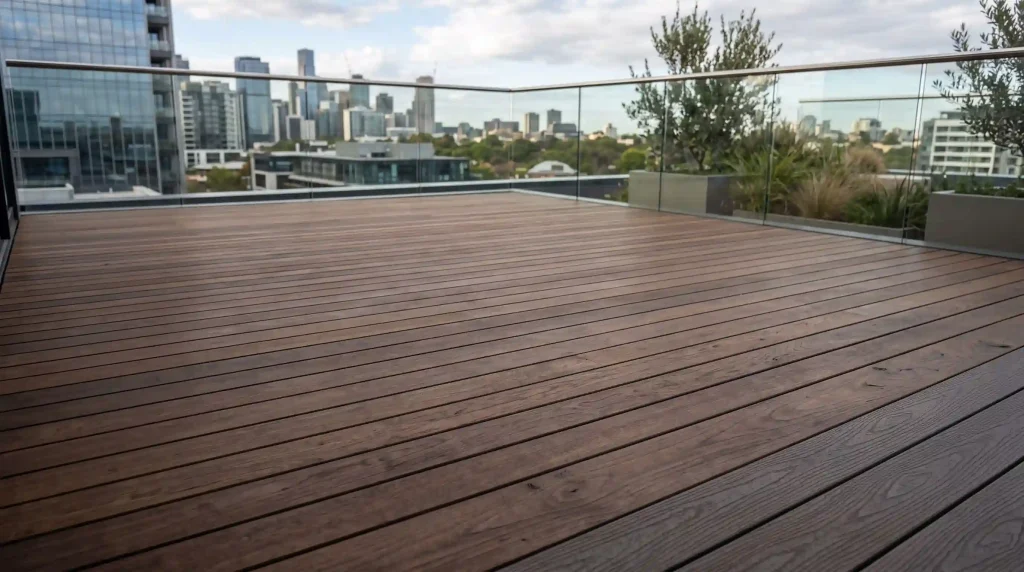
For rooftop terraces — typically above 11 metres and therefore subject to Euroclass B fire performance requirements under Approved Document B — standard WPC composite decking does not comply at material level. Furan resin modified hardwood achieving Euroclass B-s2-d0 at material level provides a compliant solid timber decking option for rooftop applications, alongside the thermal comfort advantage of lower surface heat retention versus composite in direct summer sun. The d0 designation — no flaming droplets — is particularly relevant for occupied rooftop terraces where falling burning debris represents a secondary ignition risk to occupants below.
Specify a Composite Decking Alternative With Verified Credentials
Composite decking earns its place in the specification toolkit — but not on every project. When the brief requires FSC or PEFC chain-of-custody certification for green building credits, Euroclass B fire performance for elevated or commercial applications, natural timber appearance that composite can simulate but not replicate, or lower surface heat retention on south-facing terraces, furan resin modified hardwood provides a technically verified alternative that composite cannot match.
Ultimate FBR delivers Class 2 durability under EN 350:2016 uniform throughout the board, ASE 44.33% and volumetric swelling 2.35%, density 743 kg/m³, and Euroclass B-s2-d0 fire performance — tested by IPB University and the Université de Lorraine, France. SVLK certification and FSC® Ready and PEFC™ Ready status provide the sourcing credentials that regulated B2B procurement requires and that composite cannot supply.
For technical documentation, sizing requirements, or supply enquiries, contact the team via the contact form. European distribution through Houtplex B.V. in Haaksbergen, Netherlands; Asian and Pacific markets through Wood United Pte Ltd in Singapore — both part of the Wood United Group.