Wood Panelling — Specifying Modified Hardwood for Commercial Interiors
Wood panelling in a commercial interior has to meet the wall-lining fire class for the room it sits in, hold its joints through seasonal humidity swings and keep a consistent colour across large areas. Ultimate FBR modified hardwood offers Euroclass B-s2-d0 achievable, ASE 44.33% and 743 kg/m³ density — enough for corridors and lobbies where untreated timber falls short.
The usual specification problem with solid wood panelling on interior walls is not appearance. It is the moment a fire engineer asks for the lining classification of a corridor, or the moment the first heating season opens every tongue-and-groove joint on a hotel feature wall. Both failures are predictable, and both are decided by material data rather than species name.
This guide sets out what interior wood panelling must achieve under UK and European rules, how furan resin modified hardwood compares with oak, thermally modified softwood and veneered board, and what a defensible panelling specification should contain.
What Wood Panelling Has to Deliver in a Commercial Interior
Commercial wood panelling has to satisfy four measurable criteria at once: reaction to fire for the room type, dimensional stability under indoor humidity cycling, surface hardness for the traffic level, and colour consistency across the installed area. A board that excels on three and fails on one still fails the brief.
Reaction to fire. Wall and ceiling linings are regulated by room type, not by material preference. Wood panelling that is acceptable in a small office may be non-compliant in the corridor outside it. This is the criterion most often discovered late — after a species has been chosen on appearance.
Dimensional stability. Commercial interiors are not climate-stable. Winter heating dries the air, summer ventilation and occupancy raise humidity, and a ground-floor lobby with automatic doors sees both in the same day. Every percentage point of swelling becomes joint movement, coating stress or cupping across the board width.
Surface hardness. Lobbies, corridors, retail units and hospitality spaces subject wood panelling to trolleys, luggage, chairs and hands. Hardness tracks density closely, so density is the most useful single proxy when comparing materials for high-traffic walls.
Colour consistency. A feature wall of several hundred square metres is a single visual surface. Natural variation between boards — sapwood, knots, batch-to-batch colour shifts — becomes a grading and sorting cost on site, or a visible patchwork after installation.
Wood Panelling Fire Classification: What Approved Document B Requires
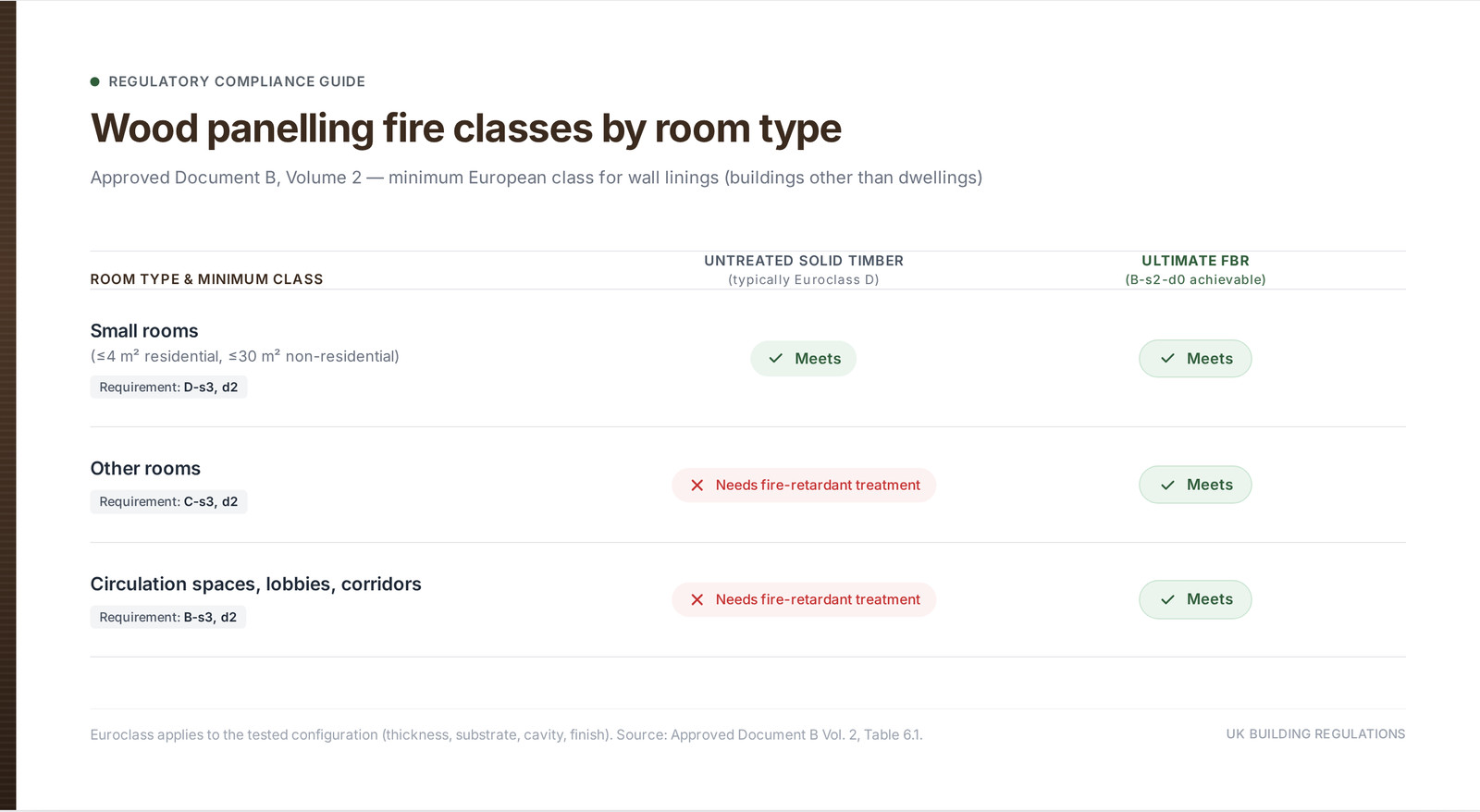
In England, the fire requirement for wood panelling used as a wall lining depends on the room type, and corridors carry the strictest class. Table 6.1 of Approved Document B, Volume 2 sets the minimum European classifications for buildings other than dwellings.
| Location (buildings other than dwellings) | Minimum European class for wall linings | Untreated solid timber (typical) | Ultimate FBR |
|---|---|---|---|
| Small rooms — max 4 m² residential, 30 m² non-residential | D-s3, d2 | Meets | Meets — B-s2-d0 achievable |
| Other rooms (including garages) | C-s3, d2 | Does not meet without treatment | Meets — B-s2-d0 achievable |
| Other circulation spaces, incl. common areas of flats | B-s3, d2 | Does not meet without treatment | Meets — B-s2-d0 achievable |
The practical consequence for wood panelling is significant. Untreated solid timber typically classifies at Euroclass D, which covers small rooms only. Larger rooms need Class C and circulation spaces need Class B — the corridors, lobbies, stairwells and reception areas where architects most often want timber walls.
The standard workaround is a fire-retardant treatment or coating. That works, but it adds a second product with its own performance declaration, its own durability questions and, for some treatments, sensitivity to humidity. Furan resin modified hardwood takes a different route: B-s2-d0 is achievable for the modified board itself, with no applied retardant chemistry.
Two details matter when writing this into a specification. First, B-s2-d0 is better than the B-s3, d2 minimum on both secondary criteria — s2 limits smoke production and d0 means no flaming droplets. Second, a Euroclass result applies to the tested configuration: thickness, substrate, air gap, fixing and any surface finish. Request the classification report that matches the wood panelling build-up being specified, rather than relying on a headline class.
The 2026 EN Panelling Standards and Where Modified Hardwood Fits
Solid hardwood panelling in Europe is now covered by EN 14951:2026, which explicitly brings modified hardwoods within scope. According to iTeh Standards’ summary of the July 2026 publications, three CEN product standards were revised together: EN 14519:2026 (softwood, tongue and groove), EN 15146:2026 (softwood, without tongue and groove) and EN 14951:2026 (solid hardwood panelling and cladding, machined profiles).
For specifiers, three points from the revision are relevant:
- Modified timber is in scope. Thermally and chemically modified wood, and modified hardwoods in the case of EN 14951, are covered — so a modified hardwood profile can be referenced to a named product standard rather than described as a bespoke item.
- Moisture content is controlled. The standards set moisture content ranges with measurement to EN 13183, which is the figure to check on delivery before installation.
- CE marking still runs through EN 14915. The profile standards define dimensions and tolerances; the harmonised standard for solid wood panelling and cladding under the Construction Products Regulation remains EN 14915, which carries the reaction-to-fire declaration.
In practice, a wood panelling specification should cite the profile standard for geometry and tolerances and the declaration of performance for fire and other regulated characteristics. Asking only for “hardwood T&G to EN 14951” leaves the fire question open.
Movement, Humidity and Joint Design in Wood Panelling
Joint behaviour in wood panelling is governed by how much the board swells and shrinks between the driest and wettest indoor conditions it will see. For wood panelling, two figures predict it better than species tables: anti-swelling efficiency (ASE), which measures how much of the natural swelling a modification removes, and absolute volumetric swelling.
Independent testing by IPB University in Indonesia and the Université de Lorraine in France gives the following for Ultimate FBR, validated against EN, BS, ASTM, AWPA and SNI test standards:
| Property | Untreated hardwood | Ultimate FBR |
|---|---|---|
| Volumetric swelling | 10.04% | 2.35% |
| Water uptake | 109.58% | 35.07% |
| Anti-swelling efficiency (ASE) | — | 44.33% |
| Density | Species dependent | 743 kg/m³ |
| Biological durability (EN 350:2016) | Species dependent | Class 2 |
Volumetric swelling falls by more than three-quarters and water uptake by roughly two-thirds. For interior wood panelling this has three direct consequences.
Narrower joint allowances. Tongue-and-groove profiles need enough tongue engagement to stay closed in dry winter conditions without the boards buckling in humid summer conditions. Lower movement means the wood panelling profile works within a narrower band, so shadow gaps and reveals stay visually consistent.
Less coating stress. Film-forming finishes crack where the substrate moves more than the film can stretch. Reduced swelling keeps a lacquer or oil-wax film intact for longer, particularly on wide boards towards the 285mm end of the range.
Slower moisture response. Lower water uptake means the board takes on and releases moisture more slowly. Short humidity spikes — a busy reception on a wet day, a cleaning cycle in a changing area — produce less movement than the same spike in untreated timber.
Dimensional stability does not remove the need for good practice. Boards should be delivered at a moisture content close to the expected in-service equilibrium, acclimatised in the conditioned space, and fixed with an expansion allowance at perimeters, abutments and penetrations.
Wood Panelling Materials Compared: Modified Hardwood, Oak, Thermally Modified and Veneered Board
The four materials most often considered for commercial wood panelling differ most on fire class and colour consistency, not on appearance. The comparison below uses verified data for Ultimate FBR and published or generic characteristics for the alternatives.
| Criterion | Ultimate FBR modified hardwood | Untreated oak | Thermally modified softwood | Veneered MDF / board |
|---|---|---|---|---|
| Material | Solid hardwood, furan resin polymer in the cell wall | Solid hardwood | Solid softwood, heat-treated | Thin veneer on engineered core |
| Reaction to fire | B-s2-d0 achievable | Euroclass D typical untreated | Fire class D (ThermoWood Handbook) | Depends on core; FR cores available |
| Density / hardness | 743 kg/m³ — higher than untreated baseline | High | Lower than untreated wood | Surface hardness limited by veneer thickness |
| Dimensional stability | ASE 44.33%, swelling 2.35% | Untreated species movement | Improved versus untreated | Stable core, edges vulnerable to moisture |
| Colour consistency | Uniform dark brown, no defects | Natural variation, grading needed | Natural variation, knots typical | Depends on veneer matching |
| Refinishing | Can be sanded and refinished | Can be sanded and refinished | Can be sanded and refinished | Limited by veneer thickness |
| Biocidal chemistry | None | None | None | Core resins vary |
Against untreated oak, the deciding factors for wood panelling are fire class and consistency. Oak delivers the hardness and the look, but larger rooms and circulation spaces need a retardant system, and colour grading adds cost on large walls.
Against thermally modified softwood, the deciding factors are density and fire class. The ThermoWood Handbook published by the Finnish ThermoWood Association states that density decreases as treatment temperature increases, and classifies ThermoWood in fire class D. That makes thermally modified boards a sound choice for small rooms and exterior use, and a weaker one for high-traffic corridors.
Against veneered board, the deciding factor is lifespan. Veneered panels can reach high fire classes with fire-retardant cores and are dimensionally stable, but surface damage cannot be sanded out beyond the veneer thickness. Solid wood panelling can be repaired and refinished several times over a fit-out cycle, which veneered panelling cannot match.
Where Modified Hardwood Wood Panelling Earns Its Place
Modified hardwood wood panelling is most worth its cost where an interior combines a Class B or C lining requirement with heavy use and a demanding appearance brief.
Lobbies, corridors and stair cores
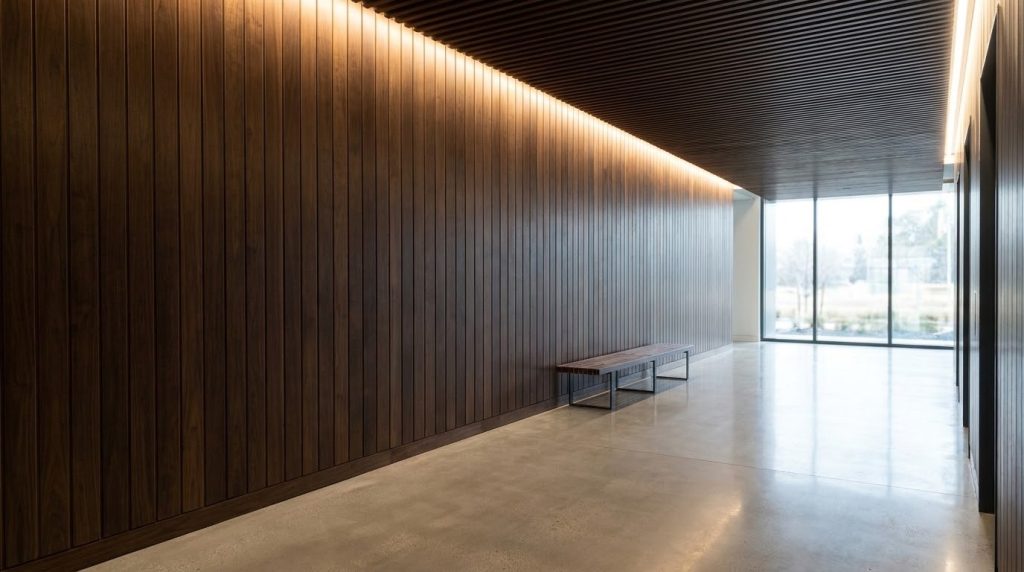
Circulation spaces carry the Class B requirement under Approved Document B and the heaviest wear. These are also the areas where clients most often want wood panelling, because they form the first impression of the building. A board with B-s2-d0 achievable and 743 kg/m³ density addresses both constraints in one product, without a separate retardant treatment to maintain.
Hospitality and retail fit-outs
Hotels, restaurants and retail units refit on short cycles and expect panelling to survive luggage, furniture and cleaning regimes. Uniform colour with no defects removes the board-by-board sorting that natural hardwood panelling needs on large feature walls, which saves time on site and avoids patchy results.
Education, healthcare and public buildings
For schools, clinics and public buildings, two criteria dominate: the lining class of corridors and assembly areas, and the material chemistry of the wall surface. Furan resin modification uses furfuryl alcohol derived from agricultural residues; the cured polymer contains no biocides or heavy metals. For sustainable timber procurement, the board also carries SVLK certification (EU FLEGT recognised) with FSC® Ready and PEFC™ Ready status.
Humid but not hot interiors
Wood panelling in changing rooms, pool-hall perimeter walls and washroom feature walls sees high humidity and frequent cleaning. Water uptake of 35.07% against 109.58% for untreated hardwood keeps movement low in these spaces. Saunas and steam rooms are a separate case with high surface temperatures; Ultimate FBR has not been tested for that use, so it should not be specified there on the basis of this data.
Continuing the line outside
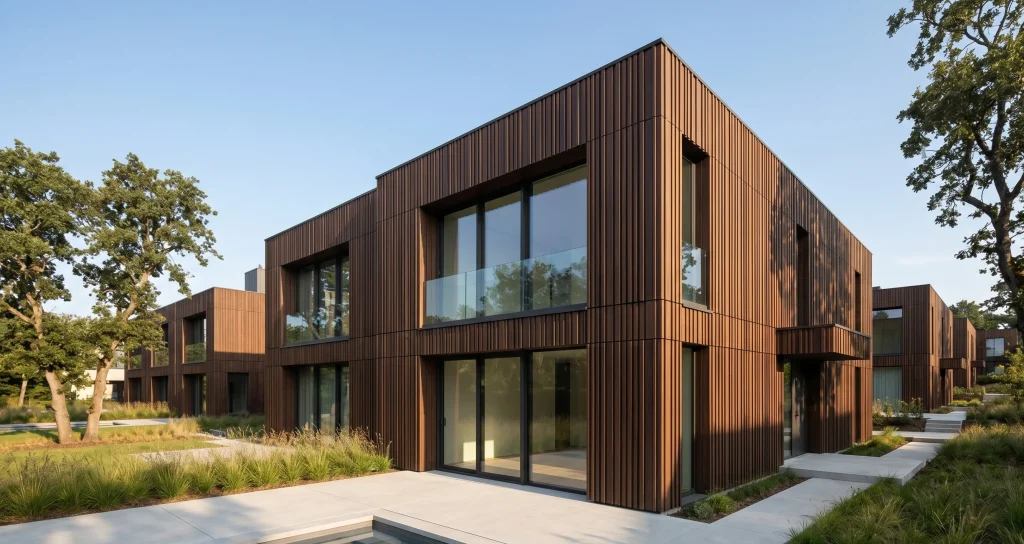
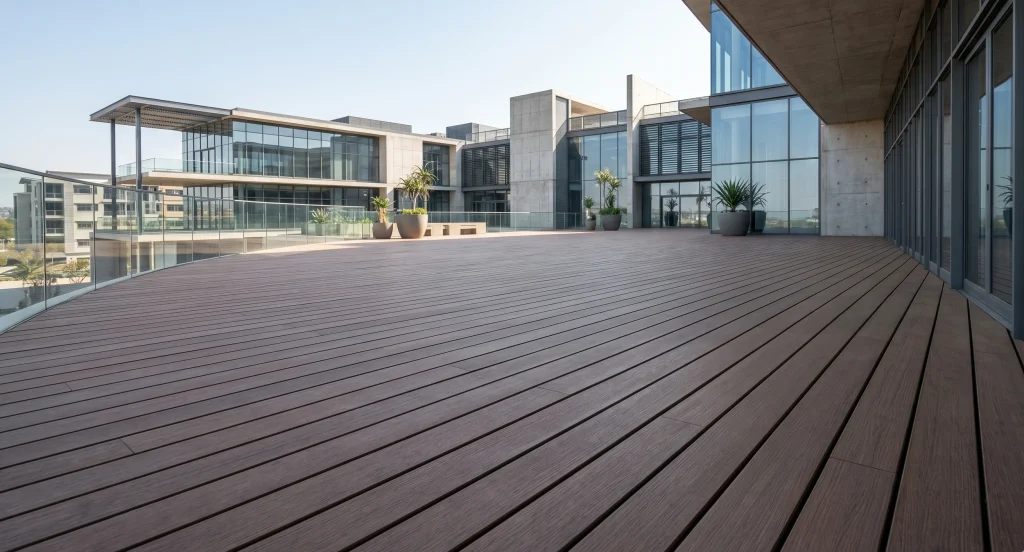
Many projects run the same wood panelling from an interior wall through a glazed screen to a soffit or façade. Because the same board is used for exterior timber cladding, the interior and exterior surfaces can match in colour and profile, which is difficult to achieve when the inside is oak and the outside is a different species or a thermally modified product.
Specifying Wood Panelling: A Seven-Point Checklist
A complete wood panelling specification answers seven questions before the order is placed.
- Lining class per room. For each area of wood panelling, list the space with its required European class under Approved Document B (or the national equivalent) and confirm the panel’s classification report covers it.
- Tested build-up. Match thickness, substrate, cavity, fixing and finish to the classification report. A different finish or an open cavity can change the result.
- Profile and standard. Reference EN 14951:2026 for hardwood profiles and tolerances, and the declaration of performance under EN 14915 for regulated characteristics.
- Moisture content on delivery. Specify a target range measured to EN 13183 and an acclimatisation period in the conditioned space.
- Movement allowances. Detail perimeter gaps and abutments using the verified swelling data — 2.35% volumetric for Ultimate FBR.
- Finish system. Specify a finish compatible with the substrate and the fire classification, and record the maintenance and refinishing interval.
- Sourcing documentation. Request SVLK V-Legal documentation for legality and EUDR timber due diligence, and confirm FSC® or PEFC™ chain-of-custody needs at tender stage.
For wood panelling, Ultimate FBR is available in 12–32mm thickness, 90–285mm width and 900–5900mm length, which covers narrow T&G boards, wide-plank feature walls and long ceiling runs without end joints in most rooms.
Frequently Asked Questions about Wood Panelling
What is the best wood for wall panelling in commercial buildings?
The best wood for commercial wall panelling is the one that meets the lining fire class of each room while holding its joints and colour over time. For circulation spaces and larger rooms, furan resin modified hardwood such as Ultimate FBR is a strong option because B-s2-d0 is achievable without a retardant coating, alongside ASE 44.33% and 743 kg/m³ density. For small rooms, untreated hardwoods and thermally modified boards are also compliant.
What fire rating does wood panelling need in the UK?
In buildings other than dwellings in England, wood panelling used as a wall lining needs at least D-s3, d2 in small rooms, C-s3, d2 in other rooms and B-s3, d2 in circulation spaces, according to Table 6.1 of Approved Document B Volume 2. Untreated timber usually reaches only Euroclass D. Always check the classification report against the exact build-up being installed.
What is the difference between panelling and cladding?
Panelling usually refers to timber boards fixed to interior walls and ceilings, while cladding usually refers to boards on the external envelope. The European product standards treat them together — EN 14951:2026 covers solid hardwood panelling and cladding — but the regulatory requirements differ, because interior linings are classified by room type and external cladding by building height and boundary distance.
Can wood panelling be used in bathrooms and changing rooms?
Yes, wood panelling can be used in bathrooms and changing rooms if the board has low moisture uptake, the finish is suited to wet cleaning and the boards are not in direct, prolonged contact with standing water. Ultimate FBR’s water uptake of 35.07% against 109.58% for untreated hardwood keeps movement low in humid rooms. Saunas and steam rooms involve high temperatures and fall outside the tested use.
Does a finish or coating change the fire classification of panelling?
A finish can change the fire classification, because the Euroclass applies to the tested product configuration including any surface treatment. If a lacquer, stain or oil is applied after the classification test, confirm with the supplier or a test report that the classification still applies, or that the finish has been tested on the same substrate.
Is furan resin modified wood suitable for interior use?
Yes. Furan resin modification polymerises furfuryl alcohol, derived from agricultural residues such as sugar cane bagasse, inside the wood cell wall. The cured polymer is fixed in the wood and the treatment uses no biocides or heavy metals, which makes the material suitable for occupied interiors including schools and healthcare buildings.
Can the same boards be used for interior and exterior wood panelling?
Yes. Ultimate FBR carries Class 2 durability under EN 350:2016 and the same dimensional stability data applies inside and out, so one board can run from an interior wall to a soffit or façade. Exterior use needs a UV-stable finish or an accepted silvering appearance, and a ventilated fixing detail behind the boards.
Request Panelling Data for Your Project
Ultimate FBR gives interior designers and specifiers solid hardwood for wood panelling, with B-s2-d0 fire performance achievable, ASE 44.33%, volumetric swelling of 2.35%, 743 kg/m³ density and uniform dark-brown colour — independently tested by IPB University and the Université de Lorraine, with SVLK certification and FSC® Ready and PEFC™ Ready status.
For classification reports, profile options, samples or project pricing, contact the team via the contact form. European and UK enquiries are handled by Houtplex B.V. in Haaksbergen, the Netherlands; Asia-Pacific projects are served by Wood United Pte Ltd in Singapore. Both are part of the Wood United Group.