Thermally Modified Wood — Process, Properties and Where It Falls Short
Thermally modified wood is timber heated to between 185 °C and 215 °C in steam-protected kilns, which permanently lowers its moisture uptake and improves decay resistance without chemicals. The trade-off is lower density and strength and a Euroclass D fire rating — limits that furan resin modified hardwood such as Ultimate FBR does not share.
Thermally modified timber is now one of the most widely specified modified woods in Europe, especially for cladding on low-rise buildings. It is also frequently misunderstood: specifiers sometimes treat it as interchangeable with chemically modified products, or expect it to behave like a dense tropical hardwood. Neither assumption holds.
This explainer covers how thermal modification works, what the two main ThermoWood classes deliver, what the heat takes away from the wood, and how thermally modified wood compares with furan resin modified hardwood on the criteria that decide specifications.
What Thermally Modified Wood Is
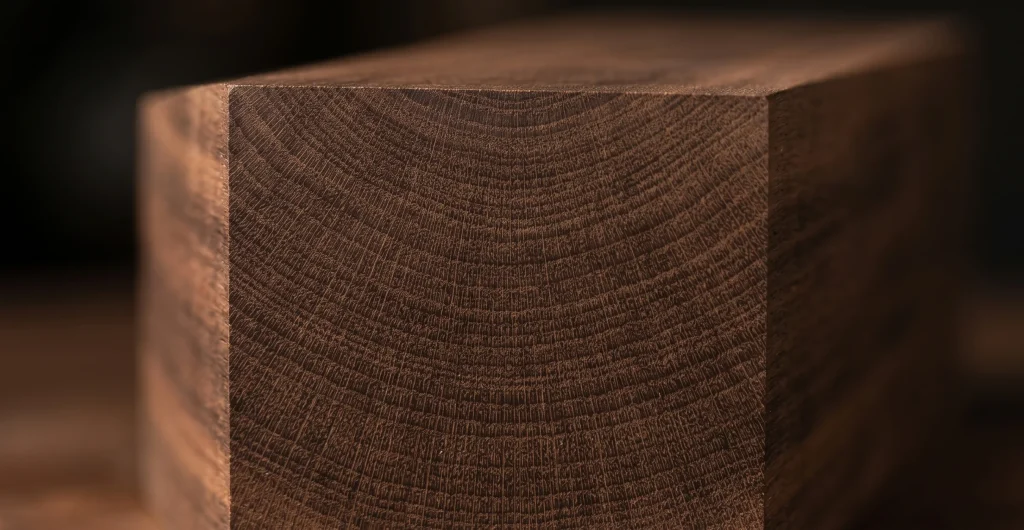
Thermally modified wood is solid timber whose chemistry has been changed by heat alone, with no added substances. Heating wood to high temperatures in a controlled atmosphere breaks down part of the hemicellulose in the cell walls — the most water-attracting component of wood — and alters the lignin. The result is a board that absorbs less moisture, moves less and is less attractive to decay fungi.
Several commercial processes exist. The best documented is ThermoWood, a registered name used under licence by members of the Finnish ThermoWood Association, whose ThermoWood Handbook sets out the process, classes and properties. Most thermally modified products on the European market are softwoods — pine and spruce — although thermally modified hardwoods such as ash and poplar are also produced.
Three features distinguish thermally modified wood from chemically modified wood:
- Nothing is added. The change comes from heat and steam; no resin, acid or polymer enters the wood.
- Mass and density fall. Breaking down hemicellulose removes material, so the board becomes lighter than the untreated source timber.
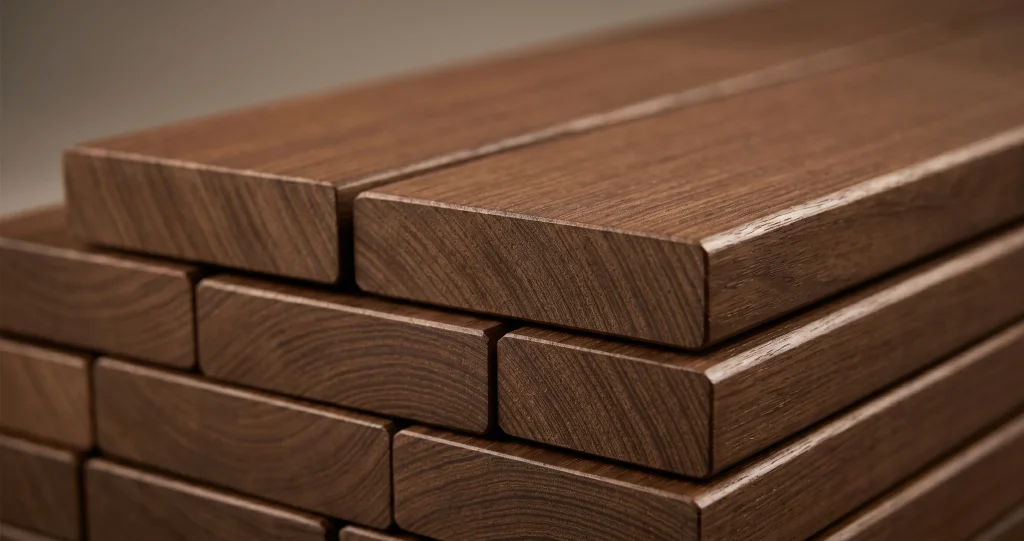
- Colour darkens through the section. The brown tone is not a surface stain; it extends through the board, although it greys under UV exposure like any untreated timber.
The Thermal Modification Process Step by Step
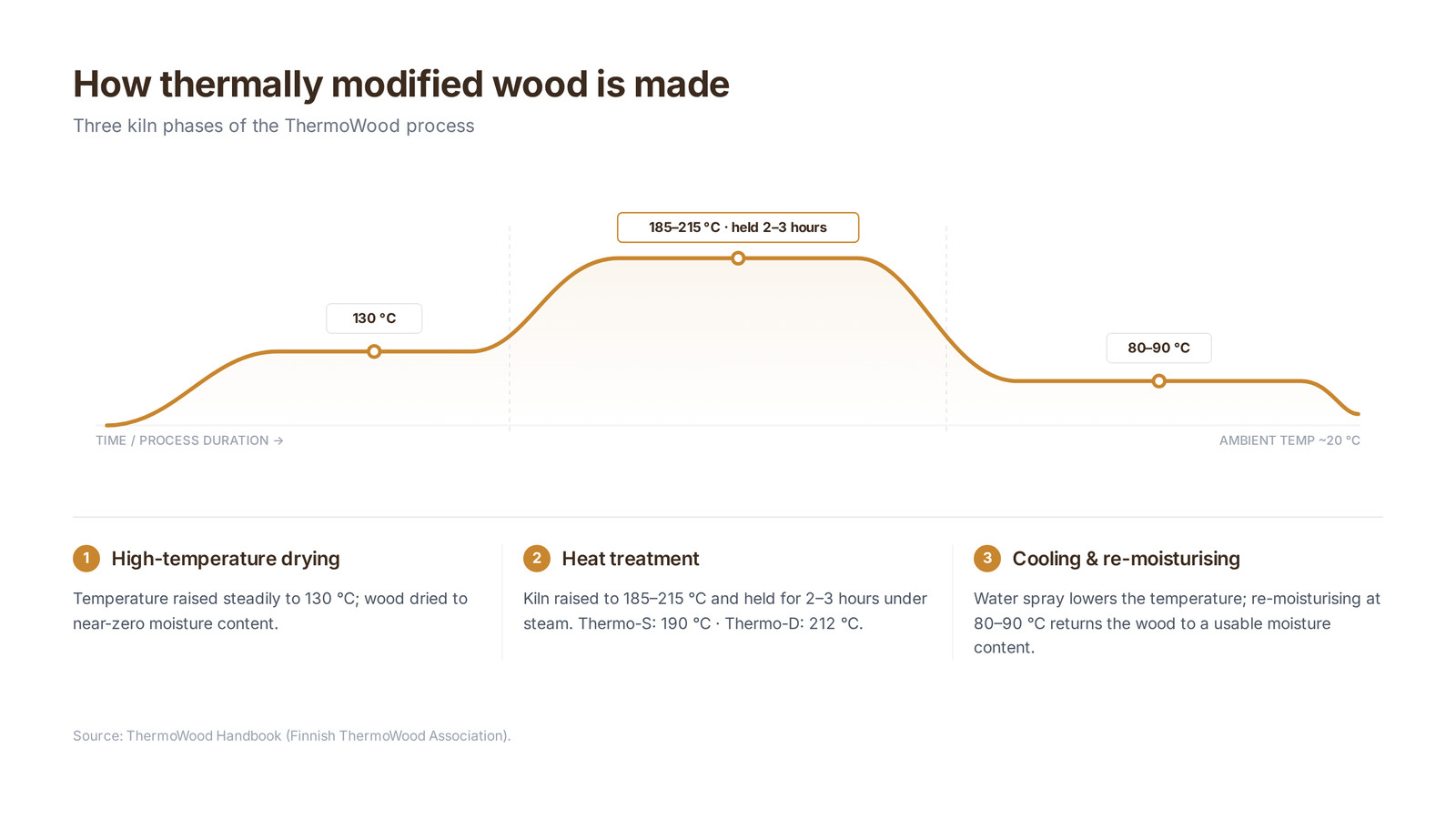
Thermally modified wood is produced in three kiln phases: drying, heat treatment and cooling with re-moisturising. The ThermoWood Handbook describes the sequence as follows.
| Phase | What happens | Temperature |
|---|---|---|
| 1. High-temperature drying | Temperature is raised steadily to dry the wood to near-zero moisture content | Up to 130 °C |
| 2. Heat treatment | Kiln temperature is raised and held for 2–3 hours, under steam to prevent combustion and protect the wood | 185–215 °C |
| 3. Cooling and conditioning | Water spray lowers the temperature; re-moisturising brings the wood back to a usable moisture content | Re-moisturising at 80–90 °C |
Total process time varies with species and board dimensions. The peak temperature in phase 2 is the main variable: higher temperatures give greater stability and decay resistance, but also greater loss of density and strength. That trade-off defines the two standard ThermoWood classes.
Thermo-S and Thermo-D: The Two Main Classes of Thermally Modified Timber
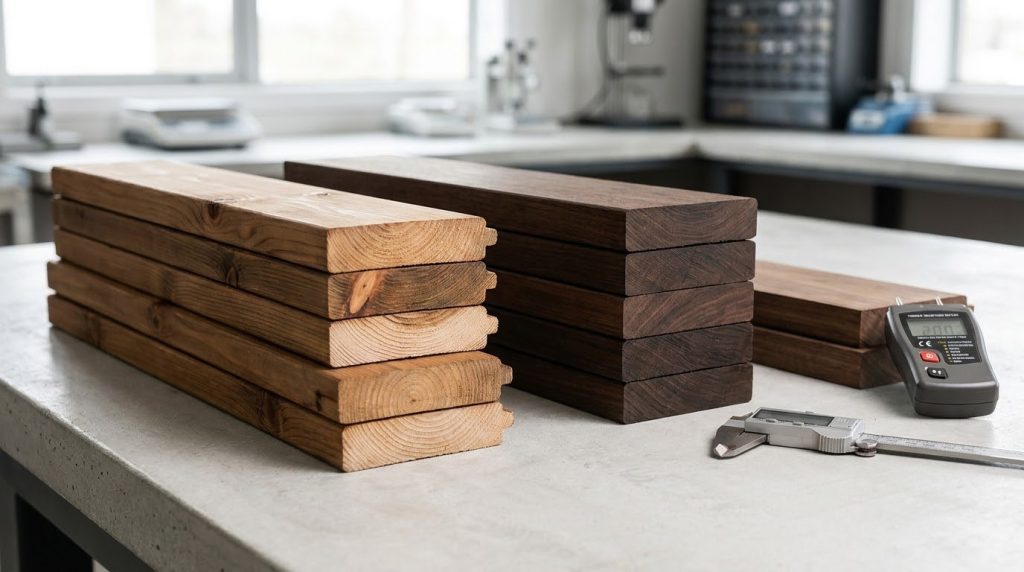
Thermally modified softwood under the ThermoWood system is sold in two classes, Thermo-S (treated at 190 °C) and Thermo-D (treated at 212 °C), and they are intended for different uses.
| Criterion | Thermo-S | Thermo-D |
|---|---|---|
| Treatment temperature (softwood) | 190 °C | 212 °C |
| Decay resistance (EN 113, as reported in the handbook) | Class 3 — relatively durable | Class 2 — durable |
| Typical uses listed in the handbook | Building components, furniture, sauna benches, door and window components | Cladding, outer doors, shutters, environmental constructions, sauna and bathroom furnishing |
| Stability | Improved versus untreated | Further improved |
| Strength retention | Higher | Lower |
The “S” stands for stability and the “D” for durability. For exterior applications, Thermo-D is the relevant class, and it is the product most specifiers mean when they write “thermally modified cladding”. Thermo-S is a joinery and interior product where retained strength matters more than maximum decay resistance.
One caution when comparing durability figures: the handbook’s classes refer to decay testing under EN 113. Current specifications reference EN 350:2016, which brings together laboratory and field test evidence. Ask the supplier which standard and test series a durability claim relies on before comparing it with other materials.
What Heat Changes in Thermally Modified Wood — and What It Takes Away
Thermal modification improves moisture behaviour and decay resistance, and it reduces density, strength and impact resistance. Both sides of that equation need to be in the specification.
Moisture behaviour. According to the ThermoWood Handbook, at treatment temperatures around 220 °C the equilibrium moisture content of thermally modified wood is about half that of untreated wood. Lower equilibrium moisture content means less swelling and shrinkage across the seasons, which is the main reason thermally modified boards perform well as cladding.
Density. The handbook states that ThermoWood has a lower density than untreated wood and that density decreases as treatment temperature rises. For cladding this is often an advantage — lighter boards are easier to handle. For decking, flooring, high-traffic interiors and fixings, lower density means a softer surface and lower screw-holding capacity.
Strength. The handbook reports that substantial bending strength loss in pine begins above 220 °C, that bending strength can fall by up to 40% at higher treatment intensities, and that splitting strength falls by 30–40%. It recommends that ThermoWood should not be used in load-bearing structural applications.
Fire. The handbook places ThermoWood in fire class D — the same broad class as untreated timber. Thermal modification does not improve reaction to fire.
Appearance. The through-colour brown weathers to grey under UV exposure. The handbook recommends a surface treatment where the original colour should be retained.
Where Thermally Modified Wood Performs Well
Thermally modified wood is a sound specification where stability and decay resistance matter, loads are low and fire requirements stop at Euroclass D.
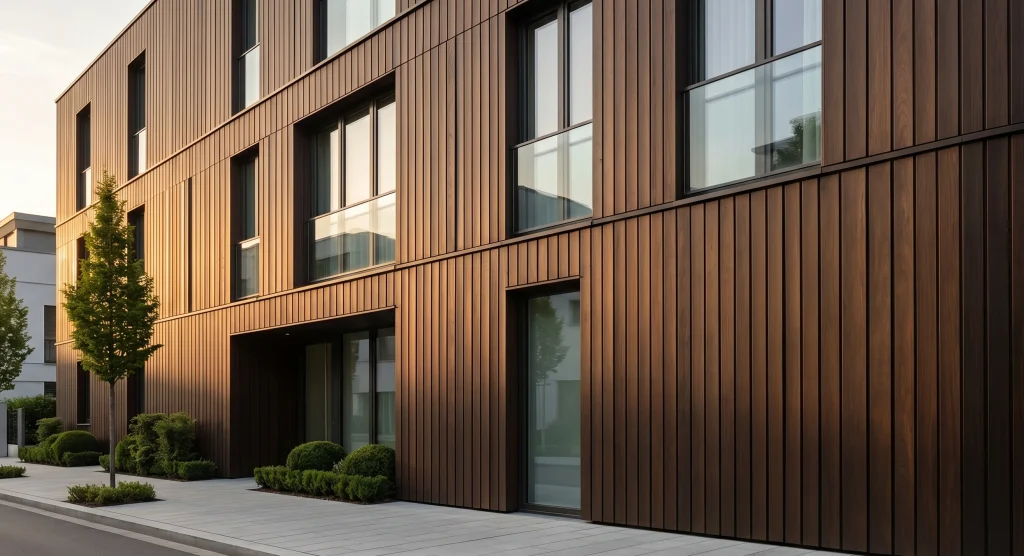
- Cladding on low-rise buildings. Below the height thresholds where national regulations require Euroclass B for external walls, Thermo-D cladding is stable, light and widely available. In England, the relevant threshold for many building types is 11 metres; see our guide to exterior timber cladding for the height bands.
- Interior linings in small rooms. Where the lining class required is D, thermally modified panelling is compliant and stable.
- Garden and landscape structures. Screens, fencing and planters benefit from improved decay resistance without biocides.
- Sauna benches and wet-room furnishing. The handbook lists these uses, reflecting the material’s low moisture uptake and the absence of resin exudation.
In each case, the common thread is non-structural use with moderate wear.
The Limits of Thermally Modified Timber in Demanding Specifications
Thermally modified timber reaches its limits where a project needs strength, hardness or fire performance above Euroclass D.
Load-bearing and structural uses. The ThermoWood Handbook advises against load-bearing structural use. Decking joists, structural frames and any member designed to Eurocode 5 need a different material.
Deep ground contact. The handbook also advises against deep ground applications where structural performance is required. Posts set in soil are outside its intended use.
High-traffic surfaces. Lower density reduces surface hardness. Commercial decking, public seating and wall panelling in busy corridors show dents and wear sooner on a lighter board.
Fixing. The handbook states that pre-drilling near board ends and countersinking are essential when screwing, unless self-tapping screws are used. Splitting strength losses make edge distances and fixing details more critical than with untreated timber.
Fire-regulated façades and interiors. Fire class D does not meet Euroclass B requirements for external walls on taller buildings or for fire resistant wall linings in circulation spaces without an added fire-retardant system — which then becomes a second product to specify, test and maintain.
None of these limits makes thermally modified wood a poor material. They define its range, and they explain why specifiers look to chemical modification when a project falls outside it.
What to Ask a Supplier of Thermally Modified Timber
A thermally modified timber specification is only as reliable as the supplier documentation behind it, and five questions close most of the gaps.
- Which class and peak temperature? “Thermally modified” covers a range of process intensities. Confirm whether the product is Thermo-S, Thermo-D or a proprietary equivalent, and the peak treatment temperature.
- Which species and origin? Pine, spruce, ash and poplar respond differently to heat. Species also determines the EUDR and legality documentation required for the supply chain.
- Which durability standard? Ask whether durability is reported to EN 113 laboratory tests or to EN 350:2016, and request the test series. Comparisons across standards are not like-for-like.
- What is the declared reaction to fire? Request the declaration of performance. If the element needs Euroclass B or C, ask for the classification report of the full system, including any fire-retardant treatment and its maintenance requirements.
- What fixing and coating guidance applies? Thermally modified boards are sensitive to splitting near ends. Obtain the manufacturer’s fixing schedule, screw type and edge distances, and the recommended UV-protective finish if the brown colour must be retained.
The same five questions apply to any modified timber, including furan resin modified hardwood — which is why Ultimate FBR publishes its density, ASE, swelling, water uptake, durability class and fire classification with the test bodies named.
Thermally Modified Wood vs Furan Resin Modified Hardwood
Thermally modified wood and furan resin modified hardwood both improve stability and durability without biocides, but they work in opposite directions on density and differ sharply on fire performance.
Furan resin modification impregnates the wood with furfuryl alcohol, a bio-based liquid derived from agricultural residues, and cures it inside the cell wall to form a stable polymer. Instead of removing material, the process adds it. Ultimate FBR applies this to hardwood, with independently verified data from IPB University and the Université de Lorraine.
| Criterion | Thermally modified softwood (ThermoWood) | Ultimate FBR furan resin modified hardwood |
|---|---|---|
| Process | Heat and steam only, 185–215 °C | Furfuryl alcohol impregnation and curing in the cell wall |
| Base timber | Mainly pine and spruce | Hardwood |
| Effect on density | Decreases | Increases — 743 kg/m³ tested |
| Moisture behaviour | Equilibrium moisture content about half of untreated (at ~220 °C) | ASE 44.33%; volumetric swelling 2.35% vs 10.04% untreated |
| Water uptake | Reduced | 35.07% vs 109.58% untreated |
| Decay resistance | Thermo-D: Class 2 (EN 113, handbook) | Class 2 (EN 350:2016) |
| Reaction to fire | Class D | B-s2-d0 achievable (EN 13501-1) |
| Strength | Bending strength loss up to 40% at high treatment intensity | No density loss; hardwood baseline retained |
| Colour | Brown, greys under UV; natural variation and knots | Uniform dark brown, no defects; greys under UV without coating |
| Biocides | None | None |
| Sizes | Supplier dependent | 12–32mm × 90–285mm × 900–5900mm |
The comparison is not a ranking on every line. On decay resistance, Thermo-D and Ultimate FBR sit in the same class. Thermally modified softwood is the lighter of the two. Where the two diverge decisively is density and fire: furan resin modified hardwood is heavier and harder, and B-s2-d0 is achievable at material level.
For a wider view that includes acetylation and preservative treatment, see the full modified timber comparison.
Choosing Between Thermally Modified and Furan Resin Modified Timber
The choice between thermally modified and furan resin modified timber follows from four project questions.
- What fire class does the element need? Euroclass D only — both are candidates. Euroclass B or C — thermally modified wood needs an added fire-retardant system; Ultimate FBR has B-s2-d0 achievable without one.
- How much wear and point loading will the surface see? Low — thermally modified wood is adequate. High traffic, furniture or impact — the higher density of modified hardwood is the safer choice.
- Does the element carry load or sit in the ground? If so, neither modified product replaces a structural design; thermally modified wood is specifically advised against for load-bearing use.
- How important is visual consistency? For large façades or feature walls where every board must match, uniform colour with no defects removes grading effort.
For the wood durability side of the decision, check that both suppliers report durability to the same standard — EN 350:2016 — before comparing classes.
Frequently Asked Questions about Thermally Modified Wood
How long does thermally modified wood last outdoors?
Thermally modified wood treated to the Thermo-D class is rated durable (Class 2) for decay resistance in the ThermoWood Handbook, which puts it in the same broad class as many durable hardwoods for above-ground exterior use. Actual service life depends on detailing, exposure and maintenance; boards kept clear of the ground and allowed to dry between wettings last longest.
Is thermally modified wood weaker than untreated wood?
Yes, thermally modified wood is generally weaker than the untreated timber it is made from. The ThermoWood Handbook reports bending strength losses of up to 40% at higher treatment intensities and splitting strength losses of 30–40%, and recommends against load-bearing structural use.
Is thermally modified wood fire resistant?
No, thermal modification does not improve fire performance. The ThermoWood Handbook places ThermoWood in fire class D, the same broad class as untreated timber. Where Euroclass B is required, a fire-retardant treatment must be added, or a material such as furan resin modified hardwood with B-s2-d0 achievable can be specified instead.
Can thermally modified wood be used for decking?
Thermally modified wood can be used for decking boards in low to moderate traffic areas, but not for joists or other load-bearing parts. Its lower density gives a softer surface than dense hardwoods, so commercial and public decks with heavy foot traffic and furniture loads are better served by a denser board such as hardwood decking in modified hardwood.
Does thermally modified wood turn grey?
Yes. The brown colour of thermally modified wood weathers to grey under UV exposure. The ThermoWood Handbook recommends a pigmented surface treatment where the original colour should be retained.
Does thermally modified timber need special fixings?
Thermally modified timber needs careful pre-drilling and an appropriate screw type. The ThermoWood Handbook states that pre-drilling near board ends and countersinking are essential when screwing, unless self-tapping screws are used, because splitting strength is reduced.
What is the difference between thermally modified and chemically modified wood?
Thermally modified wood is changed by heat alone, which removes part of the wood’s hemicellulose and lowers its density. Chemically modified wood — such as furan resin modified or acetylated timber — has a substance reacted into the cell wall, which typically maintains or increases density. Furan resin modified hardwood like Ultimate FBR reaches 743 kg/m³ and B-s2-d0 achievable, which thermal modification does not provide.
Specify Modified Timber With Verified Data
Thermally modified wood is a capable material within its range: non-structural, moderate wear, Euroclass D. When a specification moves outside that range — taller façades, Class B linings, commercial decks, high-traffic interiors — Ultimate FBR furan resin modified hardwood provides Class 2 durability under EN 350:2016, ASE 44.33%, volumetric swelling of 2.35%, 743 kg/m³ density and B-s2-d0 fire performance achievable, independently tested by IPB University and the Université de Lorraine.
For technical data sheets, test reports or project enquiries, contact the team via the contact form. European and UK enquiries are handled by Houtplex B.V. in Haaksbergen, the Netherlands; Asia-Pacific projects are served by Wood United Pte Ltd in Singapore — both part of the Wood United Group.