Timber Window Frames — Specifying Modified Hardwood for Long-Term Performance
Timber window frames fail for a predictable set of reasons. Paint film cracking at the corners. Glazing seals failing at the junction between glass and rebate. Hardware misaligning as the sash swells and contracts through seasonal humidity cycles. Sill rot at the end grain. These failure modes are not random — they are the direct consequence of specifying a material that moves too much, absorbs moisture too readily, or was not durably enough treated to resist biological attack in the conditions it faces.
The specification decisions that prevent these failures are technical, not aesthetic. They concern the dimensional stability of the frame material, its biological durability without retreatment, its moisture uptake under repeated weathering cycles, and its compatibility with the coating systems that must adhere to it across decades of thermal and moisture movement. They are decisions that need to be made at the material selection stage — before the window is designed, before the profiles are drawn, and before the joinery manufacturer receives a brief.
This guide addresses those decisions directly, with independently verified performance data on window frames in modified hardwood, the standards that govern timber window specification, and a practical framework for evaluating material options against the performance requirements of the application.
Why Timber Window Frames Fail: The Dimensional Stability Problem
The most pervasive cause of timber window frame failure in exterior applications is dimensional instability — the movement of the frame material in response to changes in moisture content. Understanding the mechanism is essential to understanding why material choice is so consequential.
Timber absorbs water vapour and liquid water through its free hydroxyl groups — the highly hydrophilic components of the cell wall’s hemicellulose and cellulose fractions. As moisture content rises, the cell wall swells in the transverse direction. As moisture content falls, it contracts. This cycle repeats continuously and involuntarily throughout the service life of an untreated or inadequately modified frame, driven by seasonal humidity changes, rainfall events, condensation cycles, and the differential drying rates between the external face and the sheltered internal face of the frame.
The practical consequences of this movement cascade through the frame assembly:
Paint film failure is the first and most visible consequence. Every wet-dry cycle stretches and relaxes the coating above the moving substrate. Coatings have finite elasticity — once micro-cracking begins, moisture infiltration accelerates, the coating loses adhesion, and delamination follows. The refinishing interval for a dimensionally unstable frame is determined not by the coating manufacturer’s specification but by the movement characteristics of the substrate beneath it.
Glazing seal failure follows a similar mechanism. The seal between the glazing unit and the rebate is a flexible gasket or bedding compound designed to accommodate a small amount of differential movement. When the frame moves beyond the seal’s designed tolerance — which happens more readily with unstable substrates in severe exposure — the seal opens, moisture enters the glazing cavity, the unit fogs, and the thermal performance of the window deteriorates.
Hardware misalignment occurs as the frame swells unevenly — particularly at the sill and head, where moisture loading differs from the jambs. A casement that closes smoothly in a dry autumn may bind in a wet winter and gap in a dry summer. Locking points designed for one frame geometry encounter a different geometry in service.
Sill rot is the end-stage failure. End grain at the sill is the most moisture-vulnerable zone of any timber frame — it absorbs water faster than face grain and dries more slowly. In an inadequately durable species, biological attack follows. By the time rot is visible, the structural integrity of the sill has already been compromised.
All four failure modes share a common root cause: a frame material that moves too much and holds moisture too long. The specification solution addresses both simultaneously.
Standards and Performance Requirements for Timber Window Frames
Timber window frames in European and UK markets are governed by a specific set of standards that define performance requirements, test methods, and compliance thresholds. Understanding this framework is essential for any specifier writing a technically defensible window specification.
BS EN 14351-1:2006+A2:2016 — The Product Standard
BS EN 14351-1 is the principal harmonised standard for windows and external pedestrian doorsets. It defines the performance characteristics that window manufacturers must declare and the test methods used to determine them. The declared performance characteristics relevant to material specification include resistance to wind load, air permeability (Class 0–4), watertightness (Class 0 to Class E1200), thermal transmittance (U-value; Building Regulations in England require a maximum of 1.4 W/m²K for replacement windows), and resistance to repeated opening and closing.
The declared performance of a window unit under BS EN 14351-1 reflects the performance of the complete assembly. However, the frame material determines the baseline from which that performance is delivered, and whether it can be sustained across the service life of the installation.
BS 644:2009 — Timber Windows Specification
BS 644:2009 covers the specification of fully finished factory-assembled timber window frames. It references material requirements including species selection, moisture content at delivery, and joinery quality. For specifiers, BS 644 provides the material quality baseline — but it does not define dimensional stability performance requirements for the frame material itself. This is where independent test data from the timber manufacturer or modifier becomes essential.
EN 350:2016 — Durability Classification
The biological durability of the timber used in window frames is classified under EN 350, the European standard for the durability and treatability of wood. For above-ground Use Class 3.1 and 3.2 conditions — the typical exposure range for exterior window frames — a minimum durability class of Class 2 is the appropriate threshold for timber that will not receive biocidal preservative retreatment.
The Dimensional Stability Gap in Current Standards
A notable limitation of the current standards framework is that none of the principal window frame standards specifies a minimum dimensional stability requirement for the frame material expressed as an Anti-Swelling Efficiency (ASE) figure or absolute volumetric swelling coefficient. This gap places the burden of dimensional stability verification on the specifier. Requiring ASE data from the timber manufacturer or modifier — referenced to a named test standard and produced by an independent testing body — is the most reliable way to address this gap. For window frames in furan resin modified hardwood, the ASE of 44.33% and volumetric swelling of 2.35% for Ultimate FBR provide exactly this independently verified data.
Modified Hardwood for Window Frames: Verified Performance Data
The performance of Ultimate FBR modified hardwood for window frames has been independently verified by IPB University (Indonesia) and the Université de Lorraine (France) — two internationally recognised academic research institutions with no commercial interest in the product outcome. Results have been validated against EN, BS, ASTM, AWPA, and SNI standards.
| Performance Property | Untreated Hardwood | Ultimate FBR | Test Standard |
|---|---|---|---|
| Density | Baseline | 743 kg/m³ | Tested |
| Volumetric swelling | 10.04% | 2.35% | EN 350 |
| Water uptake | 109.58% | 35.07% | ASTM |
| Anti-Swelling Efficiency (ASE) | — | 44.33% | Tested |
| Durability classification | Class 3–4 (species dependent) | Class 2 | EN 350:2016 |
| Fire performance | Not classified | B-s2-d0 achievable | EN 13501-1 |
What These Figures Mean for Window Frame Performance
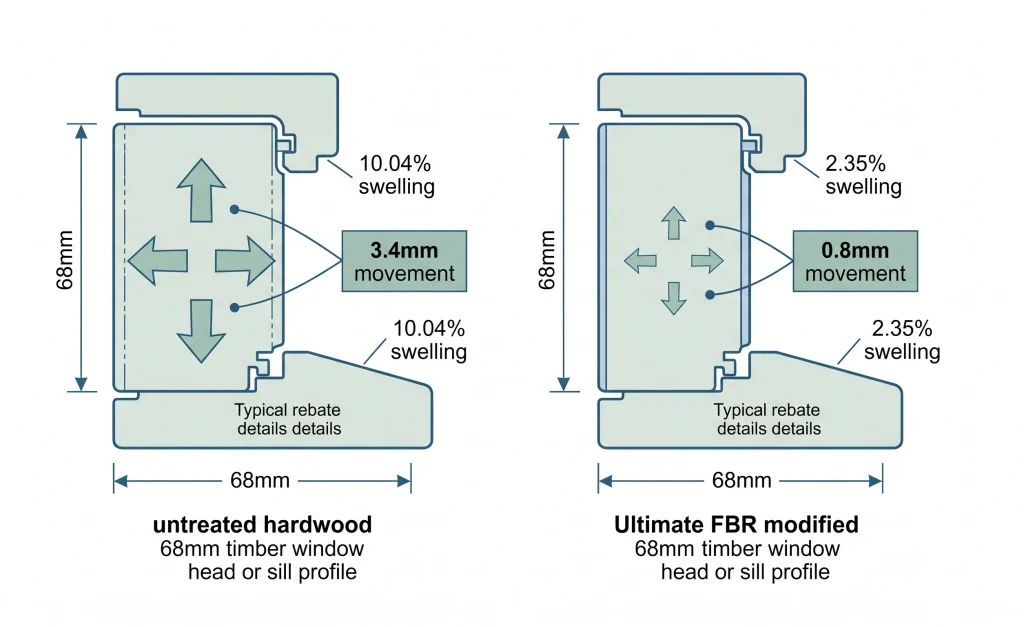
ASE 44.33% / Volumetric swelling 2.35% The Anti-Swelling Efficiency of 44.33% means that Ultimate FBR swells 44.33% less by volume than untreated hardwood of the same species under the same test conditions. For a 68mm-wide frame member — a typical outer frame width in hardwood window manufacture — untreated hardwood at 10.04% volumetric swelling would move approximately 3.4mm across its width between dry and saturated conditions. Ultimate FBR at 2.35% volumetric swelling would move approximately 0.8mm. The difference of 2.6mm is the difference between a coating that holds and a coating that cracks, between a seal that functions and a seal that fails, between a casement that operates smoothly and one that binds or gaps.
Water uptake: 35.07% vs 109.58% Untreated hardwood of this species absorbed 109.58% of its dry mass in water under test conditions. Ultimate FBR absorbed 35.07% — a reduction of approximately 68%. For window frames, this means the modified hardwood responds far less dramatically to rain events, condensation, and seasonal humidity changes. The frame spends less time at elevated moisture content, which means less dimensional movement, less coating stress, and — critically — less time in the moisture content range at which fungal decay can occur.
Class 2 durability (EN 350:2016) Class 2 biological durability — verified without biocidal preservatives, applying uniformly to the full cross-section of every frame section — confirms that the material will resist fungal attack in Use Class 3.1 and 3.2 conditions for the design life of the installation, without retreatment. The modification is structural and permanent.
Density: 743 kg/m³ The increased density of furan resin modified hardwood is relevant to window frame performance in two ways. First, a denser frame section has improved resistance to mechanical damage — impact, hardware wear, and the repeated stress of opening and closing cycles. Second, higher density correlates with lower permeability — denser frame sections absorb moisture more slowly, moderating the speed and severity of dimensional cycling.
Window Frame Material Comparison
Timber window frames are often compared against uPVC and aluminium. For B2B specification on projects where timber is a design or planning requirement, the more relevant comparison is between different timber options and their respective performance profiles.
| Property | Untreated Hardwood | Furan Resin Modified (Ultimate FBR) | Acetylated Timber | Thermally Modified Timber |
|---|---|---|---|---|
| Dimensional stability | Low — significant movement | Very high — ASE 44.33%, swelling 2.35% | Very high — ASE 50–65% (typical) | Moderate–high — ASE 20–40% |
| Durability class (EN 350) | Class 3–4 (species dependent) | Class 2 (full cross-section, verified) | Class 1 (typical) | Class 2–3 (typical) |
| Density | Baseline | 743 kg/m³ (increased) | Slightly decreased | Decreased |
| Water uptake | 109.58% (baseline species) | 35.07% | Very low | Moderate |
| Fixing requirement | Standard | Standard stainless/galvanised | Stainless/galvanised required | Standard stainless/galvanised |
| Fire performance | Standard | B-s2-d0 achievable | Euroclass D (typical) | Variable |
| Sourcing certification | Variable | SVLK, FSC® Ready, PEFC™ Ready | FSC certified | Typically FSC/PEFC |
Reading the Window Frame Material Comparison
Acetylation vs furan resin modification: Acetylated timber offers marginally higher ASE values (typically 50–65% compared to 40–50% for furan resin). For extreme exposure conditions — coastal locations, north-facing elevations, frames without protective overhangs — this additional stability margin may be a specification priority. The trade-off is that acetylated timber requires stainless steel or hot-dip galvanised fixings throughout due to residual material acidity, and produces a slight reduction in density. For most window frame applications in standard UK and European exposure conditions, furan resin modified hardwood at ASE 44.33% is more than adequate — and offers improved density, compatibility with standard exterior fixings, and a more favourable fire performance classification.
Thermal modification: Thermally modified timber achieves lower ASE values than either acetylated or furan resin modified products — typically 20–40%. For window frames in exposed conditions, this dimensional stability performance is significantly weaker than the alternatives, and the reduced density and bending strength make it less suitable for the mechanical demands of a window frame than either of the chemical modification technologies.
Untreated hardwood: The specification challenge with untreated hardwood is variability: species-level durability classifications apply only to heartwood (sapwood is Class 5 for every species), natural durability varies with provenance, and dimensional stability is entirely species and growth-ring-orientation dependent. Modified hardwood eliminates this variability — the modification applies uniformly to the full cross-section of every frame section.
Applications for Modified Hardwood Window Frames
Residential New Build and Renovation
For residential projects where timber windows are specified — for aesthetic reasons, planning requirements, or sustainability objectives — the choice of frame material determines the maintenance schedule the homeowner will face over the service life of the installation. An untreated hardwood frame in a moderately exposed location will typically require refinishing every 3–5 years. A furan resin modified hardwood frame holds its coating significantly longer — extending the refinishing interval and reducing the whole-life maintenance cost.
For renovation projects in conservation areas or listed buildings where timber window frames are a planning requirement, modified hardwood provides the same natural timber aesthetic as untreated hardwood alternatives, with a substantially better performance profile and a reduced maintenance burden.
Commercial and Educational Buildings
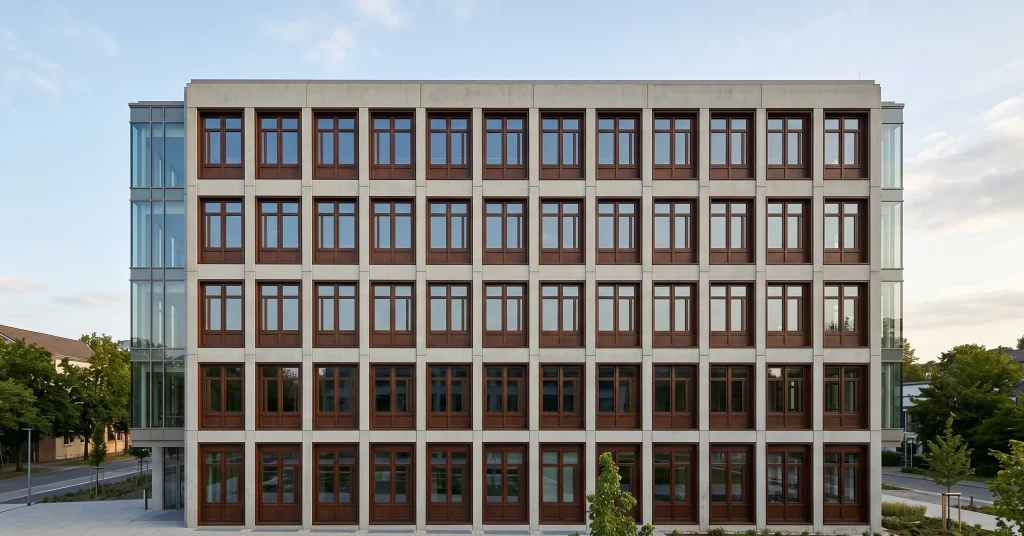
Commercial and educational buildings face a particular challenge with timber window frames: the maintenance cycle must be managed within the constraints of building operations — access, disruption, budget cycles, and facilities management capacity. An untreated hardwood frame requiring refinishing every 3–5 years imposes a recurring cost and programme burden that facilities managers typically underestimate at the point of specification. Modified hardwood window frames — with extended coating intervals driven by the frame material’s reduced dimensional movement — represent a measurably lower whole-life maintenance burden.
Heritage and Conservation Projects
Timber window frames are frequently a requirement on heritage and conservation projects. In these contexts, modified hardwood is a technically appropriate choice that satisfies both the visual and performance requirements. The uniform dark-brown colour of furan resin modified hardwood can be painted or stained to any specified colour — the modification does not affect coating compatibility. The improved dimensional stability reduces the rate of paint film degradation that heritage window frames are particularly prone to.
High-Rise and Fire-Regulated Applications
For window frames on buildings above 11 metres, or on any project where fire performance of the frame material is a regulatory or client requirement, the achievable Euroclass B-s2-d0 fire performance of Ultimate FBR under EN 13501-1 is a specification advantage that untreated hardwood and most competing modified timber products cannot match. Very limited contribution to fire propagation (Class B), moderate smoke production (s2), and no flaming droplets or particles (d0) — achieved at material level in a genuine modified hardwood product.
Specifying Timber Window Frames: A Practical Checklist
1. What is the dimensional stability of the frame material, expressed as both ASE and absolute volumetric swelling? Require both figures. For Ultimate FBR: ASE 44.33%, absolute volumetric swelling 2.35% (versus 10.04% for untreated hardwood). Both independently verified by IPB University and the Université de Lorraine, France.
2. What is the water uptake of the frame material under test conditions? For Ultimate FBR: water uptake 35.07% (versus 109.58% for untreated hardwood) — a 68% reduction that is the primary mechanism behind improved coating longevity.
3. What is the durability classification, and does it apply to the full cross-section? For Ultimate FBR: Class 2 durability under EN 350:2016, independently verified, applying uniformly throughout the frame section.
4. What moisture content is the material delivered at? BS 644:2009 specifies moisture content requirements for factory-assembled timber window frames. Confirm delivery moisture content is within the range appropriate for the climate and building type.
5. Is the modification compatible with the specified coating system? Furan resin modified hardwood is compatible with standard exterior wood coating systems. The dark substrate colour should be considered when specifying light-coloured finishes — confirm primer requirements with the coating supplier.
6. What fire performance is required, and is it achievable at frame material level? Euroclass B-s2-d0 is achievable for Ultimate FBR under EN 13501-1 — a classification that most untreated hardwood and competing modified timber products cannot match at material level.
7. What certifications cover responsible sourcing? Ultimate FBR carries SVLK certification (EU FLEGT recognised), FSC® Ready and PEFC™ Ready — enabling chain-of-custody certification where required.
8. What size range is available for the required frame profiles? Ultimate FBR is available in 12–32mm × 90–285mm × 900–5900mm — covering the principal section dimensions for casement, sash, tilt-and-turn, and fixed light window frame profiles.
9. Can the supply chain deliver at the programme required by the joinery manufacturer? Confirm with the distributor — Houtplex B.V. in Haaksbergen, Netherlands for European supply, Wood United Pte Ltd in Singapore for Asian and Pacific markets — that the required volume and sizes can be delivered within the programme required by the joinery manufacturer.
Frequently Asked Questions about Window Frames
What is the best wood for window frames?
The appropriate timber for window frames depends on the exposure conditions, the required maintenance interval, the fire performance specification, and the project’s responsible sourcing obligations. For most exterior window frame applications where long-term coating performance, minimal dimensional movement, and Class 2 biological durability are required, furan resin modified hardwood delivers the most complete verified performance profile. Window frames in Ultimate FBR achieve ASE 44.33%, volumetric swelling 2.35%, water uptake 35.07%, and Class 2 durability — independently verified figures that no single untreated hardwood species can match consistently across all delivered boards.
How long do timber window frames last?
Service life for timber window frames depends on the frame material, exposure conditions, the coating system, and the maintenance regime. Well-maintained untreated hardwood window frames in sheltered conditions can last 30–50 years with periodic refinishing every 3–5 years. Furan resin modified hardwood window frames are designed to extend the coating service interval substantially — reducing refinishing frequency and associated maintenance costs. The Class 2 durability classification under EN 350 confirms a minimum design life of 15–25 years without biocidal retreatment in above-ground exterior conditions.
Do timber window frames need maintenance?
All exterior timber window frames require some maintenance — the nature and frequency depend on the frame material and the surface coating system. Untreated hardwood frames typically require refinishing every 3–5 years in standard UK and European exposure conditions. Furan resin modified hardwood frames hold their coating significantly longer due to the reduced dimensional movement of the substrate. The absence of biocidal retreatment requirements simplifies the maintenance schedule further — maintenance consists of UV-stabilising coating renewal rather than the more complex schedule associated with preservative-treated alternatives.
Are timber window frames better than uPVC?
For B2B projects where natural material specification is a design, planning, or sustainability requirement, timber window frames offer advantages that uPVC cannot match: the ability to be painted to any colour, repairability at section level, natural carbon storage, and — in high-quality modified hardwood — a service life that can exceed standard uPVC profiles. uPVC offers lower maintenance requirements and a more predictable short-term performance profile, but cannot be recycled effectively, cannot be repaired at section level, and does not meet the responsible sourcing certification requirements of most regulated construction procurement frameworks.
What is the most durable wood for window frames?
Among naturally durable species, tropical hardwoods such as iroko and teak carry Class 1–2 durability under EN 350 — the highest for natural timber. However, these species carry sourcing risk and documentation burdens that have increased substantially since the 2025 CITES Appendix II listing of key tropical species and the implementation of EUDR requirements. Among modified timber products, acetylated timber typically achieves Class 1 durability; furan resin modified hardwood achieves a verified Class 2 — adequate for all above-ground exterior window frame applications in Use Class 3.1 and 3.2 conditions, without biocidal retreatment.
How often do timber windows need painting?
The refinishing interval for timber window frames depends primarily on the dimensional stability of the frame material, the orientation and exposure of the elevation, and the coating system. Untreated hardwood frames in standard UK exposure conditions typically require refinishing every 3–5 years on exposed elevations. Furan resin modified hardwood frames, with volumetric swelling of 2.35% compared to 10.04% for untreated hardwood, apply substantially less mechanical stress to the coating through each moisture cycle. With properly specified microporous coating systems, refinishing intervals of 7–10 years or more are realistic for modified hardwood window frames in standard exposure conditions.
How do you specify timber windows?
A technically complete timber window specification addresses five areas: frame material (modification type, dimensional stability data, durability class, moisture content at delivery); frame profile (section dimensions, joint details, hardware specification); glazing specification (unit type, U-value, edge seal type); coating system (primer, intermediate, topcoat — compatibility with frame material confirmed); and installation details (frame set-back from external face, sill slope and drainage, cavity closure, weatherstrip specification). For modified hardwood window frames, the frame material specification should include ASE and volumetric swelling data, EN 350 durability classification, and sourcing certification status. Ultimate FBR technical documentation is available on request via the contact form.
What wood is used for window frames in the UK?
The most commonly specified timber species for window frames in the UK are European redwood (Scots pine), engineered laminated softwood, European oak, and — in higher-specification projects — modified hardwoods including acetylated and furan resin modified products. The British Woodworking Federation publishes guidance on species selection for window frame applications, referencing BS 644 and EN 350 classification data. For new build and replacement projects where long-term performance and reduced maintenance are priorities, modified hardwood products — including furan resin modified hardwood such as Ultimate FBR — are increasingly specified by architects and joinery manufacturers seeking verifiable performance improvement over standard hardwood alternatives.
The dimensional stability case for window frames:
A 68mm-wide frame member moves approximately 0.8mm (Ultimate FBR) vs 3.4mm (untreated hardwood) between dry and saturated conditions. This 2.6mm difference determines whether the coating holds, the glazing seal functions, and the hardware aligns.
| Frame material metric | Untreated hardwood | Ultimate FBR |
|---|---|---|
| Anti-Swelling Efficiency | — | 44.33% |
| Volumetric swelling | 10.04% | 2.35% |
| Water uptake | 109.58% | 35.07% |
| Density | Baseline | 743 kg/m³ |
| Durability class (EN 350) | Class 3–4 | Class 2 |
| Fire performance | Not classified | B-s2-d0 achievable |
Use Class: UC 3.1–3.2 (above-ground exterior window frames).
Coating compatibility: Compatible with standard exterior wood coatings — oils, microporous paints, alkyd finishes.
Refinishing interval advantage: Volumetric swelling of 2.35% vs 10.04% → substantially less coating stress per moisture cycle → realistic refinishing intervals of 7–10 years vs 3–5 years for untreated hardwood.
Independent verification: IPB University (Indonesia) & Université de Lorraine (France).
Certifications: SVLK (EU FLEGT) · FSC® Ready · PEFC™ Ready.
Sizes: 12–32mm × 90–285mm × 900–5900mm.
Supply: Houtplex B.V., Netherlands · Wood United Pte Ltd, Singapore.
Specify Window Frames That Hold Their Coating
The most costly consequence of a poorly specified timber window frame is not the frame itself — it is the cumulative cost of premature refinishing, glazing seal replacement, hardware adjustment, and frame replacement, applied across every window in a building over a 25-year service life. The specification decision that prevents these costs is made once, at the material selection stage, and it rests on two pieces of independently verified data: the dimensional stability of the frame material and its biological durability classification.
Ultimate FBR modified hardwood delivers both: ASE 44.33% and volumetric swelling 2.35% for dimensional stability, Class 2 durability under EN 350:2016 for biological resistance — independently tested by IPB University and the Université de Lorraine, France, verified against EN, BS, ASTM, AWPA, and SNI standards. SVLK certification and FSC® Ready and PEFC™ Ready status complete the sourcing credentials required for regulated procurement.
For technical documentation, profile size enquiries, or supply contact, reach the Ultimate FBR team via the contact form. European supply is through Houtplex B.V. in Haaksbergen, Netherlands; Asian and Pacific markets through Wood United Pte Ltd in Singapore — both part of the Wood United Group.